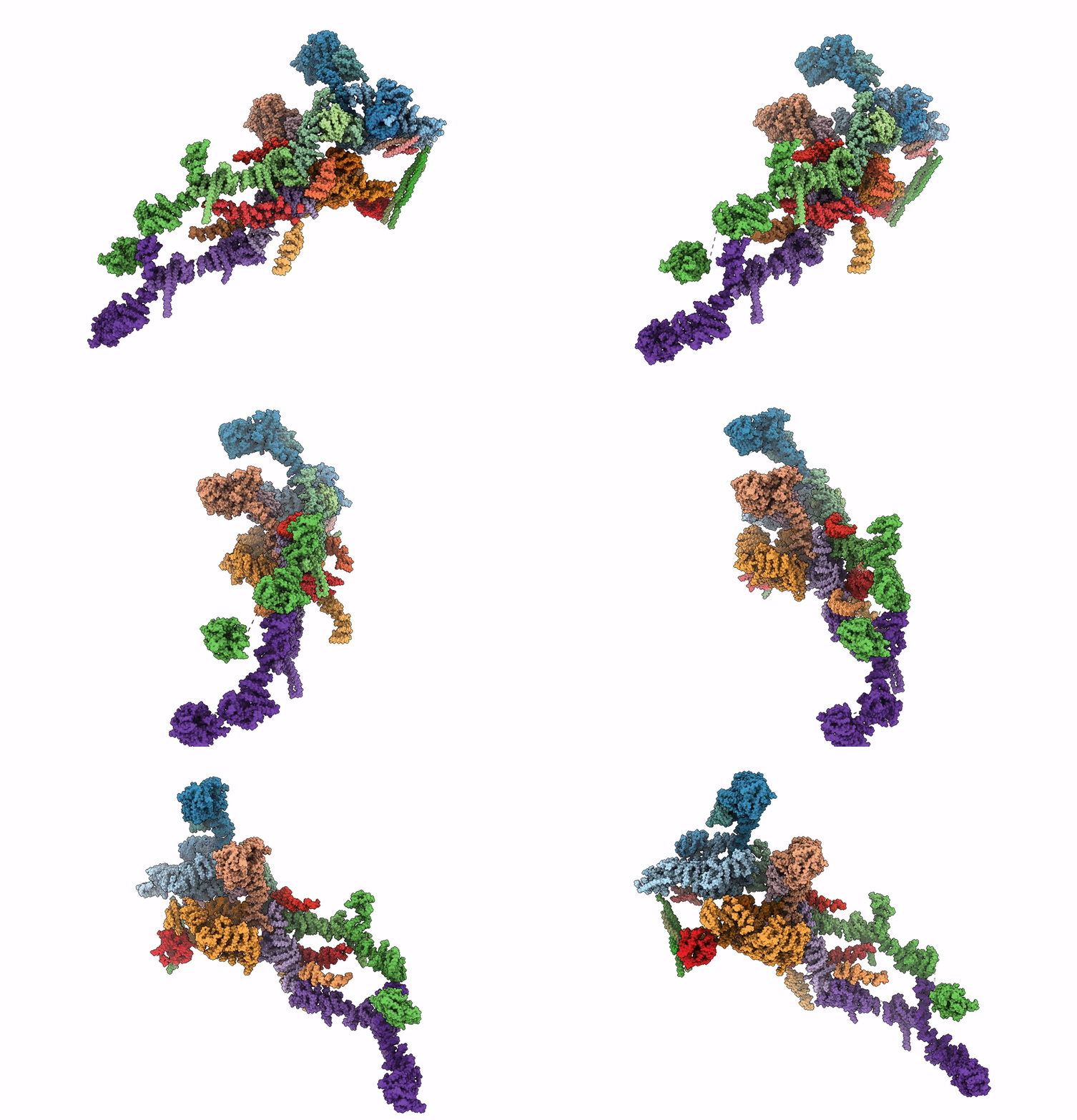
6LK8 image
Deposition Date 2019-12-18
Release Date 2021-07-21
Last Version Date 2024-05-29
Entry Detail
PDB ID:
6LK8
Title:
Structure of Xenopus laevis Cytoplasmic Ring subunit.
Biological Source:
Source Organism:
Xenopus laevis (Taxon ID: 8355)
Method Details:
Experimental Method:
Resolution:
5.50 Å
Aggregation State:
TISSUE
Reconstruction Method:
SINGLE PARTICLE
Macromolecular Entities
Structures with similar UniProt ID
Protein Blast
Polymer Type:polypeptide(L)
Molecule:MGC83295 protein
Gene (Uniprot):nup205.S
Chain IDs:A, W (auth: a)
Chain Length:2011
Number of Molecules:2
Biological Source:Xenopus laevis
Structures with similar UniProt ID
Protein Blast
Polymer Type:polypeptide(L)
Molecule:Nuclear pore complex protein Nup85
Gene (Uniprot):nup85
Chain IDs:B, X (auth: b)
Chain Length:653
Number of Molecules:2
Biological Source:Xenopus laevis
Structures with similar UniProt ID
Protein Blast
Polymer Type:polypeptide(L)
Molecule:MGC154553 protein
Gene (Uniprot):nup43.S
Chain IDs:C, Y (auth: c)
Chain Length:375
Number of Molecules:2
Biological Source:Xenopus laevis
Structures with similar UniProt ID
Protein Blast
Polymer Type:polypeptide(L)
Molecule:Nucleoporin SEH1-A
Gene (Uniprot):seh1l-a
Chain IDs:D, Z (auth: d)
Chain Length:322
Number of Molecules:2
Biological Source:Xenopus laevis
Polymer Type:polypeptide(L)
Molecule:outer Nup160
Chain IDs:E, AA (auth: e)
Chain Length:1435
Number of Molecules:2
Biological Source:Xenopus laevis
Structures with similar UniProt ID
Protein Blast
Polymer Type:polypeptide(L)
Molecule:MGC83926 protein
Gene (Uniprot):nup37.L
Chain IDs:F, BA (auth: f)
Chain Length:326
Number of Molecules:2
Biological Source:Xenopus laevis
Polymer Type:polypeptide(L)
Molecule:Nuclear pore complex protein Nup96
Chain IDs:G, CA (auth: g)
Chain Length:923
Number of Molecules:2
Biological Source:Xenopus laevis
Structures with similar UniProt ID
Protein Blast
Polymer Type:polypeptide(L)
Molecule:GATOR complex protein SEC13
Gene (Uniprot):sec13.S
Chain IDs:H, DA (auth: h)
Chain Length:320
Number of Molecules:2
Biological Source:Xenopus laevis
Structures with similar UniProt ID
Protein Blast
Polymer Type:polypeptide(L)
Molecule:Nuclear pore complex protein
Gene (Uniprot):nup107.S
Chain IDs:I, EA (auth: i)
Chain Length:916
Number of Molecules:2
Biological Source:Xenopus laevis
Structures with similar UniProt ID
Protein Blast
Polymer Type:polypeptide(L)
Molecule:outer Nup133
Gene (Uniprot):nup133.L
Chain IDs:J, FA (auth: j)
Chain Length:1140
Number of Molecules:2
Biological Source:Xenopus laevis
Polymer Type:polypeptide(L)
Molecule:Nup214 complex Coiled-coil region 1, helix 1
Chain IDs:O (auth: K)
Chain Length:69
Number of Molecules:1
Biological Source:Xenopus laevis
Polymer Type:polypeptide(L)
Molecule:Nup214 complex coiled coil region 1, helix 2
Chain IDs:P (auth: L)
Chain Length:80
Number of Molecules:1
Biological Source:Xenopus laevis
Polymer Type:polypeptide(L)
Molecule:Nup214 complex coiled coil region 1, helix 3
Chain IDs:Q (auth: M)
Chain Length:73
Number of Molecules:1
Biological Source:Xenopus laevis
Polymer Type:polypeptide(L)
Molecule:Nup214 complex Coiled coil region 2, helix 1
Chain IDs:R (auth: N)
Chain Length:31
Number of Molecules:1
Biological Source:Xenopus laevis
Polymer Type:polypeptide(L)
Molecule:Nup214 complex Coiled coil region 2, helix 2
Chain IDs:S (auth: O)
Chain Length:35
Number of Molecules:1
Biological Source:Xenopus laevis
Polymer Type:polypeptide(L)
Molecule:Nup214 complex Coiled coil region 2, helix 3
Chain IDs:T (auth: P)
Chain Length:26
Number of Molecules:1
Biological Source:Xenopus laevis
Polymer Type:polypeptide(L)
Molecule:bridge domain
Chain IDs:U (auth: Q), V (auth: R)
Chain Length:391
Number of Molecules:2
Biological Source:Xenopus laevis
Structures with similar UniProt ID
Protein Blast
Polymer Type:polypeptide(L)
Molecule:Nup358 complex, clamps
Gene (Uniprot):ranbp2.L
Chain IDs:K (auth: S), L (auth: T), M (auth: U), N (auth: V)
Chain Length:2905
Number of Molecules:4
Biological Source:Xenopus laevis
Ligand Molecules
Primary Citation
Structure of the cytoplasmic ring of the Xenopus laevis nuclear pore complex by cryo-electron microscopy single particle analysis.
Cell Res. 30 520 531 (2020)
PMID: 32376910 DOI: 10.1038/s41422-020-0319-4

Abstact

The nuclear pore complex (NPC) exhibits structural plasticity and has only been characterized at local resolutions of up to 15 Å for the cytoplasmic ring (CR). Here we present a single-particle cryo-electron microscopy (cryo-EM) structure of the CR from Xenopus laevis NPC at average resolutions of 5.5-7.9 Å, with local resolutions reaching 4.5 Å. Improved resolutions allow identification and placement of secondary structural elements in the majority of the CR components. The two Y complexes in each CR subunit interact with each other and associate with those from flanking subunits, forming a circular scaffold. Within each CR subunit, the Nup358-containing region wraps around the stems of both Y complexes, likely stabilizing the scaffold. Nup205 connects the short arms of the two Y complexes and associates with the stem of a neighboring Y complex. The Nup214-containing region uses an extended coiled-coil to link Nup85 of the two Y complexes and protrudes into the axial pore of the NPC. These previously uncharacterized structural features reveal insights into NPC assembly.

Legend

Protein

Chemical

Disease

Primary Citation of related structures
Feedback Form
Name
Email
Institute
Feedback