6LIT image
Deposition Date 2019-12-13
Release Date 2020-10-07
Last Version Date 2023-11-22
Entry Detail
PDB ID:
6LIT
Keywords:
Title:
Estrogen-related receptor beta(ERR2) in complex with BPA
Biological Source:
Source Organism:
Homo sapiens (Taxon ID: 9606)
Host Organism:
Method Details:
Experimental Method:
Resolution:
2.00 Å
R-Value Free:
0.23
R-Value Work:
0.19
R-Value Observed:
0.19
Space Group:
P 1
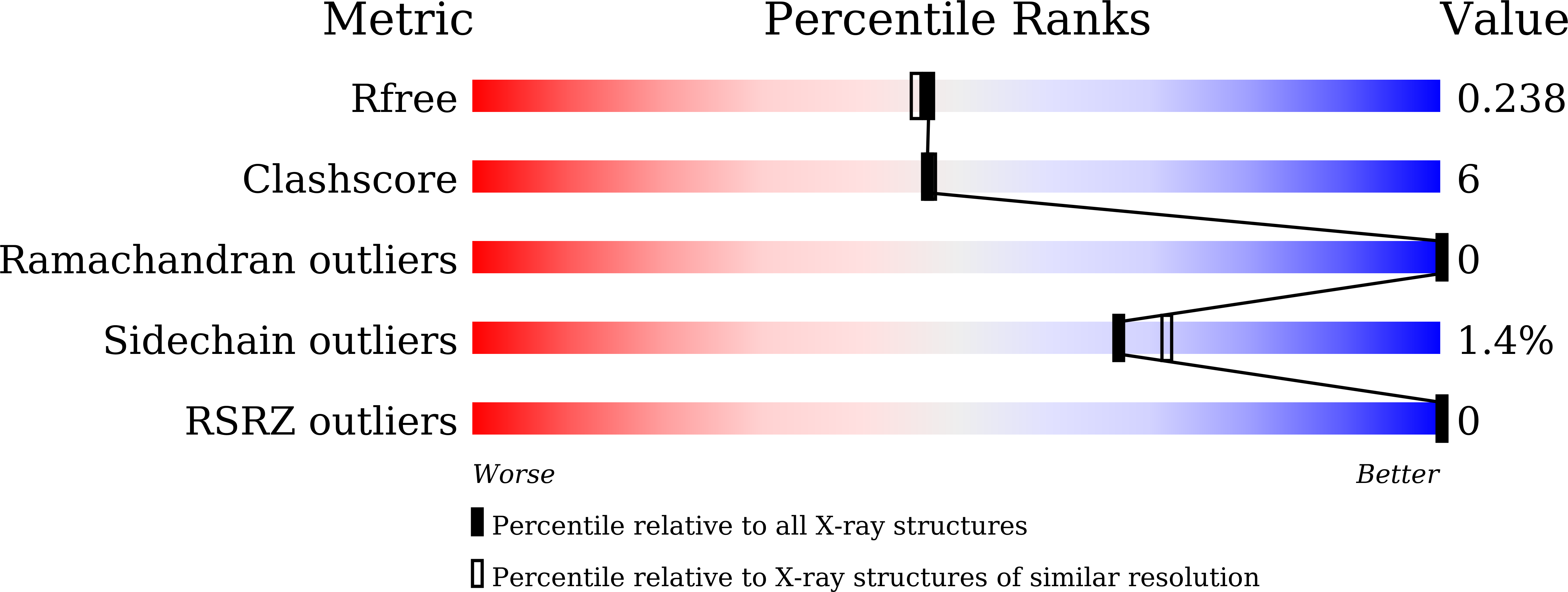
Macromolecular Entities
Structures with similar UniProt ID
Protein Blast
Polymer Type:polypeptide(L)
Molecule:Steroid hormone receptor ERR2
Gene (Uniprot):ESRRB
Mutagens:R382H,Y356H,Y215H
Chain IDs:A, B
Chain Length:230
Number of Molecules:2
Biological Source:Homo sapiens
Structures with similar UniProt ID
Protein Blast
Polymer Type:polypeptide(L)
Molecule:10-mer from Nuclear receptor coactivator 2
Gene (Uniprot):NCOA2
Chain IDs:C (auth: D), D (auth: E)
Chain Length:11
Number of Molecules:2
Biological Source:Homo sapiens
Ligand Molecules
Primary Citation
Structural Insights into the Specificity of Ligand Binding and Coactivator Assembly by Estrogen-Related Receptor beta.
J.Mol.Biol. 432 5460 5472 (2020)
PMID: 32795533 DOI: 10.1016/j.jmb.2020.08.007

Abstact

Estrogen-related receptor β (ERRβ) is a nuclear receptor critical for many biological processes. Despite the biological and pharmaceutical importance of ERRβ, deciphering the structure of ERRβ has been hampered by the difficulties in obtaining a pure and stable protein for structural studies. In fact, the ERRβ ligand-binding domain remains the last unsolved ERR structure and also one of only a few unknown nuclear receptor structures. Here, we report the identification of a critical single-residue mutation resulted in robust solubility and stability of an active ERRβ ligand-binding domain, thereby providing a protein tool enabling the first probe into the biochemical and structural studies of this important receptor. The crystal structure reveals key structural features that have enabled the integration of the molecular determinants of signals transduced across the ligand binding and coregulator recruitment by all three ERR subtypes, which also provides a framework for the rational design of selective and potent ligands for the treatment of various ERR-mediated diseases.

Legend

Protein

Chemical

Disease

Primary Citation of related structures
Feedback Form
Name
Email
Institute
Feedback