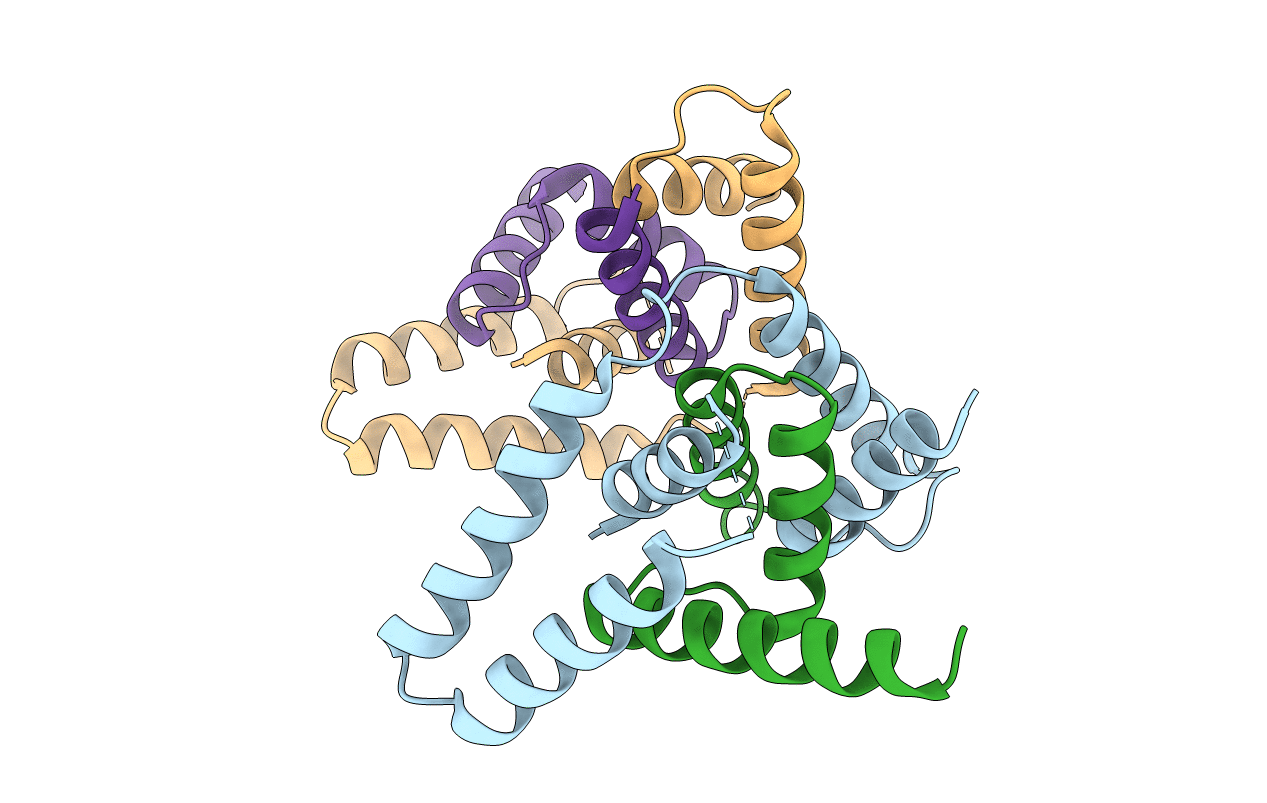
6L81 image
Deposition Date 2019-11-04
Release Date 2020-07-15
Last Version Date 2024-03-27
Entry Detail
PDB ID:
6L81
Keywords:
Title:
Crystal structure of Homo sapiens GCP5 N-terminus and Mozart1
Biological Source:
Source Organism:
Homo sapiens (Taxon ID: 9606)
Host Organism:
Method Details:
Experimental Method:
Resolution:
2.20 Å
R-Value Free:
0.26
R-Value Work:
0.21
R-Value Observed:
0.22
Space Group:
P 21 21 2

Macromolecular Entities
Structures with similar UniProt ID
Protein Blast
Polymer Type:polypeptide(L)
Molecule:Gamma-tubulin complex component 5
Gene (Uniprot):TUBGCP5
Chain IDs:A, C
Chain Length:124
Number of Molecules:2
Biological Source:Homo sapiens
Structures with similar UniProt ID
Protein Blast
Polymer Type:polypeptide(L)
Molecule:Mitotic-spindle organizing protein 1
Gene (Uniprot):MZT1
Chain IDs:B, D
Chain Length:85
Number of Molecules:2
Biological Source:Homo sapiens
Primary Citation
Promiscuous Binding of Microprotein Mozart1 to gamma-Tubulin Complex Mediates Specific Subcellular Targeting to Control Microtubule Array Formation.
Cell Rep 31 107836 107836 (2020)
PMID: 32610137 DOI: 10.1016/j.celrep.2020.107836

Abstact

How γ-tubulin ring complex (γ-TuRC), a master template for microtubule nucleation, is spatially and temporally regulated for the assembly of new microtubule arrays remains unclear. Here, we report that an evolutionarily conserved microprotein, Mozart1 (Mzt1), regulates subcellular targeting and microtubule formation activity of γ-TuRC at different cell cycle stages. Crystal structures of protein complexes demonstrate that Mzt1 promiscuously interacts with the N-terminal domains of multiple γ-tubulin complex protein subunits in γ-TuRC via an intercalative binding mode. Genetic- and microscopy-based analyses show that promiscuous binding of Mzt1 in γ-TuRC controls specific subcellular localization of γ-TuRC to modulate microtubule nucleation and stabilization in fission yeast. Moreover, we find Mzt1-independent targeting of γ-TuRC to be crucial for mitotic spindle assembly, demonstrating the cell-cycle-dependent regulation and function of γ-TuRC. Our findings reveal a microprotein-mediated regulatory mechanism underlying microtubule cytoskeleton formation, whereby Mzt1 binding promiscuity confers localization specificity on the multi-protein complex γ-TuRC.

Legend

Protein

Chemical

Disease

Primary Citation of related structures
Feedback Form
Name
Email
Institute
Feedback