6L5J image
Deposition Date 2019-10-23
Release Date 2020-07-29
Last Version Date 2024-11-20
Entry Detail
PDB ID:
6L5J
Title:
Crystal structure of human rootletin 1108-1317
Biological Source:
Source Organism:
Homo sapiens (Taxon ID: 9606)
Host Organism:
Method Details:
Experimental Method:
Resolution:
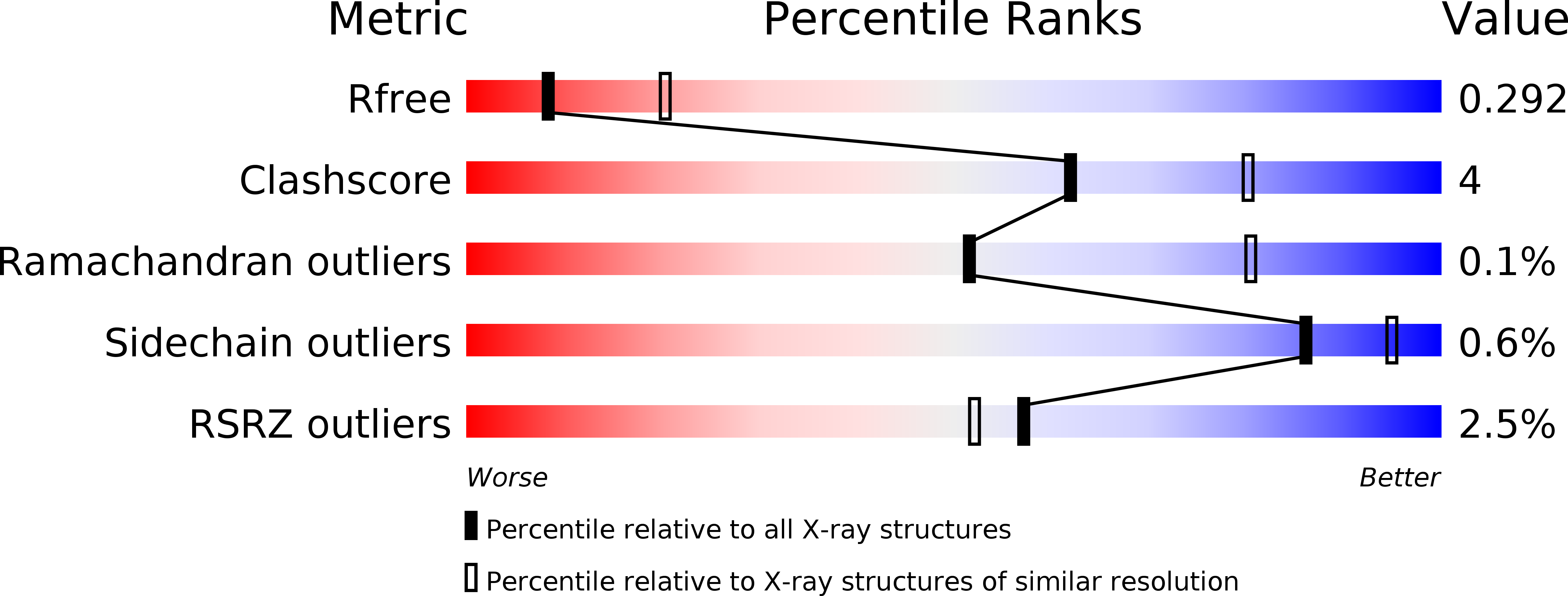
2.77 Å
R-Value Free:
0.28
R-Value Work:
0.28
R-Value Observed:
0.28
Space Group:
P 1
Macromolecular Entities
Structures with similar UniProt ID
Protein Blast
Polymer Type:polypeptide(L)
Molecule:Rootletin
Gene (Uniprot):CROCC
Mutagens:L1153M, L1166M
Chain IDs:A, B, C, D
Chain Length:215
Number of Molecules:4
Biological Source:Homo sapiens
Modified Residue
Compound ID Chain ID Parent Comp ID Details 2D Image
MSE A MET modified residue
Ligand Molecules
Primary Citation
Identification of a Structurally Dynamic Domain for Oligomer Formation in Rootletin.
J.Mol.Biol. 432 3915 3932 (2020)
PMID: 32325071 DOI: 10.1016/j.jmb.2020.04.012

Abstact

Rootletin is the main component of the ciliary rootlet and functions as a centriole linker connecting the two mother centrioles. Despite the functional importance of rootletin, the molecular architecture of the rootletin filament and its assembly mechanism are poorly understood. Here, we identify the coiled-coil domain 3 (CCD3) of rootletin as the key domain for its cellular function. The crystal structure of the CCD31108-1317 fragment containing 28 heptad repeats and 1 hendecad repeat reveals that it forms a parallel coiled-coil dimer spanning approximately 300 Å in length. Crosslinking experiments and biophysical analyses of the minimal functional region of CCD3 (CCD3-6) suggest that CCD3-6 is structurally dynamic and may be important for oligomer formation. We also show that oligomerization-defective CCD3 mutants fail in centrosomal localization and centriole linkage, suggesting that rootletin oligomerization may be important for its function.

Legend

Protein

Chemical

Disease

Primary Citation of related structures
Feedback Form
Name
Email
Institute
Feedback