6L2M image
Deposition Date 2019-10-05
Release Date 2020-08-12
Last Version Date 2023-11-22
Entry Detail
PDB ID:
6L2M
Title:
The structure of the tRNA-specific deaminase mutant from M. capricolum
Biological Source:
Source Organism:
Host Organism:
Method Details:
Experimental Method:
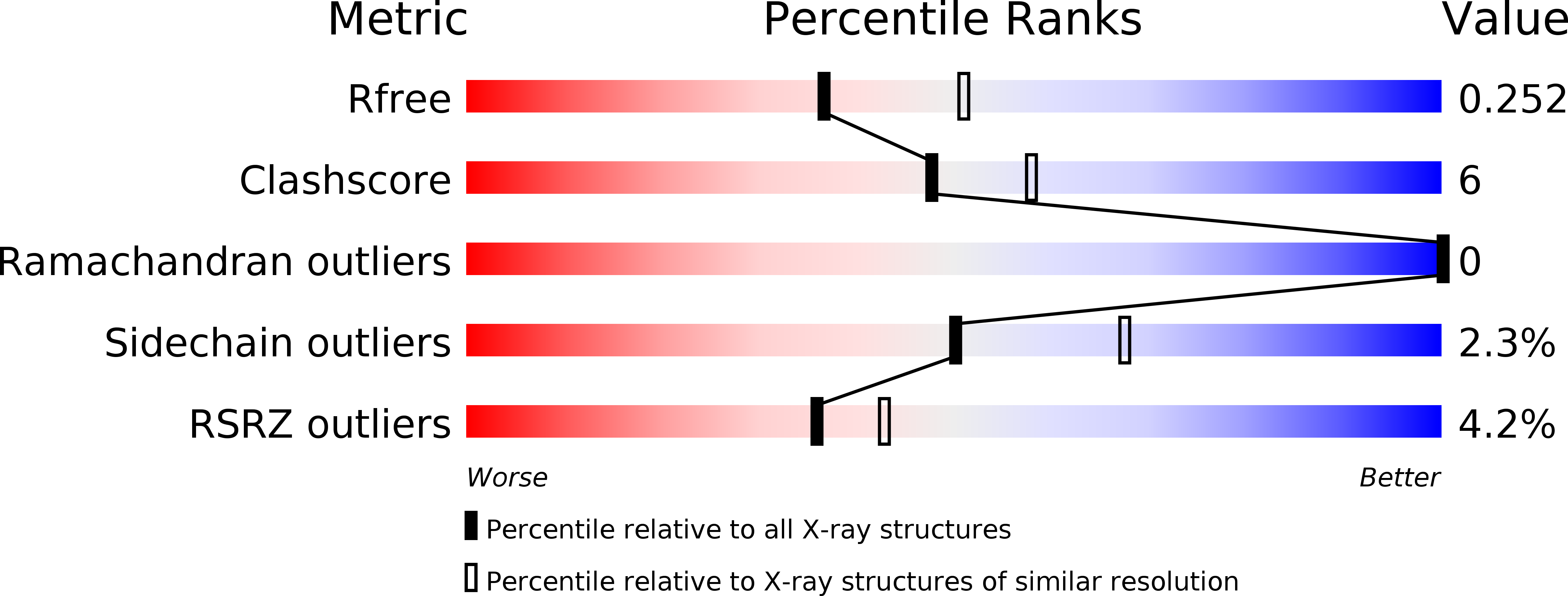
Resolution:
2.30 Å
R-Value Free:
0.25
R-Value Work:
0.19
R-Value Observed:
0.20
Space Group:
P 32 2 1
Macromolecular Entities
Structures with similar UniProt ID
Protein Blast
Polymer Type:polypeptide(L)
Molecule:Nucleoside deaminase family protein
Gene (Uniprot):MCGM508_01875
Mutagens:I19A,K20Q,H21L,N22G,S105D,Y106P,K146A, DEL(108-110)
Chain IDs:A
Chain Length:152
Number of Molecules:1
Biological Source:Mycoplasma capricolum subsp. capricolum
Primary Citation
Structure of a tRNA-specific deaminase with compromised deamination activity.
Biochem.J. 477 1483 1497 (2020)
PMID: 32270856 DOI: 10.1042/BCJ20190858

Abstact

Nucleotide 34 in tRNA is extensively modified to ensure translational fidelity and efficacy in cells. The deamination of adenosine at this site catalyzed by the enzyme TadA gives rise to inosine (I), which serves as a typical example of the wobble hypothesis due to its diverse basepairing capability. However, recent studies have shown that tRNAArgACG in Mycoplasma capricolum contains unmodified adenosine, in order to decode the CGG codon. The structural basis behind the poorly performing enzyme M. capricolum TadA (McTadA) is largely unclear. Here we present the structures of the WT and a mutant form of McTadA determined at high resolutions. Through structural comparison between McTadA and other active TadA enzymes as well as modeling efforts, we found that McTadA presents multiple structural conflicts with RNA substrates and thus offered support to previous studies from a structural perspective. These clashes would potentially lead to reduced substrate binding affinity of McTadA, consistent with our in vitro deamination activity and binding assays. To rescue the deamination activity of McTadA, we carried out two rounds of protein engineering through structure-guided design. The unsuccessful attempts of the activity restoration could be attributed to the altered dimer interface and stereo hindrance from the non-catalytic subunit of McTadA, which could be the inevitable outcome of the natural evolution. Our study provides structural insight into an alternative decoding and evolutionary strategy by a compromised TadA enzyme at a molecular level.

Legend

Protein

Chemical

Disease

Primary Citation of related structures
Feedback Form
Name
Email
Institute
Feedback