6KPP image
Deposition Date 2019-08-15
Release Date 2020-08-19
Last Version Date 2023-11-22
Entry Detail
PDB ID:
6KPP
Title:
BNC105 in complex with tubulin
Biological Source:
Source Organism:
Mus musculus (Taxon ID: 10090)
Gallus gallus (Taxon ID: 9031)
Sus scrofa (Taxon ID: 9823)
Host Organism:
Method Details:
Experimental Method:
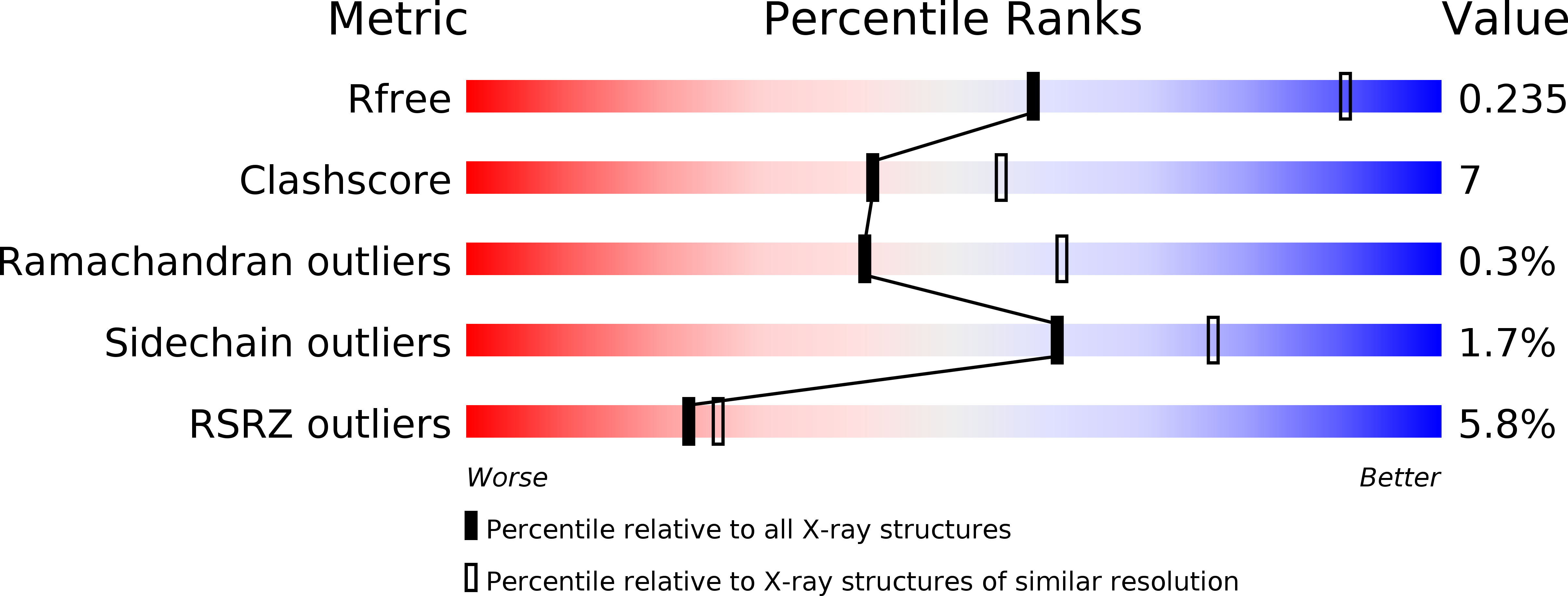
Resolution:
2.75 Å
R-Value Free:
0.23
R-Value Work:
0.19
R-Value Observed:
0.19
Space Group:
P 21 21 21
Macromolecular Entities
Structures with similar UniProt ID
Protein Blast
Polymer Type:polypeptide(L)
Molecule:Tubulin alpha-1B chain
Gene (Uniprot):TUBA1B
Chain IDs:A, C
Chain Length:450
Number of Molecules:2
Biological Source:Sus scrofa
Structures with similar UniProt ID
Protein Blast
Polymer Type:polypeptide(L)
Molecule:Tubulin beta chain
Chain IDs:B, D
Chain Length:445
Number of Molecules:2
Biological Source:Sus scrofa
Structures with similar UniProt ID
Protein Blast
Polymer Type:polypeptide(L)
Molecule:Stathmin-4
Gene (Uniprot):Stmn4
Chain IDs:E
Chain Length:143
Number of Molecules:1
Biological Source:Mus musculus
Polymer Type:polypeptide(L)
Molecule:Tubulin tyrosine ligase
Chain IDs:F
Chain Length:384
Number of Molecules:1
Biological Source:Gallus gallus
Primary Citation
Unraveling the molecular mechanism of BNC105, a phase II clinical trial vascular disrupting agent, provides insights into drug design.
Biochem.Biophys.Res.Commun. ? ? ? (2020)
PMID: 32085900 DOI: 10.1016/j.bbrc.2019.12.083

Abstact

Microtubules are made up of tubulin protein and play a very important part in numerous cellular events of eukaryotic cells, which is why they are seen as attractive targets for tumor chemotherapy. BNC105, a known vascular targeting agent, has entered in phase II clinical trials. It has previously been confirmed that BNC105 is an effective microtubule targeting agent for various cancers. BNC105 exhibits selectivity for tumor cells, elicits vascular disrupting effects, and inhibits tumor growth. However, the molecular mechanism of BNC105 is still elusive. Herein, the crystal structure of BNC105 in complex with tubulin protein is revealed, demonstrating the its interaction with the colchicine binding site. In order to thoroughly evaluate its molecular mechanism from a structural-activity-relationship standpoint, the binding mode of tubulin to BNC-105 is compared with colchicine, CA-4 and other BNC-105 derivatives. Our study not only confirms the detailed interactions of the BNC105-tubulin complex, but also offer substantial structural foundation for the design and development of novel benzo[b]furan derivatives as microtubule targeting agents.

Legend

Protein

Chemical

Disease

Primary Citation of related structures
Feedback Form
Name
Email
Institute
Feedback