6K64 image
Deposition Date 2019-06-01
Release Date 2019-08-14
Last Version Date 2023-11-22
Entry Detail
PDB ID:
6K64
Title:
Application of anti-helix antibodies in protein structure determination (8188-3LRH)
Biological Source:
Source Organism:
Host Organism:
Method Details:
Experimental Method:
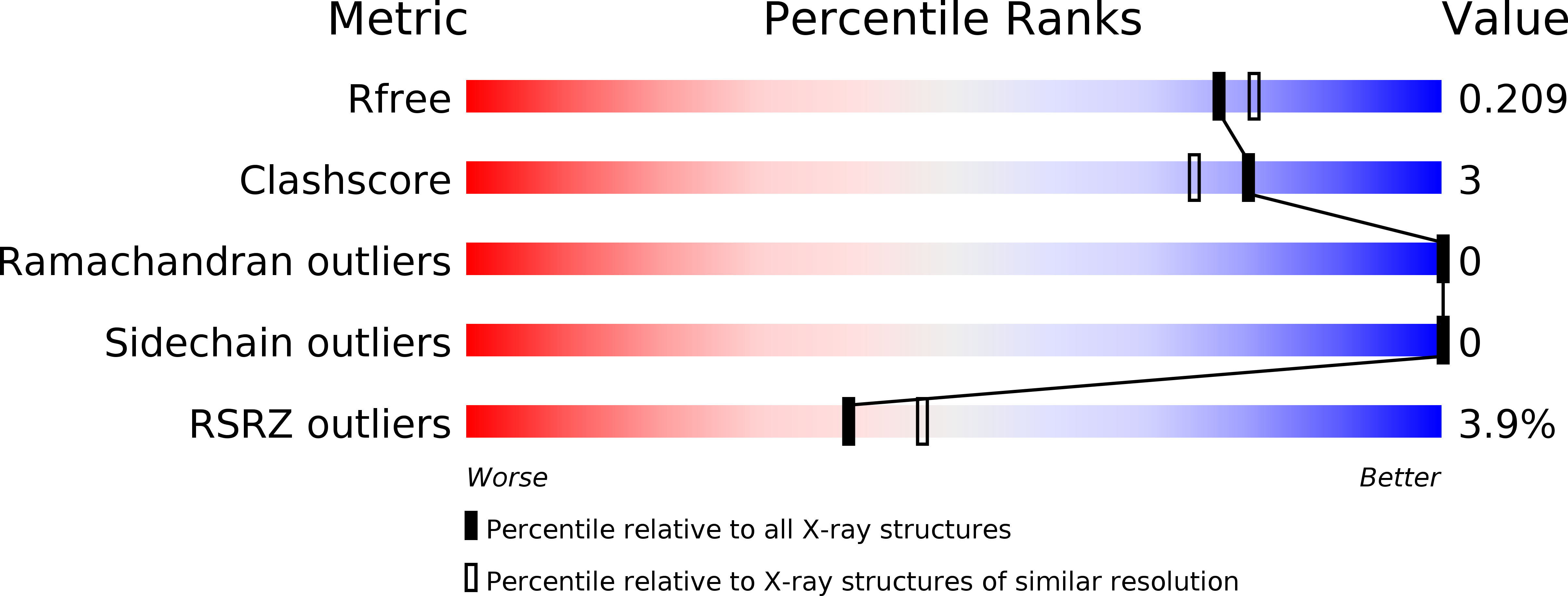
Resolution:
1.93 Å
R-Value Free:
0.20
R-Value Work:
0.17
R-Value Observed:
0.17
Space Group:
P 1
Macromolecular Entities
Polymer Type:polypeptide(L)
Molecule:3LRH intrabody
Chain IDs:A, B
Chain Length:135
Number of Molecules:2
Biological Source:Homo sapiens
Structures with similar UniProt ID
Protein Blast
Polymer Type:polypeptide(L)
Molecule:Protein A
Chain IDs:C (auth: H), D (auth: C)
Chain Length:79
Number of Molecules:2
Biological Source:Staphylococcus aureus subsp. aureus
Primary Citation
Application of antihelix antibodies in protein structure determination.
Proc.Natl.Acad.Sci.USA 116 17786 17791 (2019)
PMID: 31371498 DOI: 10.1073/pnas.1910080116

Abstact

Antibodies are indispensable tools in protein engineering and structural biology. Antibodies suitable for structural studies should recognize the 3-dimensional (3D) conformations of target proteins. Generating such antibodies and characterizing their complexes with antigens take a significant amount of time and effort. Here, we show that we can expand the application of well-characterized antibodies by "transplanting" the epitopes that they recognize to proteins with completely different structures and sequences. Previously, several antibodies have been shown to recognize the alpha-helical conformation of antigenic peptides. We demonstrate that these antibodies can be made to bind to a variety of unrelated "off-target" proteins by modifying amino acids in the preexisting alpha helices of such proteins. Using X-ray crystallography, we determined the structures of the engineered protein-antibody complexes. All of the antibodies bound to the epitope-transplanted proteins, forming accurately predictable structures. Furthermore, we showed that binding of these antihelix antibodies to the engineered target proteins can modulate their catalytic activities by trapping them in selected functional states. Our method is simple and efficient, and it will have applications in protein X-ray crystallography, electron microscopy, and nanotechnology.

Legend

Protein

Chemical

Disease

Primary Citation of related structures
Feedback Form
Name
Email
Institute
Feedback