6K1R image
Deposition Date 2019-05-12
Release Date 2020-05-13
Last Version Date 2023-11-22
Entry Detail
PDB ID:
6K1R
Keywords:
Title:
Crystal structure of Ketopantoate reductase from Pseudomonas aeruginosa in complex with NAD+ and ketopantoate
Biological Source:
Source Organism:
Host Organism:
Method Details:
Experimental Method:
Resolution:
2.55 Å
R-Value Free:
0.26
R-Value Work:
0.24
R-Value Observed:
0.24
Space Group:
P 42 21 2
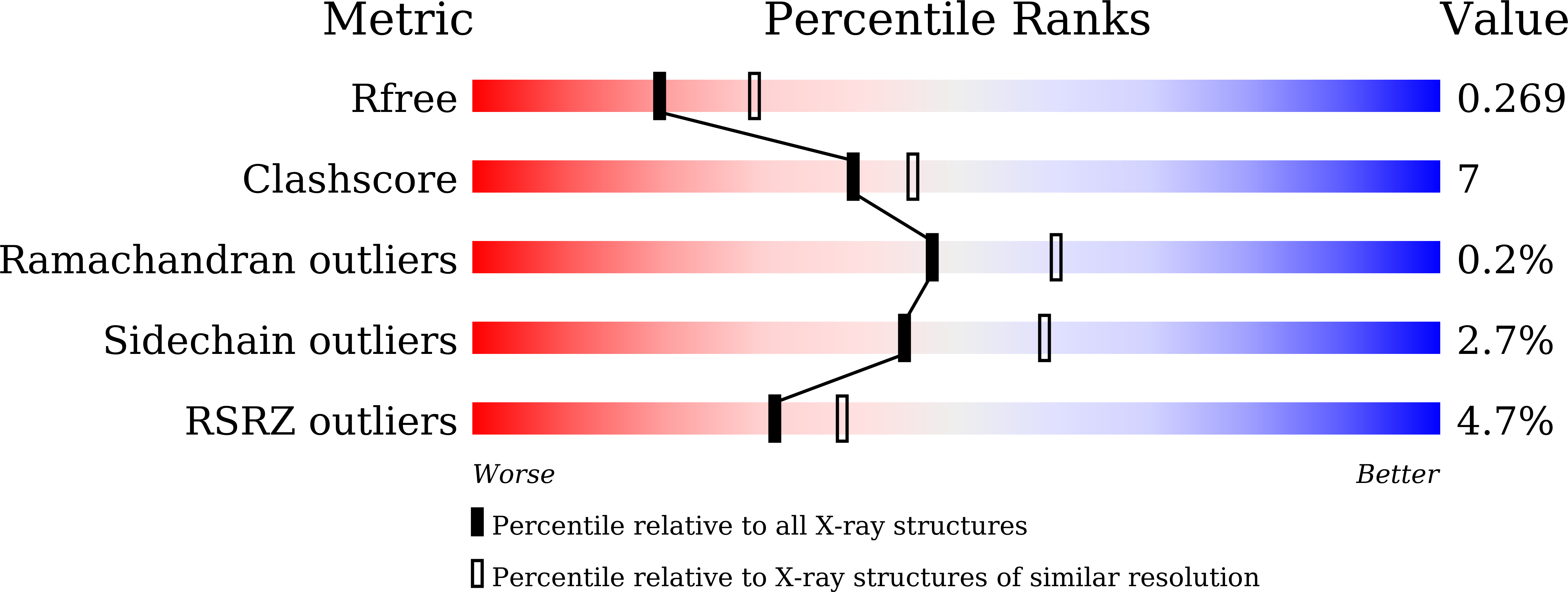
Macromolecular Entities
Structures with similar UniProt ID
Protein Blast
Polymer Type:polypeptide(L)
Molecule:Probable 2-dehydropantoate 2-reductase
Gene (Uniprot):panE
Chain IDs:A, B, C
Chain Length:323
Number of Molecules:3
Biological Source:Pseudomonas aeruginosa PAO1
Primary Citation
Crystallographic and biophysical analyses of Pseudomonas aeruginosa ketopantoate reductase: Implications of ligand induced conformational changes in cofactor recognition.
Biochimie ? ? ? (2021)
PMID: 34757166 DOI: 10.1016/j.biochi.2021.10.015

Abstact

Ketopantoate reductases (KPRs) catalyse NADPH-dependent reduction of ketopantoate to pantoate, the rate-limiting step of pantothenate biosynthetic pathway. In our recent study, we showed KPRs are under dynamic evolutionary selection and highlighted the possible role of ordered substrate binding kinetics for cofactor selection. To further delineate this at molecular level, here, we perform X-ray crystallographic and biophysical analyses of KPR in presence of non-canonical cofactor NAD+. In our structure, NAD+ was found to be highly dynamic in catalytic pocket of KPR, which could attain stable conformation only in presence of ketopantoate. Further, isothermal calorimetric (ITC) titrations showed that affinity of KPR for ketopantoate is higher in presence of NADP+ than in presence of NAD+ and lowest in absence of redox cofactors. In sum, our results clearly depict two modes of redox cofactor selections in KPRs, firstly by specific salt bridge interactions with unique phosphate moiety of NADP+ and secondly via ordered sequential heterotrophic cooperative binding of substrate ketopantoate.

Legend

Protein

Chemical

Disease

Primary Citation of related structures
Feedback Form
Name
Email
Institute
Feedback