6JXG image
Deposition Date 2019-04-23
Release Date 2019-11-20
Last Version Date 2024-11-20
Entry Detail
PDB ID:
6JXG
Keywords:
Title:
Crystasl Structure of Beta-glucosidase D2-BGL from Chaetomella Raphigera
Biological Source:
Source Organism:
Host Organism:
Method Details:
Experimental Method:
Resolution:
1.90 Å
R-Value Free:
0.19
R-Value Work:
0.14
R-Value Observed:
0.14
Space Group:
P 21 21 21
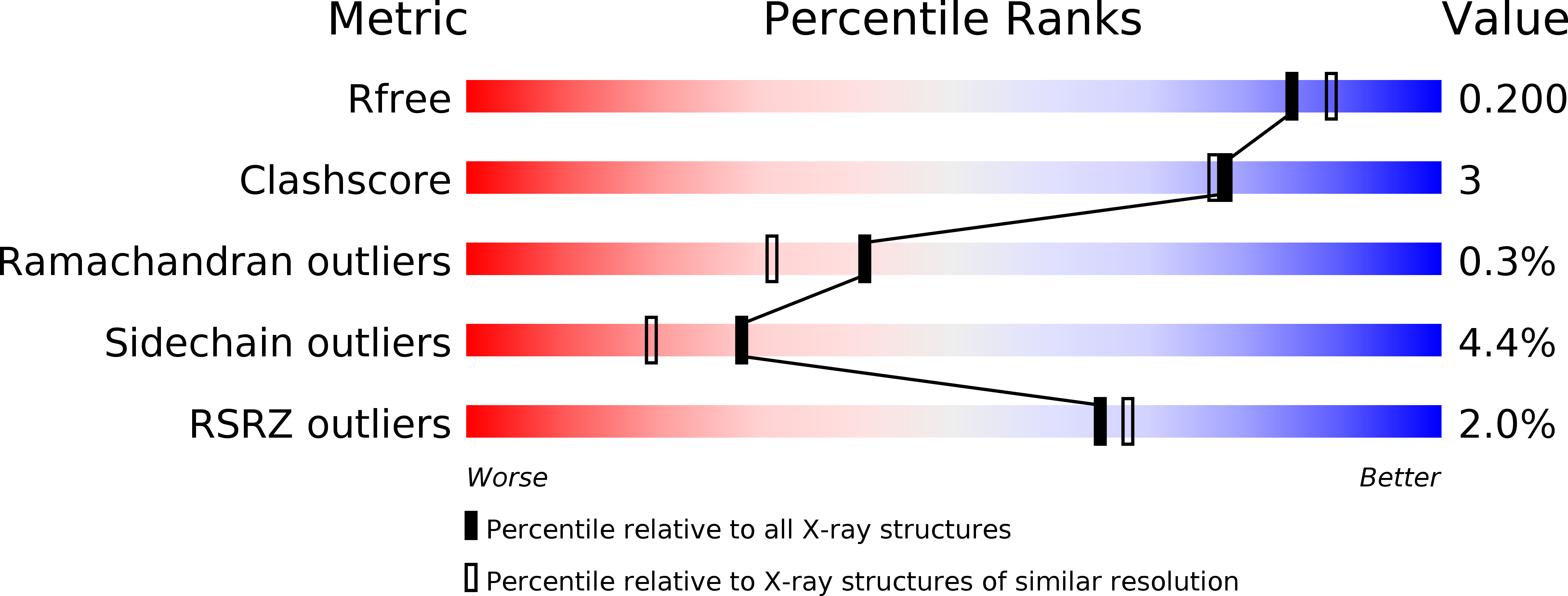
Macromolecular Entities
Structures with similar UniProt ID
Protein Blast
Polymer Type:polypeptide(L)
Molecule:Beta-glucosidase
Chain IDs:A
Chain Length:722
Number of Molecules:1
Biological Source:Chaetomella raphigera
Modified Residue
Compound ID Chain ID Parent Comp ID Details 2D Image
MAN E MAN -D
NAG B NAG -D
Primary Citation
Chaetomella raphigerabeta-glucosidase D2-BGL has intriguing structural features and a high substrate affinity that renders it an efficient cellulase supplement for lignocellulosic biomass hydrolysis.
Biotechnol Biofuels 12 258 258 (2019)
PMID: 31700541 DOI: 10.1186/s13068-019-1599-0

Abstact

BACKGROUND To produce second-generation biofuels, enzymatic catalysis is required to convert cellulose from lignocellulosic biomass into fermentable sugars. β-Glucosidases finalize the process by hydrolyzing cellobiose into glucose, so the efficiency of cellulose hydrolysis largely depends on the quantity and quality of these enzymes used during saccharification. Accordingly, to reduce biofuel production costs, new microbial strains are needed that can produce highly efficient enzymes on a large scale. RESULTS We heterologously expressed the fungal β-glucosidase D2-BGL from a Taiwanese indigenous fungus Chaetomella raphigera in Pichia pastoris for constitutive production by fermentation. Recombinant D2-BGL presented significantly higher substrate affinity than the commercial β-glucosidase Novozyme 188 (N188; K m = 0.2 vs 2.14 mM for p-nitrophenyl β-d-glucopyranoside and 0.96 vs 2.38 mM for cellobiose). When combined with RUT-C30 cellulases, it hydrolyzed acid-pretreated lignocellulosic biomasses more efficiently than the commercial cellulase mixture CTec3. The extent of conversion from cellulose to glucose was 83% for sugarcane bagasse and 63% for rice straws. Compared to N188, use of D2-BGL halved the time necessary to produce maximal levels of ethanol by a semi-simultaneous saccharification and fermentation process. We upscaled production of recombinant D2-BGL to 33.6 U/mL within 15 days using a 1-ton bioreactor. Crystal structure analysis revealed that D2-BGL belongs to glycoside hydrolase (GH) family 3. Removing the N-glycosylation N68 or O-glycosylation T431 residues by site-directed mutagenesis negatively affected enzyme production in P. pastoris. The F256 substrate-binding residue in D2-BGL is located in a shorter loop surrounding the active site pocket relative to that of Aspergillus β-glucosidases, and this short loop is responsible for its high substrate affinity toward cellobiose. CONCLUSIONS D2-BGL is an efficient supplement for lignocellulosic biomass saccharification, and we upscaled production of this enzyme using a 1-ton bioreactor. Enzyme production could be further improved using optimized fermentation, which could reduce biofuel production costs. Our structure analysis of D2-BGL offers new insights into GH3 β-glucosidases, which will be useful for strain improvements via a structure-based mutagenesis approach.

Legend

Protein

Chemical

Disease

Primary Citation of related structures
Feedback Form
Name
Email
Institute
Feedback