6JNN image
Deposition Date 2019-03-17
Release Date 2019-03-27
Last Version Date 2023-11-22
Entry Detail
PDB ID:
6JNN
Title:
REF6 ZnF2-4-NAC004-mC1 complex
Biological Source:
Source Organism:
Host Organism:
Method Details:
Experimental Method:
Resolution:
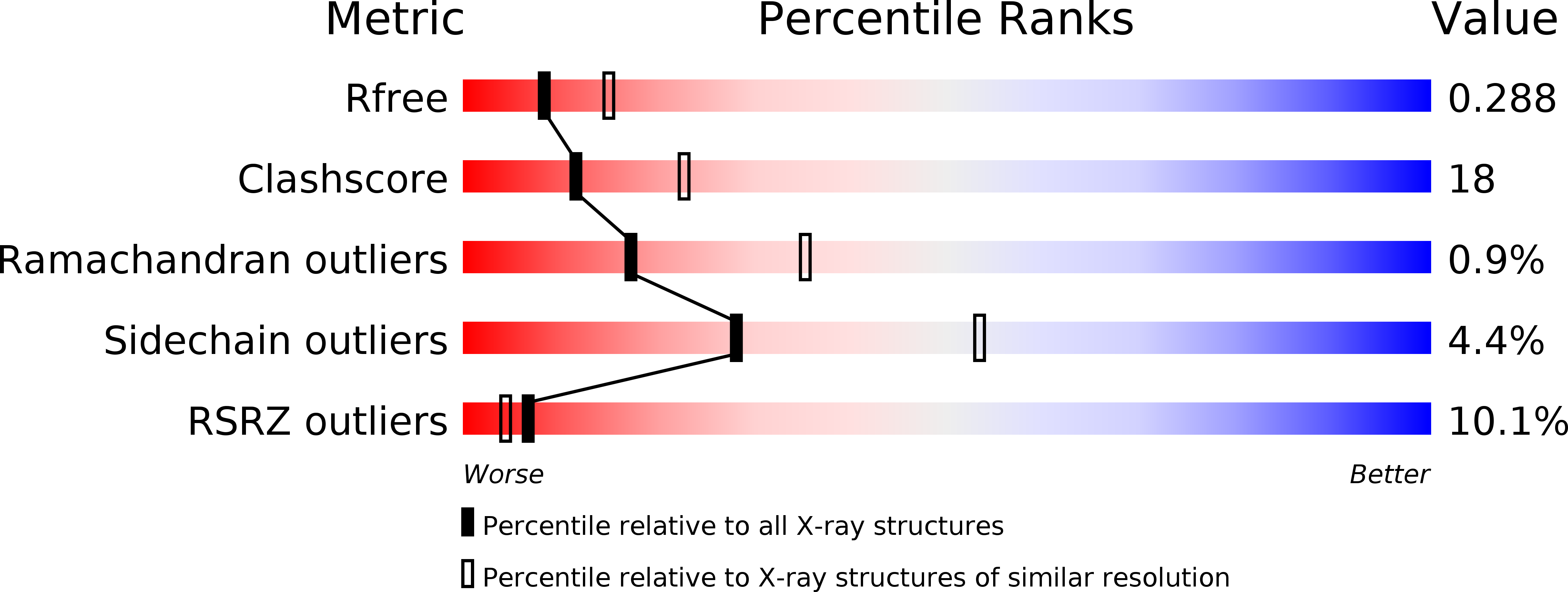
2.60 Å
R-Value Free:
0.26
R-Value Work:
0.25
R-Value Observed:
0.25
Space Group:
P 31
Macromolecular Entities
Structures with similar UniProt ID
Protein Blast
Polymer Type:polypeptide(L)
Molecule:Lysine-specific demethylase REF6
Gene (Uniprot):REF6
Chain IDs:A, D (auth: B), K (auth: N), L (auth: G)
Chain Length:101
Number of Molecules:4
Biological Source:Arabidopsis thaliana
Polymer Type:polydeoxyribonucleotide
Molecule:DNA (5'-D(*CP*AP*AP*AP*AP*CP*AP*GP*AP*GP*AP*A)-3')
Chain IDs:C, F (auth: E), H, J (auth: K)
Chain Length:12
Number of Molecules:4
Biological Source:synthetic construct
Polymer Type:polydeoxyribonucleotide
Molecule:DNA (5'-D(*TP*TP*(5CM)P*TP*CP*TP*GP*TP*TP*TP*TP*G)-3')
Chain IDs:B (auth: D), E (auth: F), G (auth: I), I (auth: L)
Chain Length:12
Number of Molecules:4
Biological Source:synthetic construct
Ligand Molecules
Primary Citation
DNA methylation repels targeting of Arabidopsis REF6.
Nat Commun 10 2063 2063 (2019)
PMID: 31048693 DOI: 10.1038/s41467-019-10026-1

Abstact

RELATIVE OF EARLY FLOWERING 6 (REF6/JMJ12), a Jumonji C (JmjC)-domain-containing H3K27me3 histone demethylase, finds its target loci in Arabidopsis genome by directly recognizing the CTCTGYTY motif via its zinc-finger (ZnF) domains. REF6 tends to bind motifs located in active chromatin states that are depleted for heterochromatic modifications. However, the underlying mechanism remains unknown. Here, we show that REF6 preferentially bind to hypo-methylated CTCTGYTY motifs in vivo, and that CHG methylation decreases REF6 DNA binding affinity in vitro. In addition, crystal structures of ZnF-clusters in complex with DNA oligonucleotides reveal that 5-methylcytosine is unfavorable for REF6 binding. In drm1 drm2 cmt2 cmt3 (ddcc) quadruple mutants, in which non-CG methylation is significantly reduced, REF6 can ectopically bind a small number of new target loci, most of which are located in or neighbored with short TEs in euchromatic regions. Collectively, our findings reveal that DNA methylation, likely acting in combination with other epigenetic modifications, may partially explain why REF6 binding is depleted in heterochromatic loci.

Legend

Protein

Chemical

Disease

Primary Citation of related structures
Feedback Form
Name
Email
Institute
Feedback