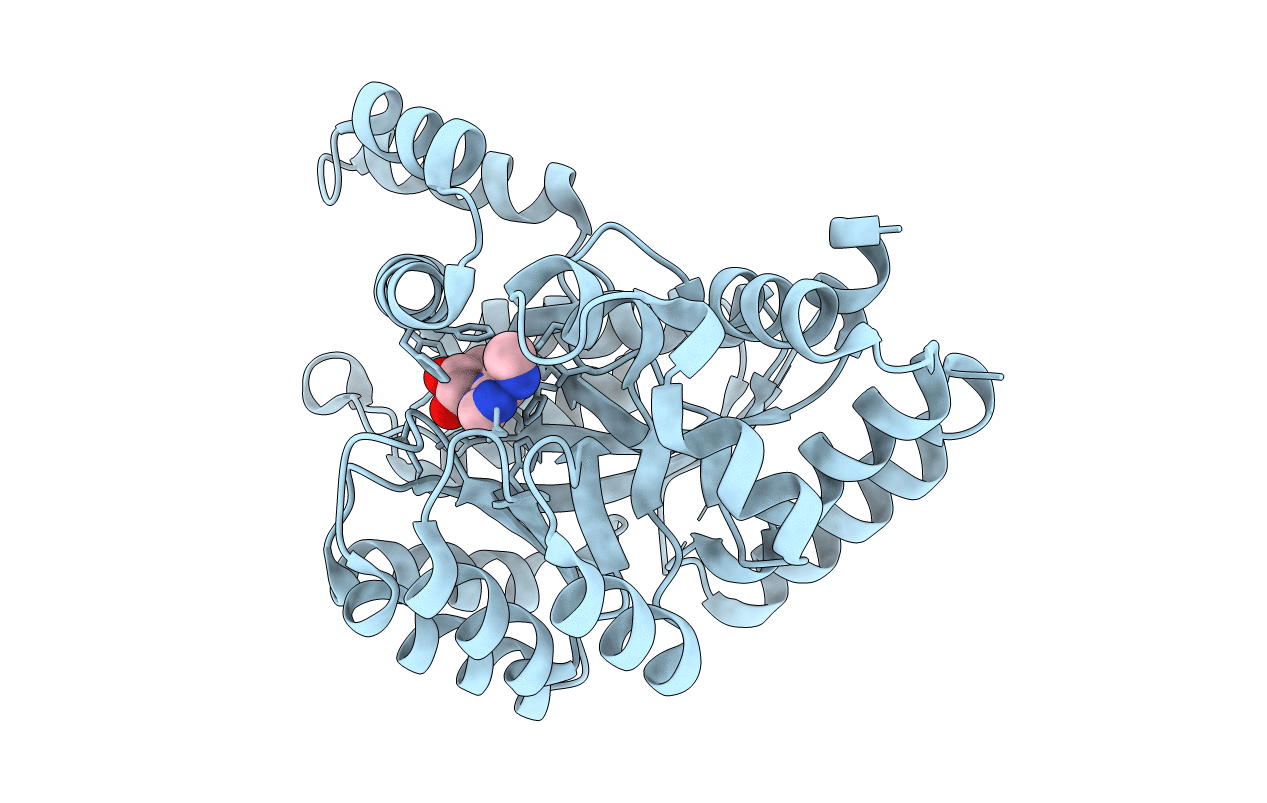
6IJN image
Deposition Date 2018-10-10
Release Date 2019-02-06
Last Version Date 2023-11-22
Entry Detail
PDB ID:
6IJN
Keywords:
Title:
The D295N mutant of the N6-methyl-AMP deaminase from Arabidopsis thaliana complexed with N6m-AMP
Biological Source:
Source Organism:
Host Organism:
Method Details:
Experimental Method:
Resolution:
1.66 Å
R-Value Free:
0.17
R-Value Work:
0.14
R-Value Observed:
0.14
Space Group:
P 21 21 21

Macromolecular Entities
Structures with similar UniProt ID
Protein Blast
Polymer Type:polypeptide(L)
Molecule:Adenosine/AMP deaminase family protein
Gene (Uniprot):MAPDA
Mutagens:D295N
Chain IDs:A
Chain Length:376
Number of Molecules:1
Biological Source:Arabidopsis thaliana
Ligand Molecules
Primary Citation
Alternative conformation induced by substrate binding for Arabidopsis thalianaN6-methyl-AMP deaminase.
Nucleic Acids Res. 47 3233 3243 (2019)
PMID: 30721978 DOI: 10.1093/nar/gkz070

Abstact

Adenosine deaminase is involved in adenosine degradation and salvage pathway, and plays important physiological roles in purine metabolism. Recently, a novel type of adenosine deaminase-like protein has been identified, which displays deamination activity toward N6-methyl-adenosine monophosphate but not adenosine or AMP, and was consequently named N6-methyl-AMP deaminase (MAPDA). The underlying structural basis of MAPDA recognition and catalysis is poorly understood. Here, we present the crystal structures of MAPDA from Arabidopsis thaliana in the free and in the ligand-bound forms. The protein contains a conserved (β/α)8 Tim-barrel domain and a typical zinc-binding site, but it also exhibits idiosyncratic local differences for two flexible helices important for substrate binding. The extensive interactions between the N6-methyl-AMP substrate or the inosine monophosphate product and the enzyme were identified, and subsequently evaluated by the deamination activity assays. Importantly, each structure reported here represents a different stage of the catalytic pathway and their structural differences suggested that the enzyme can exist in two distinct conformational states. The open state switches to the closed one upon the binding of ligands, brought about by the two critical helices. Our structural studies provide the first look of this important metabolic enzyme and shed lights on its catalytic pathway, which holds promise for the structure-based drug design for MAPDA-related diseases.

Legend

Protein

Chemical

Disease

Primary Citation of related structures
Feedback Form
Name
Email
Institute
Feedback