6I8X image
Deposition Date 2018-11-21
Release Date 2019-07-17
Last Version Date 2024-01-24
Entry Detail
PDB ID:
6I8X
Title:
As-p18, an extracellular fatty acid binding protein
Biological Source:
Source Organism:
Ascaris suum (Taxon ID: 6253)
Method Details:
Experimental Method:
Resolution:
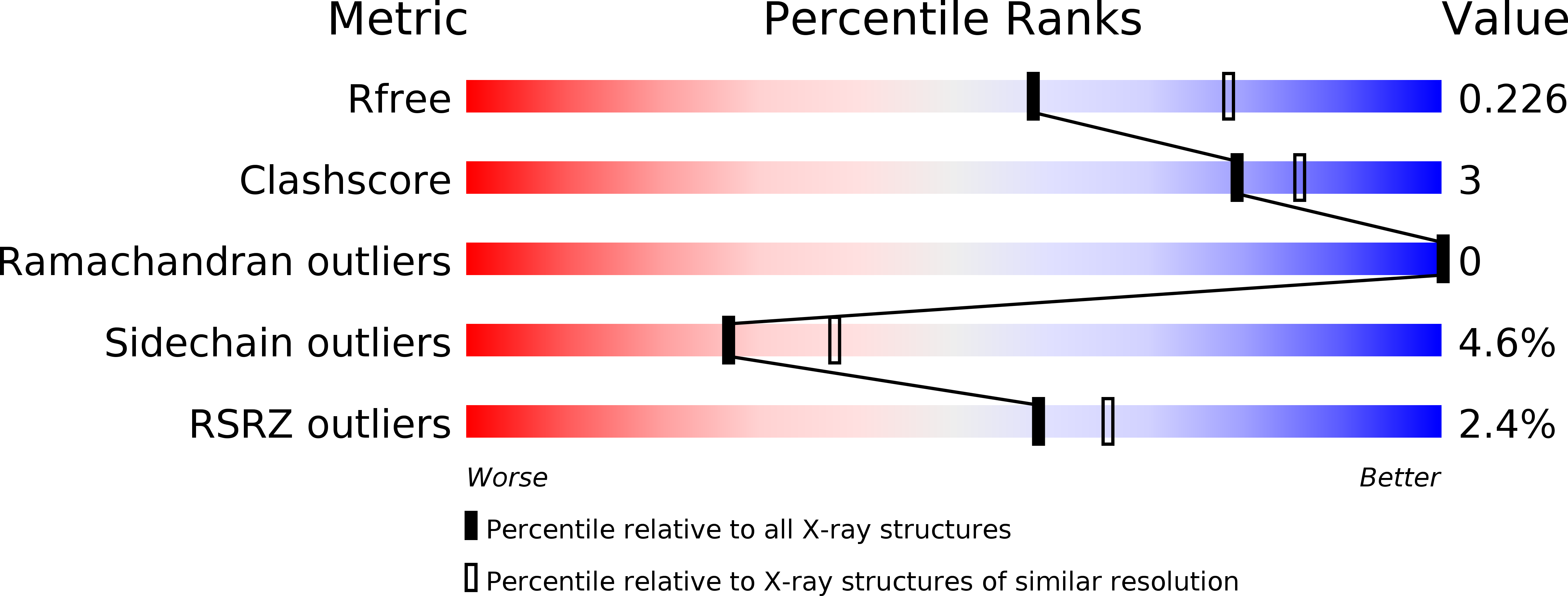
2.30 Å
R-Value Free:
0.22
R-Value Work:
0.17
R-Value Observed:
0.18
Space Group:
I 4
Macromolecular Entities
Structures with similar UniProt ID
Protein Blast
Polymer Type:polypeptide(L)
Molecule:Fatty acid-binding protein homolog
Chain IDs:A, B
Chain Length:149
Number of Molecules:2
Biological Source:Ascaris suum
Primary Citation

Abstact

Intracellular lipid-binding proteins (iLBPs) of the fatty acid-binding protein (FABP) family of animals transport, mainly fatty acids or retinoids, are confined to the cytosol and have highly similar 3D structures. In contrast, nematodes possess fatty acid-binding proteins (nemFABPs) that are secreted into the perivitelline fluid surrounding their developing embryos. We report structures of As-p18, a nemFABP of the large intestinal roundworm Ascaris suum, with ligand bound, determined using X-ray crystallography and nuclear magnetic resonance spectroscopy. In common with other FABPs, As-p18 comprises a ten β-strand barrel capped by two short α-helices, with the carboxylate head group of oleate tethered in the interior of the protein. However, As-p18 exhibits two distinctive longer loops amongst β-strands not previously seen in a FABP. One of these is adjacent to the presumed ligand entry portal, so it may help to target the protein for efficient loading or unloading of ligand. The second, larger loop is at the opposite end of the molecule and has no equivalent in any iLBP structure yet determined. As-p18 preferentially binds a single 18-carbon fatty acid ligand in its central cavity but in an orientation that differs from iLBPs. The unusual structural features of nemFABPs may relate to resourcing of developing embryos of nematodes.

Legend

Protein

Chemical

Disease

Primary Citation of related structures
Feedback Form
Name
Email
Institute
Feedback