6I7M image
Deposition Date 2018-11-16
Release Date 2020-02-12
Last Version Date 2024-05-15
Entry Detail
PDB ID:
6I7M
Keywords:
Title:
Influenza A nucleoprotein docked into 3D helical structure of the wild type ribonucleoprotein complex obtained using cryoEM. Conformation 4.
Biological Source:
Source Organism:
Method Details:
Experimental Method:
Resolution:
10.00 Å
Aggregation State:
HELICAL ARRAY
Reconstruction Method:
HELICAL
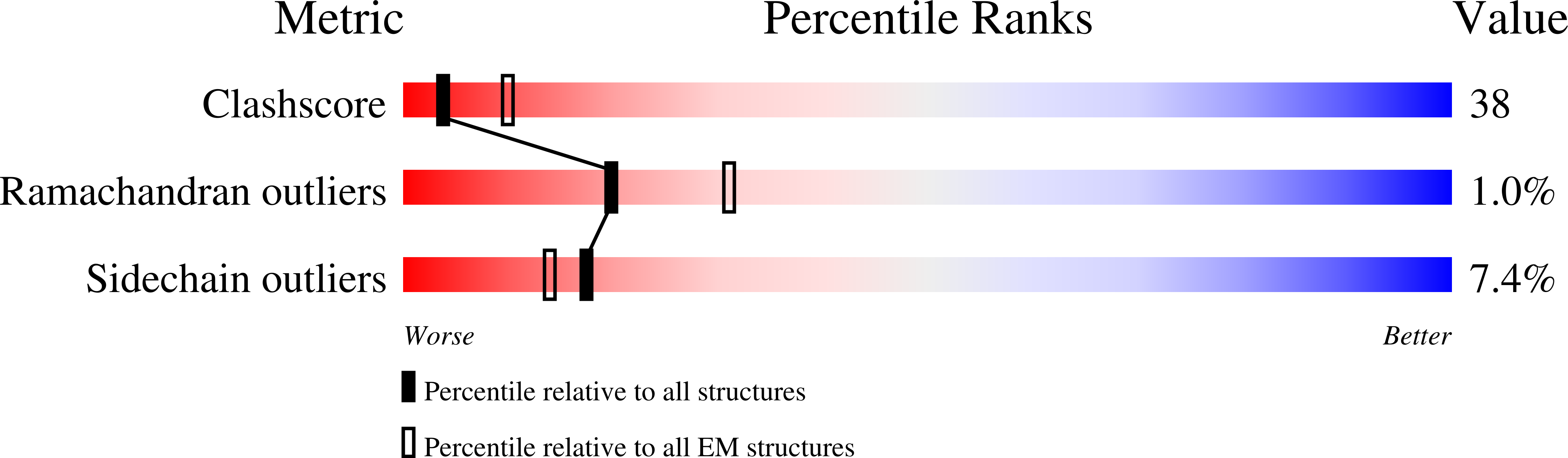
Macromolecular Entities
Structures with similar UniProt ID
Protein Blast
Polymer Type:polypeptide(L)
Molecule:Nucleoprotein
Gene (Uniprot):NP
Chain IDs:A, C
Chain Length:469
Number of Molecules:2
Biological Source:Influenza A virus
Structures with similar UniProt ID
Protein Blast
Polymer Type:polypeptide(L)
Molecule:Nucleoprotein
Gene (Uniprot):NP
Chain IDs:B, D
Chain Length:19
Number of Molecules:2
Biological Source:Influenza A virus
Ligand Molecules
Primary Citation
Structural insights into influenza A virus ribonucleoproteins reveal a processive helical track as transcription mechanism.
Nat Microbiol 5 727 734 (2020)
PMID: 32152587 DOI: 10.1038/s41564-020-0675-3

Abstact

The influenza virus genome consists of eight viral ribonucleoproteins (vRNPs), each consisting of a copy of the polymerase, one of the genomic RNA segments and multiple copies of the nucleoprotein arranged in a double helical conformation. vRNPs are macromolecular machines responsible for messenger RNA synthesis and genome replication, that is, the formation of progeny vRNPs. Here, we describe the structural basis of the transcription process. The mechanism, which we call the 'processive helical track', is based on the extreme flexibility of the helical part of the vRNP that permits a sliding movement between both antiparallel nucleoprotein-RNA strands, thereby allowing the polymerase to move over the genome while bound to both RNA ends. Accordingly, we demonstrate that blocking this movement leads to inhibition of vRNP transcriptional activity. This mechanism also reveals a critical role of the nucleoprotein in maintaining the double helical structure throughout the copying process to make the RNA template accessible to the polymerase.

Legend

Protein

Chemical

Disease

Primary Citation of related structures
Feedback Form
Name
Email
Institute
Feedback