6I2M image
Deposition Date 2018-11-01
Release Date 2019-01-23
Last Version Date 2024-01-24
Entry Detail
PDB ID:
6I2M
Keywords:
Title:
Crystal structure of vaccinia virus protein A55 BTB-Back domain in complex with human Cullin-3 N-terminus
Biological Source:
Source Organism:
Vaccinia virus WR (Taxon ID: 10254)
Homo sapiens (Taxon ID: 9606)
Host Organism:
Method Details:
Experimental Method:
Resolution:
2.30 Å
R-Value Free:
0.28
R-Value Work:
0.26
R-Value Observed:
0.26
Space Group:
C 1 2 1
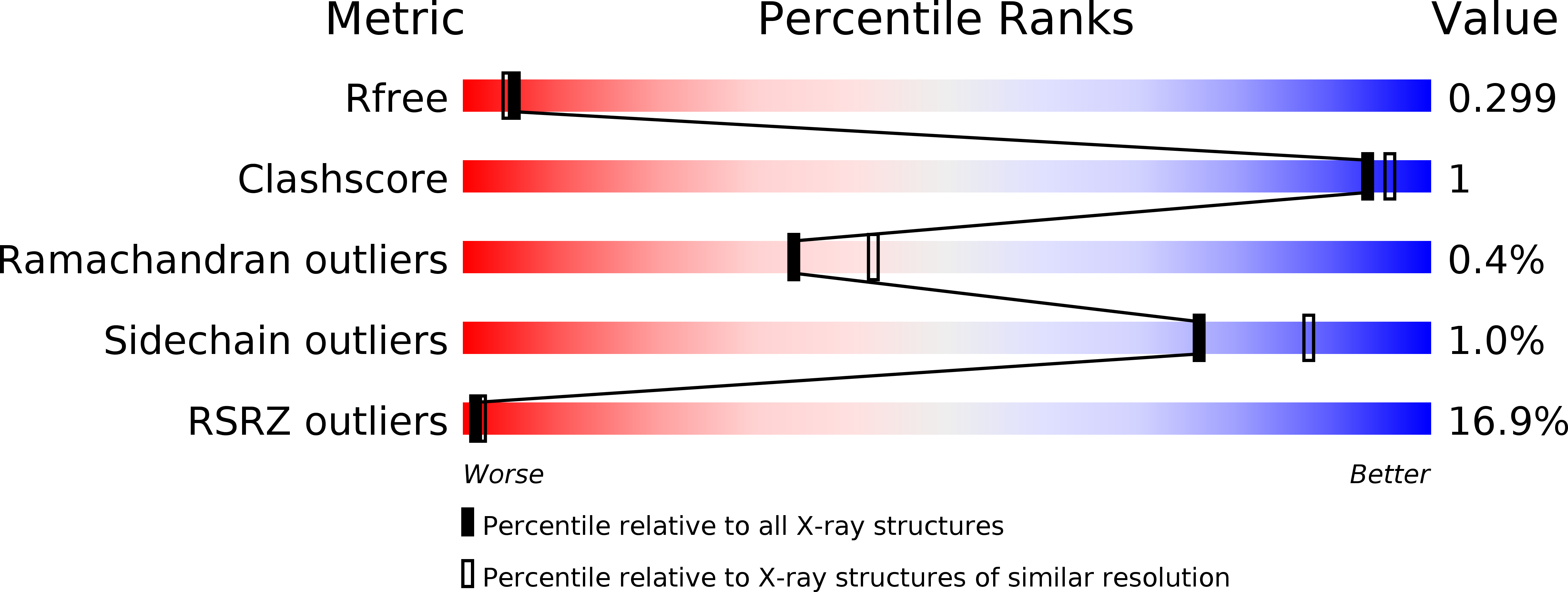
Macromolecular Entities
Structures with similar UniProt ID
Protein Blast
Polymer Type:polypeptide(L)
Molecule:Kelch repeat and BTB domain-containing protein A55
Gene (Uniprot):KBTB1
Chain IDs:A
Chain Length:259
Number of Molecules:1
Biological Source:Vaccinia virus WR
Structures with similar UniProt ID
Protein Blast
Polymer Type:polypeptide(L)
Molecule:Cullin-3
Gene (Uniprot):CUL3
Mutagens:I342R and L346D
Chain IDs:B
Chain Length:388
Number of Molecules:1
Biological Source:Homo sapiens
Ligand Molecules
Primary Citation
Molecular basis of cullin-3 (Cul3) ubiquitin ligase subversion by vaccinia virus protein A55.
J.Biol.Chem. 294 6416 6429 (2019)
PMID: 30819806 DOI: 10.1074/jbc.RA118.006561

Abstact

BTB-Kelch proteins are substrate-specific adaptors for cullin-3 (Cul3) RING-box-based E3 ubiquitin ligases, mediating protein ubiquitylation for subsequent proteasomal degradation. Vaccinia virus encodes three BTB-Kelch proteins: A55, C2, and F3. Viruses lacking A55 or C2 have altered cytopathic effects in cultured cells and altered pathology in vivo Previous studies have shown that the ectromelia virus orthologue of A55 interacts with Cul3 in cells. We report that the N-terminal BTB-BACK (BB) domain of A55 binds directly to the Cul3 N-terminal domain (Cul3-NTD), forming a 2:2 complex in solution. We solved the structure of an A55BB/Cul3-NTD complex from anisotropic crystals diffracting to 2.3/3.7 Å resolution in the best/worst direction, revealing that the overall interaction and binding interface closely resemble the structures of cellular BTB/Cul3-NTD complexes, despite low sequence identity between A55 and cellular BTB domains. Surprisingly, despite this structural similarity, the affinity of Cul3-NTD for A55BB was stronger than for cellular BTB proteins. Glutamate substitution of the A55 residue Ile-48, adjacent to the canonical φX(D/E) Cul3-binding motif, reduced affinity of A55BB for Cul3-NTD by at least 2 orders of magnitude. Moreover, Ile-48 and the φX(D/E) motif are conserved in A55 orthologues from other poxviruses, but not in the vaccinia virus proteins C2 or F3. The high-affinity interaction between A55BB and Cul3-NTD suggests that, in addition to directing the Cul3-RING E3 ligase complex to degrade cellular/viral target proteins that are normally unaffected, A55 may also sequester Cul3 from cellular adaptor proteins, thereby protecting substrates of these cellular adaptors from ubiquitylation and degradation.

Legend

Protein

Chemical

Disease

Primary Citation of related structures
Feedback Form
Name
Email
Institute
Feedback