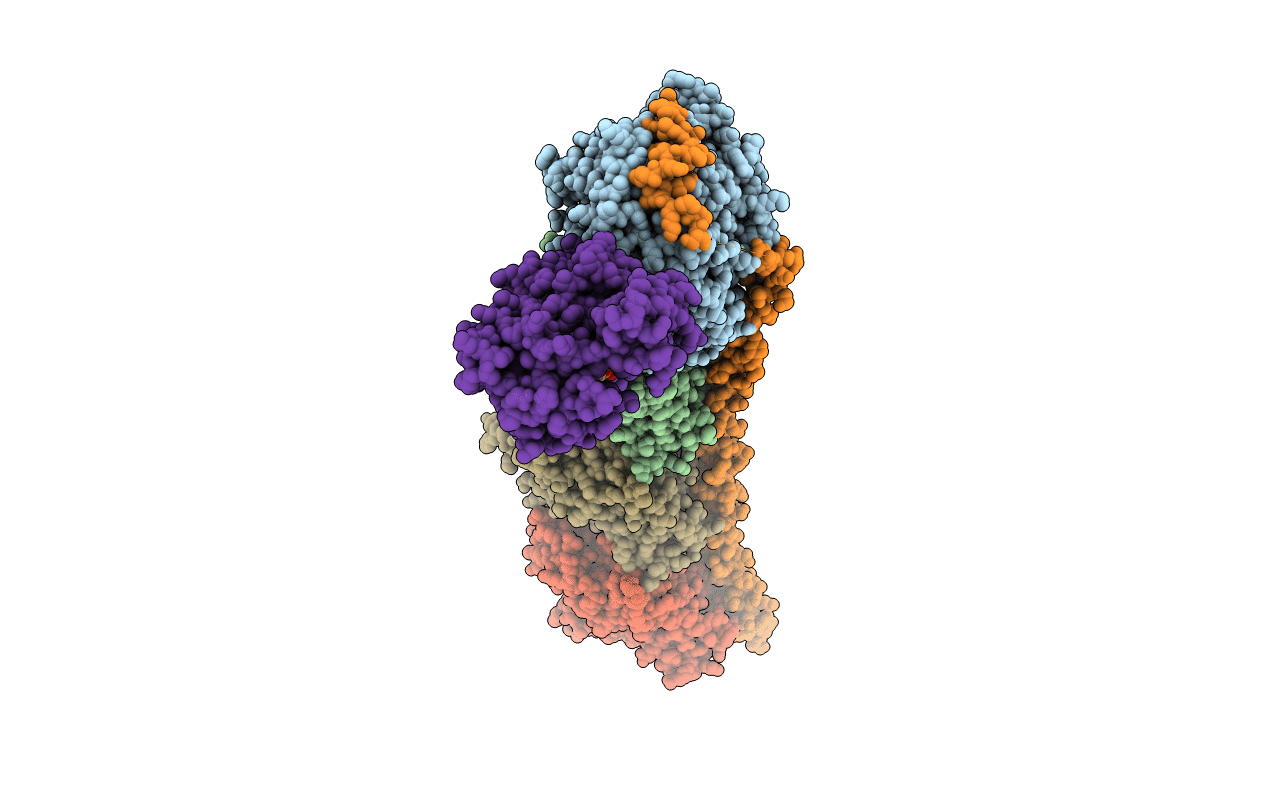
6HX8 image
Deposition Date 2018-10-16
Release Date 2019-02-27
Last Version Date 2024-01-24
Entry Detail
PDB ID:
6HX8
Keywords:
Title:
Tubulin-STX3451 complex
Biological Source:
Source Organism:
Rattus norvegicus (Taxon ID: 10116)
Gallus gallus (Taxon ID: 9031)
Bos taurus (Taxon ID: 9913)
Host Organism:
Method Details:
Experimental Method:
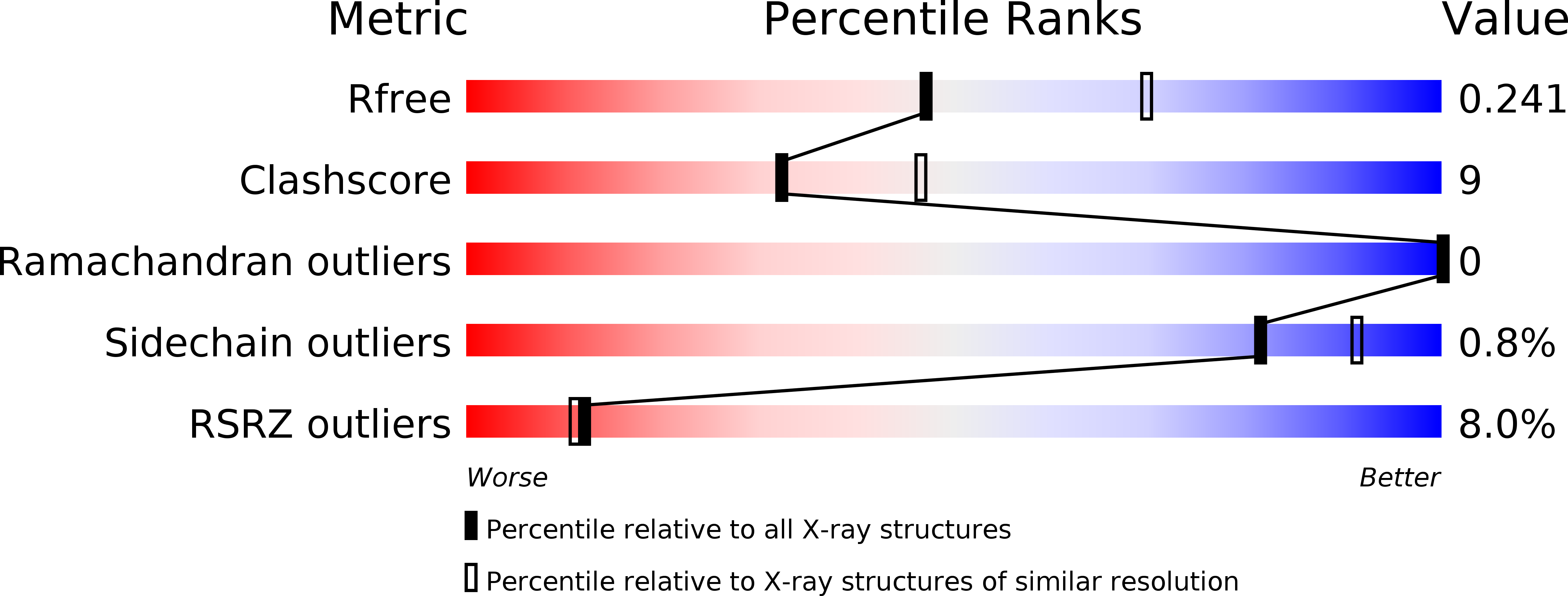
Resolution:
2.40 Å
R-Value Free:
0.24
R-Value Work:
0.19
R-Value Observed:
0.19
Space Group:
P 21 21 21
Macromolecular Entities
Structures with similar UniProt ID
Protein Blast
Polymer Type:polypeptide(L)
Molecule:Tubulin alpha-1B chain
Chain IDs:A, C
Chain Length:451
Number of Molecules:2
Biological Source:Bos taurus
Structures with similar UniProt ID
Protein Blast
Polymer Type:polypeptide(L)
Molecule:Tubulin beta-2B chain
Gene (Uniprot):TUBB2B
Chain IDs:B, D
Chain Length:445
Number of Molecules:2
Biological Source:Bos taurus
Structures with similar UniProt ID
Protein Blast
Polymer Type:polypeptide(L)
Molecule:Stathmin-4
Gene (Uniprot):Stmn4
Chain IDs:E
Chain Length:143
Number of Molecules:1
Biological Source:Rattus norvegicus
Polymer Type:polypeptide(L)
Molecule:Tubulin-Tyrosine Ligase
Chain IDs:F
Chain Length:384
Number of Molecules:1
Biological Source:Gallus gallus
Primary Citation
Tetrahydroisoquinoline Sulfamates as Potent Microtubule Disruptors: Synthesis, Antiproliferative and Antitubulin Activity of Dichlorobenzyl-Based Derivatives, and a Tubulin Cocrystal Structure.
ACS Omega 4 755 764 (2019)
PMID: 30775645 DOI: 10.1021/acsomega.8b02879

Abstact

Tetrahydroisoquinoline (THIQ) 6-O-sulfamate-based anticancer agents, inspired by the endogenous steroid 2-methoxyestradiol and its sulfamate derivatives, are further explored for antiproliferative and microtubule disruptor activity. Based on recently designed C3-methyl C7-methoxy-substituted THIQ derivatives, compounds with mono- and dichloro-substitutions on the pendant N-benzyl ring were synthesized and evaluated. Although improved antiproliferative activity was observed, for example, 4a versus 4b and 4b versus 8c, it was relatively modest. Compound 8c, a 2',5'-dichlorobenzyl derivative was, however, identified as a promising antiproliferative agent with in vitro activities exceeding that of the parent steroid (e.g., GI50 90 nM in DU-145 cells) and was highly potent against a range of tumor cell lines (e.g., GI50 26 nM for OVCAR-3). 8c inhibited the polymerization of tubulin in vitro with an IC50 only twofold less potent than combretastatin A-4 and inhibited colchicine binding to tubulin. Tubulin polymerization assays showed the parent THIQ 4a to be only a very weak inhibitor, but a striking potency difference was seen between compounds with C2' methoxy and chloro substituents, whereas this was much smaller when these substituents were positioned at C5'. To confirm the target in atomic detail and because 8c is a racemic mixture, an achiral parent THIQ 6-O-sulfamate derivative 10 was successfully cocrystallized with the αβ-tubulin heterodimer. The derivative 10 binds at the colchicine site on tubulin, the first example of this compound class investigated in such detail, with its sulfamate group interacting with residues beyond the reach of colchicine itself, similar to a recently reported quinazolinone sulfamate derivative, 6a. The structure also suggests that for racemic C3-methyl-substituted THIQ derivatives, such as 8c, the (S)-enantiomer is likely to be preferentially accommodated within the colchicine site for steric reasons. The results further confirm the potential of nonsteroidal THIQ sulfamate derivatives for oncology and suggest that the mechanism of microtubule destabilization for the THIQ compound class is to prevent the curved-to-straight conformational transition of tubulin required for polymerization.

Legend

Protein

Chemical

Disease

Primary Citation of related structures
Feedback Form
Name
Email
Institute
Feedback