6HP7 image
Deposition Date 2018-09-19
Release Date 2019-02-13
Last Version Date 2024-05-15
Entry Detail
PDB ID:
6HP7
Title:
ARBITRIUM PEPTIDE RECEPTOR FROM SPBETA PHAGE in complex with 43 mer DNA
Biological Source:
Source Organism(s):
Expression System(s):
Method Details:
Experimental Method:
Resolution:
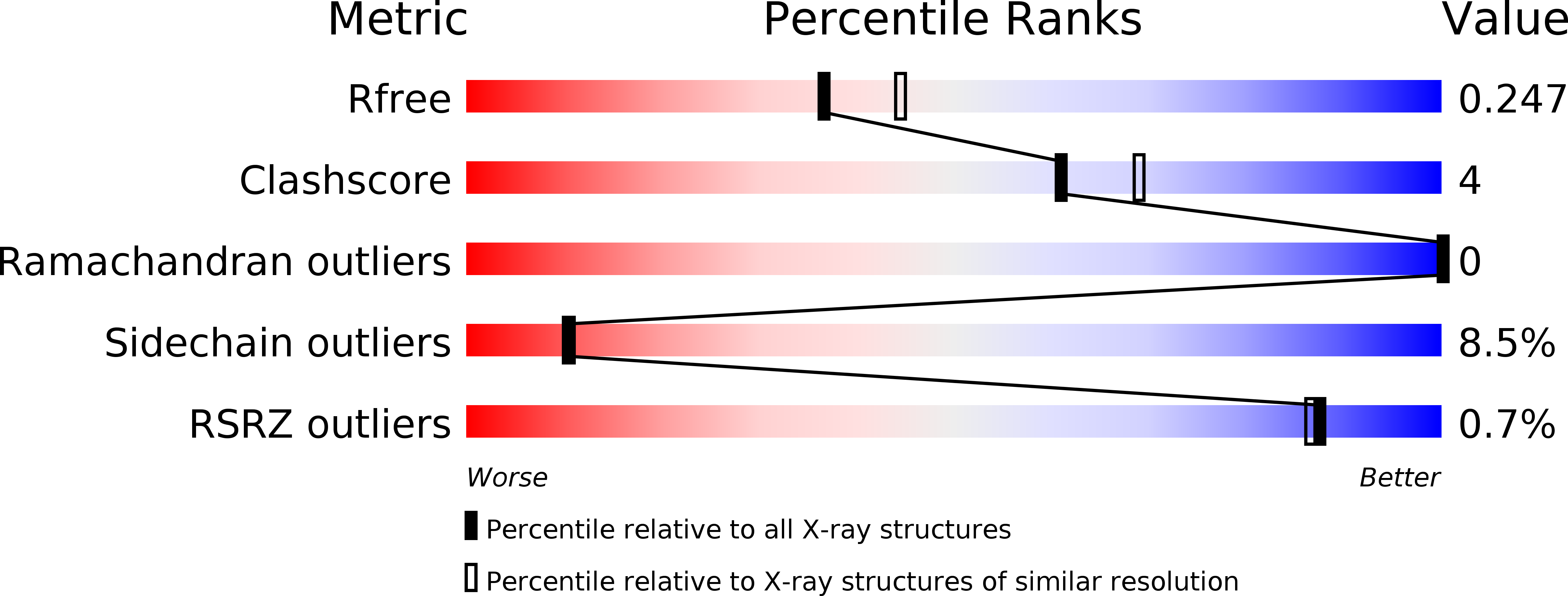
2.20 Å
R-Value Free:
0.24
R-Value Work:
0.21
R-Value Observed:
0.21
Space Group:
I 41 2 2
Macromolecular Entities
Structures with similar UniProt ID
Protein Blast
Polymer Type:polypeptide(L)
Molecule:SPBc2 prophage-derived uncharacterized protein YopK
Gene (Uniprot):yopK
Chain IDs:A, B
Chain Length:386
Number of Molecules:2
Biological Source:Bacillus subtilis (strain 168)
Polymer Type:polydeoxyribonucleotide
Molecule:DNA (43-MER)
Chain IDs:C
Chain Length:43
Number of Molecules:1
Biological Source:Bacillus phage SPbeta
Polymer Type:polydeoxyribonucleotide
Molecule:DNA (43-MER)
Chain IDs:D
Chain Length:43
Number of Molecules:1
Biological Source:Bacillus phage SPbeta
Ligand Molecules
Primary Citation
Deciphering the Molecular Mechanism Underpinning Phage Arbitrium Communication Systems.
Mol.Cell 74 59 72.e3 (2019)
PMID: 30745087 DOI: 10.1016/j.molcel.2019.01.025

Abstact

Bacillus phages use a communication system, termed "arbitrium," to coordinate lysis-lysogeny decisions. Arbitrium communication is mediated by the production and secretion of a hexapeptide (AimP) during lytic cycle. Once internalized, AimP reduces the expression of the negative regulator of lysogeny, AimX, by binding to the transcription factor, AimR, promoting lysogeny. We have elucidated the crystal structures of AimR from the Bacillus subtilis SPbeta phage in its apo form, bound to its DNA operator and in complex with AimP. AimR presents intrinsic plasticity, sharing structural features with the RRNPP quorum-sensing family. Remarkably, AimR binds to an unusual operator with a long spacer that interacts nonspecifically with the receptor TPR domain, while the HTH domain canonically recognizes two inverted repeats. AimP stabilizes a compact conformation of AimR that approximates the DNA-recognition helices, preventing AimR binding to the aimX promoter region. Our results establish the molecular basis of the arbitrium communication system.

Legend

Protein

Chemical

Disease

Primary Citation of related structures
Feedback Form
Name
Email
Institute
Feedback