6H8J image
Deposition Date 2018-08-02
Release Date 2019-06-12
Last Version Date 2024-01-17
Entry Detail
PDB ID:
6H8J
Keywords:
Title:
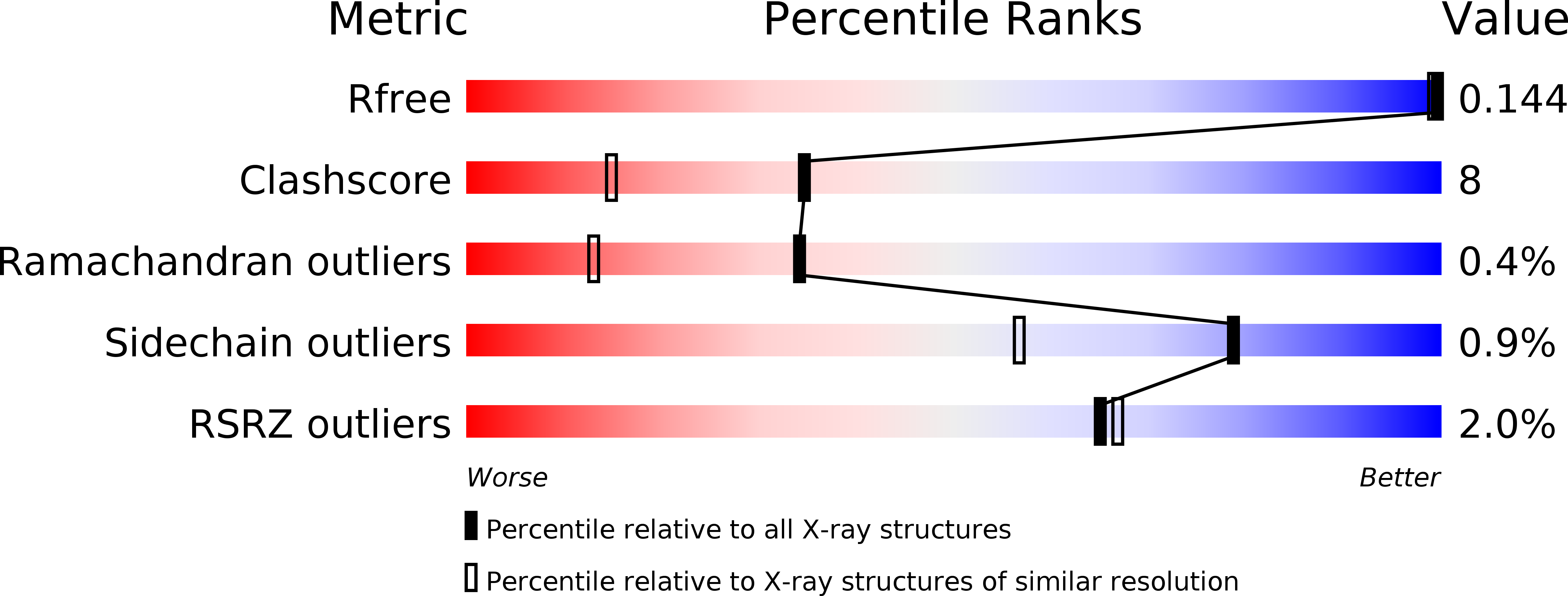
1.45 A resolution of Sporosarcina pasteurii urease inhibited in the presence of NBPTO
Biological Source:
Source Organism:
Method Details:
Experimental Method:
Resolution:
1.45 Å
R-Value Free:
0.14
R-Value Work:
0.12
R-Value Observed:
0.12
Space Group:
P 63 2 2
Macromolecular Entities
Structures with similar UniProt ID
Protein Blast
Polymer Type:polypeptide(L)
Molecule:Urease subunit gamma
Chain IDs:A
Chain Length:100
Number of Molecules:1
Biological Source:Sporosarcina pasteurii
Structures with similar UniProt ID
Protein Blast
Polymer Type:polypeptide(L)
Molecule:Urease subunit beta
Gene (Uniprot):ureB
Chain IDs:B
Chain Length:122
Number of Molecules:1
Biological Source:Sporosarcina pasteurii
Structures with similar UniProt ID
Protein Blast
Polymer Type:polypeptide(L)
Molecule:Urease subunit alpha
Chain IDs:C
Chain Length:570
Number of Molecules:1
Biological Source:Sporosarcina pasteurii
Modified Residue
Compound ID Chain ID Parent Comp ID Details 2D Image
CXM A ? modified residue
KCX C LYS modified residue
Primary Citation
Insights into Urease Inhibition by N-( n-Butyl) Phosphoric Triamide through an Integrated Structural and Kinetic Approach.
J.Agric.Food Chem. 67 2127 2138 (2019)
PMID: 30735374 DOI: 10.1021/acs.jafc.8b04791

Abstact

The nickel-dependent enzyme urease represents a negative element for the efficiency of soil nitrogen fertilization as well as a virulence factor for a large number of pathogenic and antibiotic-resistant bacteria. The development of ever more efficient urease inhibitors demands knowledge of their modes of action at the molecular level. N-(n-Butyl)-phosphoric triamide (NBPTO) is the oxo-derivative of N-(n-butyl)-thiophosphoric triamide (NBPT), which is extensively employed in agriculture to increase the efficiency of urea-based fertilizers. The 1.45 Å resolution structure of the enzyme-inhibitor complex obtained upon incubation of Sporosarcina pasteurii urease (SPU) with NBPTO shows the presence of diamido phosphoric acid (DAP), generated upon enzymatic hydrolysis of NBPTO with the release of n-butyl amine. DAP is bound in a tridentate binding mode to the two Ni(II) ions in the active site of urease via two O atoms and an amide NH2 group, whereas the second amide group of DAP points away from the metal center into the active-site channel. The mobile flap modulating the size of the active-site cavity is found in a disordered closed-open conformation. A kinetic characterization of the NBPTO-based inhibition of both bacterial (SPU) and plant (Canavalia ensiformis or jack bean, JBU) ureases, carried out by calorimetric measurements, indicates the occurrence of a reversible slow-inhibition mode of action. The latter is characterized by a very small value of the equilibrium dissociation constant of the urease-DAP complex caused, in turn, by the large rate constant for the formation of the enzyme-inhibitor complex. The much greater capability of NBPTO to inhibit urease, as compared with that of NBPT, is thus not caused by the presence of a P═O moiety versus a P═S moiety, as previously suggested, but rather by the readiness of NBPTO to react with urease without the need to convert one of the P-NH2 amide moieties to its P-OH acid derivative, as in the case of NBPT. The latter process is indeed characterized by a very small equilibrium constant that reduces drastically the concentration of the active form of the inhibitor in the case of NBPT. This indicates that high-efficiency phosphoramide-based urease inhibitors must have at least one O atom bound to the central P atom in order for the molecule to efficiently and rapidly bind to the dinickel center of the enzyme.

Legend

Protein

Chemical

Disease

Primary Citation of related structures
Feedback Form
Name
Email
Institute
Feedback