6GPU image
Deposition Date 2018-06-07
Release Date 2019-02-27
Last Version Date 2024-01-17
Entry Detail
PDB ID:
6GPU
Keywords:
Title:
Crystal structure of miniSOG at 1.17A resolution
Biological Source:
Source Organism:
Host Organism:
Method Details:
Experimental Method:
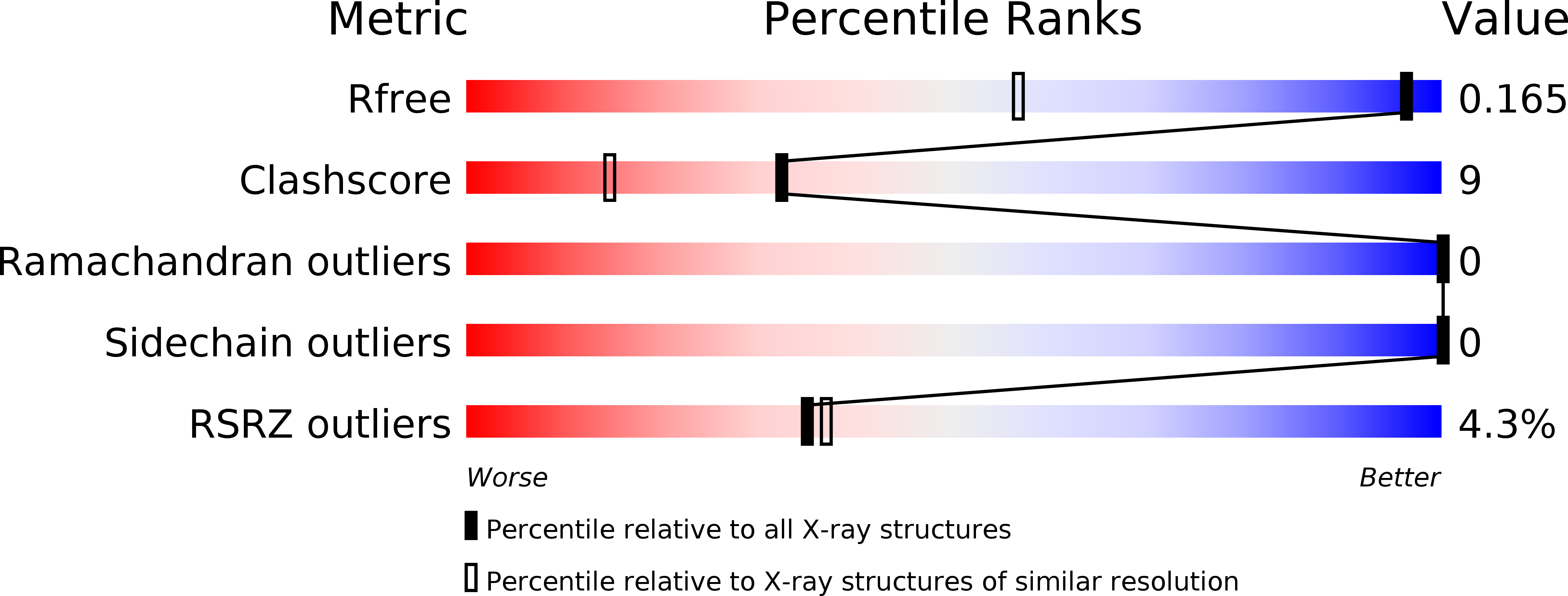
Resolution:
1.17 Å
R-Value Free:
0.16
R-Value Work:
0.13
R-Value Observed:
0.13
Space Group:
P 43 21 2
Macromolecular Entities
Structures with similar UniProt ID
Protein Blast
Polymer Type:polypeptide(L)
Molecule:Phototropin-2
Gene (Uniprot):PHOT2
Chain IDs:A
Chain Length:115
Number of Molecules:1
Biological Source:Arabidopsis thaliana
Primary Citation
Tailing miniSOG: structural bases of the complex photophysics of a flavin-binding singlet oxygen photosensitizing protein.
Sci Rep 9 2428 2428 (2019)
PMID: 30787421 DOI: 10.1038/s41598-019-38955-3

Abstact

miniSOG is the first flavin-binding protein that has been developed with the specific aim of serving as a genetically-encodable light-induced source of singlet oxygen (1O2). We have determined its 1.17 Å resolution structure, which has allowed us to investigate its mechanism of photosensitization using an integrated approach combining spectroscopic and structural methods. Our results provide a structural framework to explain the ability of miniSOG to produce 1O2 as a competition between oxygen- and protein quenching of its triplet state. In addition, a third excited-state decay pathway has been identified that is pivotal for the performance of miniSOG as 1O2 photosensitizer, namely the photo-induced transformation of flavin mononucleotide (FMN) into lumichrome, which increases the accessibility of oxygen to the flavin FMN chromophore and makes protein quenching less favourable. The combination of the two effects explains the increase in the 1O2 quantum yield by one order of magnitude upon exposure to blue light. Besides, we have identified several surface electron-rich residues that are progressively photo-oxidized, further contributing to facilitate the production of 1O2. Our results help reconcile the apparent poor level of 1O2 generation by miniSOG and its excellent performance in correlative light and electron microscopy experiments.

Legend

Protein

Chemical

Disease

Primary Citation of related structures
Feedback Form
Name
Email
Institute
Feedback