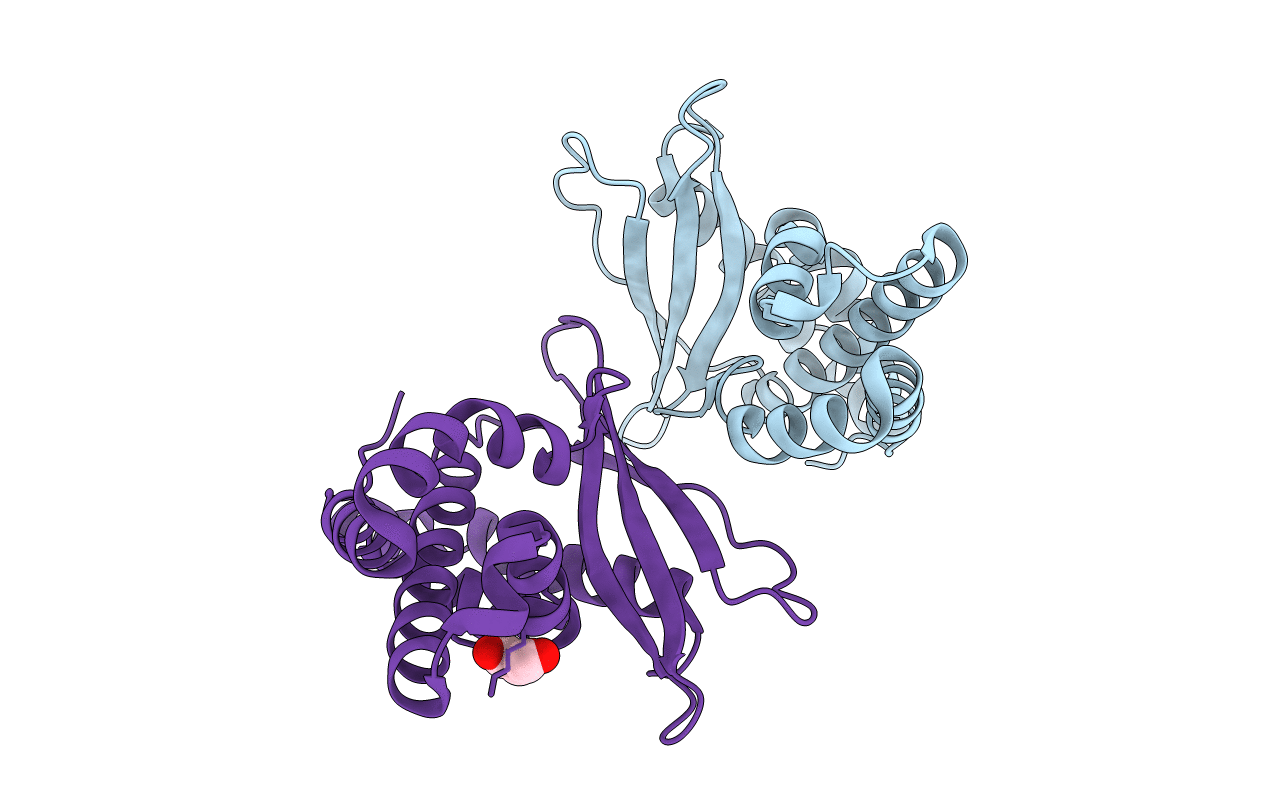
6GKI image
Deposition Date 2018-05-21
Release Date 2019-04-17
Last Version Date 2024-01-17
Entry Detail
PDB ID:
6GKI
Keywords:
Title:
Structure of E coli MlaC in Variously Loaded States
Biological Source:
Source Organism:
Host Organism:
Method Details:
Experimental Method:
Resolution:
2.23 Å
R-Value Free:
0.23
R-Value Work:
0.19
R-Value Observed:
0.19
Space Group:
P 31 2 1
Macromolecular Entities
Structures with similar UniProt ID
Protein Blast
Polymer Type:polypeptide(L)
Molecule:Probable phospholipid-binding protein MlaC
Gene (Uniprot):mlaC
Chain IDs:A, B
Chain Length:198
Number of Molecules:2
Biological Source:Escherichia coli K-12
Primary Citation
Evidence for phospholipid export from the bacterial inner membrane by the Mla ABC transport system.
Nat Microbiol 4 1692 1705 (2019)
PMID: 31235958 DOI: 10.1038/s41564-019-0481-y

Abstact

The Mla pathway is believed to be involved in maintaining the asymmetrical Gram-negative outer membrane via retrograde phospholipid transport. The pathway is composed of three components: the outer membrane MlaA-OmpC/F complex, a soluble periplasmic protein, MlaC, and the inner membrane ATPase, MlaFEDB complex. Here, we solve the crystal structure of MlaC in its phospholipid-free closed apo conformation, revealing a pivoting β-sheet mechanism that functions to open and close the phospholipid-binding pocket. Using the apo form of MlaC, we provide evidence that the inner-membrane MlaFEDB machinery exports phospholipids to MlaC in the periplasm. Furthermore, we confirm that the phospholipid export process occurs through the MlaD component of the MlaFEDB complex and that this process is independent of ATP. Our data provide evidence of an apparatus for lipid export away from the inner membrane and suggest that the Mla pathway may have a role in anterograde phospholipid transport.

Legend

Protein

Chemical

Disease

Primary Citation of related structures
Feedback Form
Name
Email
Institute
Feedback