6GFI image
Deposition Date 2018-04-30
Release Date 2018-09-12
Last Version Date 2024-11-13
Entry Detail
PDB ID:
6GFI
Keywords:
Title:
Structure of Human Mesotrypsin in complex with APPI variant T11V/M17R/I18F/F34V
Biological Source:
Source Organism:
Homo sapiens (Taxon ID: 9606)
Method Details:
Experimental Method:
Resolution:
2.30 Å
R-Value Free:
0.30
R-Value Work:
0.24
R-Value Observed:
0.24
Space Group:
P 31
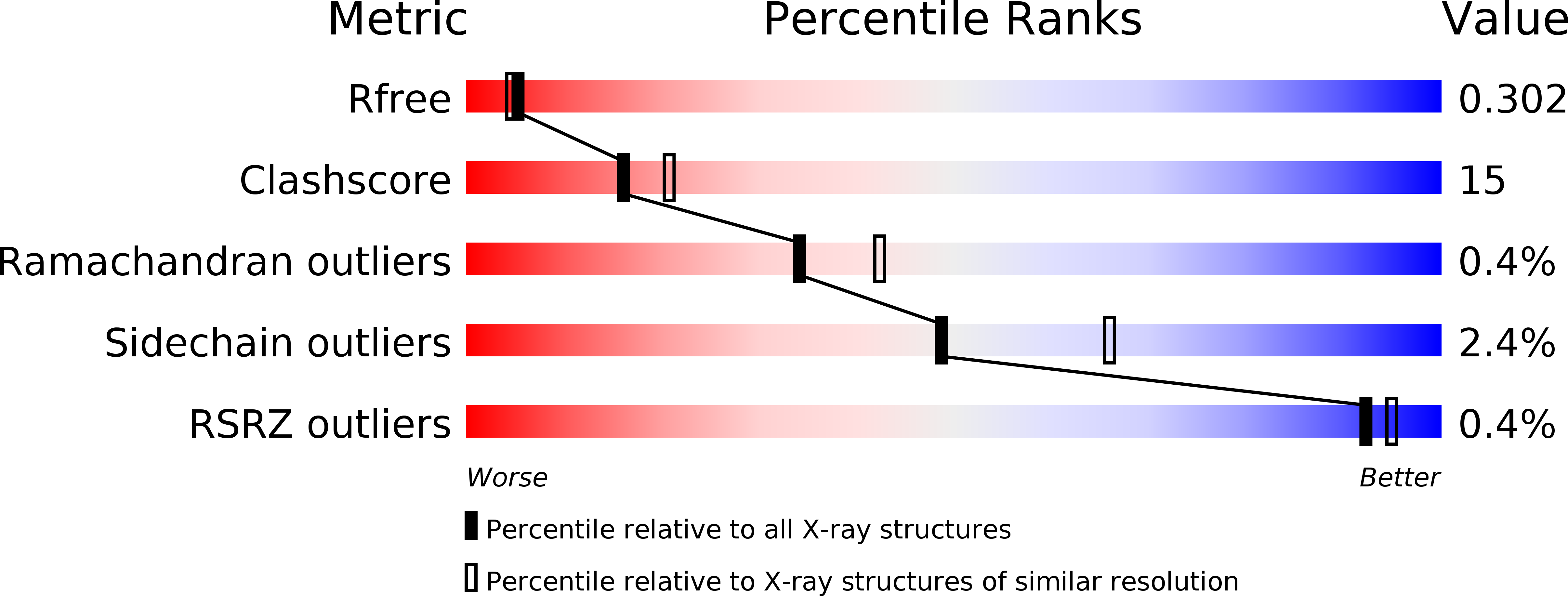
Macromolecular Entities
Structures with similar UniProt ID
Protein Blast
Polymer Type:polypeptide(L)
Molecule:PRSS3 protein
Chain IDs:A, C (auth: B)
Chain Length:224
Number of Molecules:2
Biological Source:Homo sapiens
Structures with similar UniProt ID
Protein Blast
Polymer Type:polypeptide(L)
Molecule:Amyloid-beta A4 protein
Gene (Uniprot):APP
Chain IDs:B (auth: E), D (auth: C)
Chain Length:81
Number of Molecules:2
Biological Source:Homo sapiens
Ligand Molecules
Primary Citation
Mapping protein selectivity landscapes using multi-target selective screening and next-generation sequencing of combinatorial libraries.
Nat Commun 9 3935 3935 (2018)
PMID: 30258049 DOI: 10.1038/s41467-018-06403-x

Abstact

Characterizing the binding selectivity landscape of interacting proteins is crucial both for elucidating the underlying mechanisms of their interaction and for developing selective inhibitors. However, current mapping methods are laborious and cannot provide a sufficiently comprehensive description of the landscape. Here, we introduce a novel and efficient strategy for comprehensively mapping the binding landscape of proteins using a combination of experimental multi-target selective library screening and in silico next-generation sequencing analysis. We map the binding landscape of a non-selective trypsin inhibitor, the amyloid protein precursor inhibitor (APPI), to each of the four human serine proteases (kallikrein-6, mesotrypsin, and anionic and cationic trypsins). We then use this map to dissect and improve the affinity and selectivity of APPI variants toward each of the four proteases. Our strategy can be used as a platform for the development of a new generation of target-selective probes and therapeutic agents based on selective protein-protein interactions.

Legend

Protein

Chemical

Disease

Primary Citation of related structures
Feedback Form
Name
Email
Institute
Feedback