6FWW image
Deposition Date 2018-03-07
Release Date 2018-08-01
Last Version Date 2024-11-13
Entry Detail
PDB ID:
6FWW
Title:
GFP/KKK. A redesigned GFP with improved solubility
Biological Source:
Source Organism:
Host Organism:
Method Details:
Experimental Method:
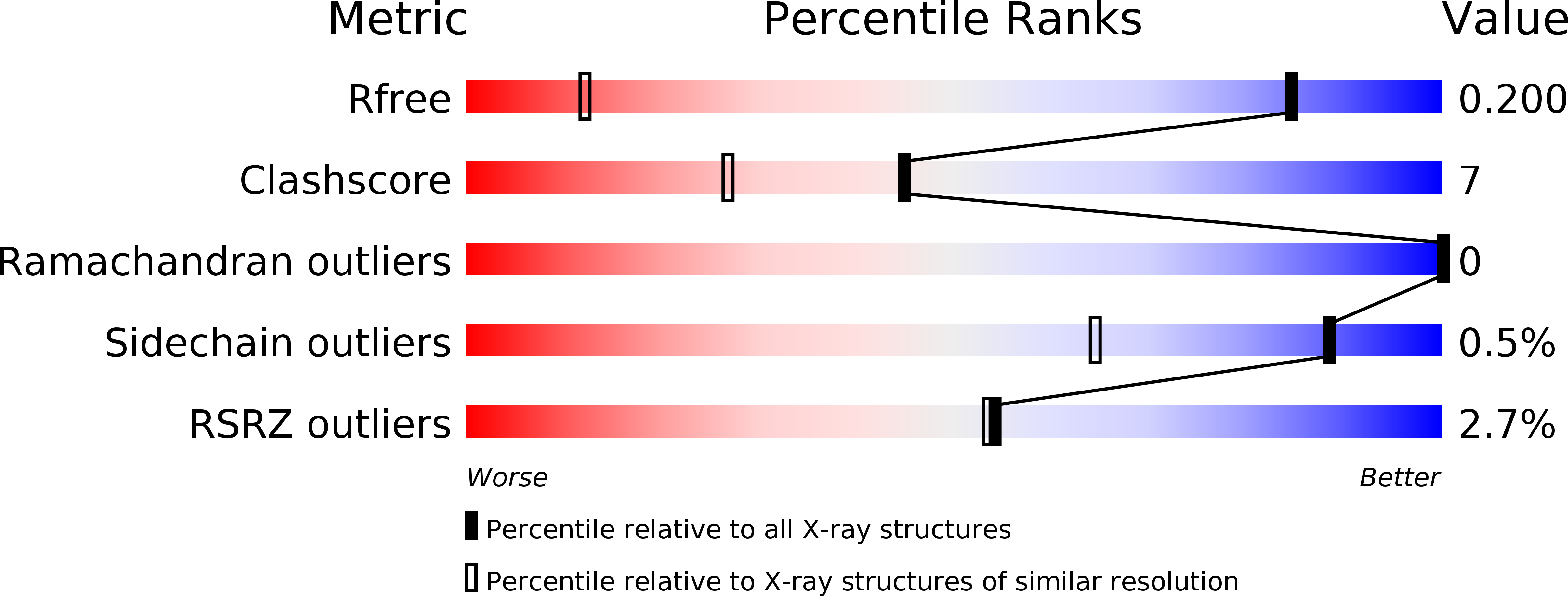
Resolution:
1.13 Å
R-Value Free:
0.20
R-Value Work:
0.18
R-Value Observed:
0.18
Space Group:
P 21 21 21
Macromolecular Entities
Structures with similar UniProt ID
Protein Blast
Polymer Type:polypeptide(L)
Molecule:Green fluorescent protein
Gene (Uniprot):GFP
Mutagens:V11K, Y39K, F64L, F99S, M153T, V163A, L221K
Chain IDs:A
Chain Length:266
Number of Molecules:1
Biological Source:Aequorea victoria
Modified Residue
Compound ID Chain ID Parent Comp ID Details 2D Image
CRO A GLY chromophore
Primary Citation
Combining Structural Aggregation Propensity and Stability Predictions To Redesign Protein Solubility.
Mol. Pharm. 15 3846 3859 (2018)
PMID: 30036481 DOI: 10.1021/acs.molpharmaceut.8b00341

Abstact

The aggregation propensity of each particular protein seems to be shaped by evolution according to its natural abundance in the cell. The production and downstream processing of recombinant polypeptides implies attaining concentrations that are orders of magnitude above their natural levels, often resulting in their aggregation; a phenomenon that precludes the marketing of many globular proteins for biomedical or biotechnological applications. Therefore, there is a huge interest in methods aimed to increase the proteins solubility above their natural limits. Here, we demonstrate that an updated version of our AGGRESCAN 3D structural aggregation predictor, that now takes into account protein stability, allows for designing mutations at specific positions in the structure that improve the solubility of proteins without compromising their conformation. Using this approach, we have designed a highly soluble variant of the green fluorescent protein and a human single-domain VH antibody displaying significantly reduced aggregation propensity. Overall, our data indicate that the solubility of unrelated proteins can be easily tuned by in silico-designed nondestabilizing amino acid changes at their surfaces.

Legend

Protein

Chemical

Disease

Primary Citation of related structures
Feedback Form
Name
Email
Institute
Feedback