6FWR image
Deposition Date 2018-03-07
Release Date 2018-12-19
Last Version Date 2024-05-08
Entry Detail
PDB ID:
6FWR
Title:
Structure of DinG in complex with ssDNA
Biological Source:
Source Organism:
Host Organism:
Method Details:
Experimental Method:
Resolution:
2.50 Å
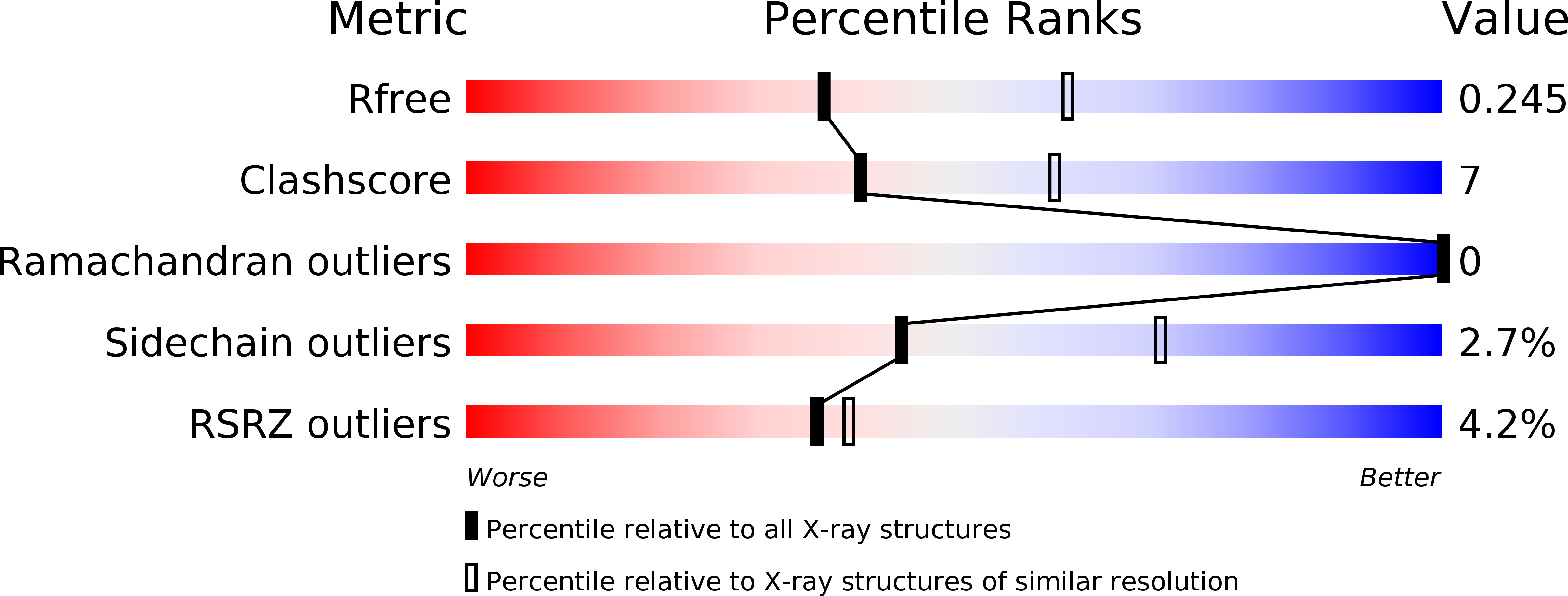
R-Value Free:
0.24
R-Value Work:
0.21
R-Value Observed:
0.21
Space Group:
P 21 21 2
Macromolecular Entities
Structures with similar UniProt ID
Protein Blast
Polymer Type:polypeptide(L)
Molecule:ATP-dependent DNA helicase DinG
Chain IDs:A
Chain Length:716
Number of Molecules:1
Biological Source:Escherichia coli
Polymer Type:polydeoxyribonucleotide
Molecule:DNA (5'-D(*TP*TP*TP*TP*TP*TP*TP*TP*TP*TP*T)-3')
Chain IDs:B
Chain Length:11
Number of Molecules:1
Biological Source:synthetic construct
Ligand Molecules
Primary Citation
DNA translocation mechanism of an XPD family helicase.
Elife 7 ? ? (2018)
PMID: 30520735 DOI: 10.7554/eLife.42400

Abstact

The XPD family of helicases, that includes human disease-related FANCJ, DDX11 and RTEL1, are Superfamily two helicases that contain an iron-sulphur cluster domain, translocate on ssDNA in a 5'-3' direction and play important roles in genome stability. Consequently, mutations in several of these family members in eukaryotes cause human diseases. Family members in bacteria, such as the DinG helicase from Escherichia coli, are also involved in DNA repair. Here we present crystal structures of complexes of DinG bound to single-stranded DNA (ssDNA) in the presence and absence of an ATP analogue (ADP•BeF3), that suggest a mechanism for 5'-3' translocation along the ssDNA substrate. This proposed mechanism has implications for how those enzymes of the XPD family that recognise bulky DNA lesions might stall at these as the first step in initiating DNA repair. Biochemical data reveal roles for conserved residues that are mutated in human diseases.

Legend

Protein

Chemical

Disease

Primary Citation of related structures
Feedback Form
Name
Email
Institute
Feedback