6F3T image
Deposition Date 2017-11-28
Release Date 2018-12-05
Last Version Date 2024-10-23
Entry Detail
PDB ID:
6F3T
Keywords:
Title:
Crystal structure of the human TAF5-TAF6-TAF9 complex
Biological Source:
Source Organism:
Homo sapiens (Taxon ID: 9606)
Method Details:
Experimental Method:
Resolution:
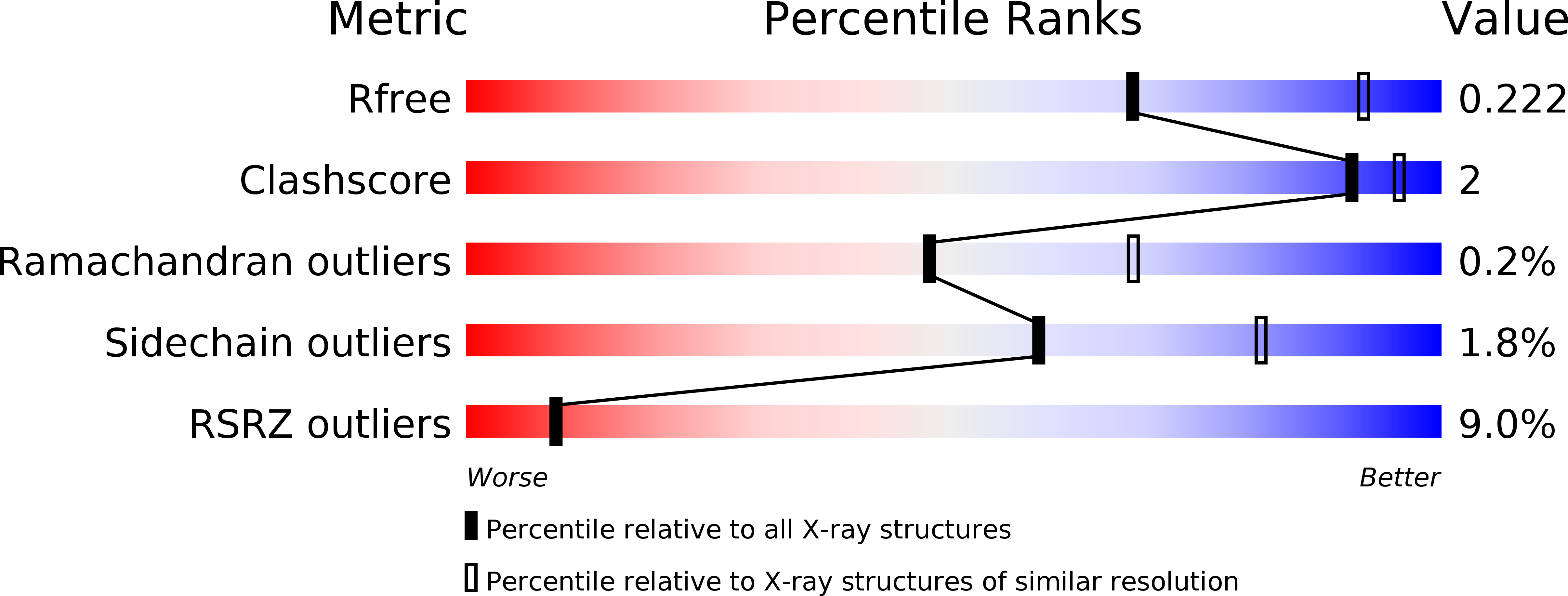
2.50 Å
R-Value Free:
0.22
R-Value Work:
0.19
R-Value Observed:
0.19
Space Group:
I 2 3
Macromolecular Entities
Structures with similar UniProt ID
Protein Blast
Polymer Type:polypeptide(L)
Molecule:Transcription initiation factor TFIID subunit 5
Gene (Uniprot):TAF5
Chain IDs:A, B, C, D
Chain Length:608
Number of Molecules:4
Biological Source:Homo sapiens
Structures with similar UniProt ID
Protein Blast
Polymer Type:polypeptide(L)
Molecule:Transcription initiation factor TFIID subunit 6
Gene (Uniprot):TAF6
Chain IDs:E, G, I, K
Chain Length:94
Number of Molecules:4
Biological Source:Homo sapiens
Structures with similar UniProt ID
Protein Blast
Polymer Type:polypeptide(L)
Molecule:Transcription initiation factor TFIID subunit 9
Gene (Uniprot):TAF9
Chain IDs:F, H, J, L
Chain Length:116
Number of Molecules:4
Biological Source:Homo sapiens
Modified Residue
Compound ID Chain ID Parent Comp ID Details 2D Image
SEP F SER modified residue
Ligand Molecules
Primary Citation
Chaperonin CCT checkpoint function in basal transcription factor TFIID assembly.
Nat. Struct. Mol. Biol. 25 1119 1127 (2018)
PMID: 30510221 DOI: 10.1038/s41594-018-0156-z

Abstact

TFIID is a cornerstone of eukaryotic gene regulation. Distinct TFIID complexes with unique subunit compositions exist and several TFIID subunits are shared with other complexes, thereby conveying precise cellular control of subunit allocation and functional assembly of this essential transcription factor. However, the molecular mechanisms that underlie the regulation of TFIID remain poorly understood. Here we use quantitative proteomics to examine TFIID submodules and assembly mechanisms in human cells. Structural and mutational analysis of the cytoplasmic TAF5-TAF6-TAF9 submodule identified novel interactions that are crucial for TFIID integrity and for allocation of TAF9 to TFIID or the Spt-Ada-Gcn5 acetyltransferase (SAGA) co-activator complex. We discover a key checkpoint function for the chaperonin CCT, which specifically associates with nascent TAF5 for subsequent handover to TAF6-TAF9 and ultimate holo-TFIID formation. Our findings illustrate at the molecular level how multisubunit complexes are generated within the cell via mechanisms that involve checkpoint decisions facilitated by a chaperone.

Legend

Protein

Chemical

Disease

Primary Citation of related structures
Feedback Form
Name
Email
Institute
Feedback