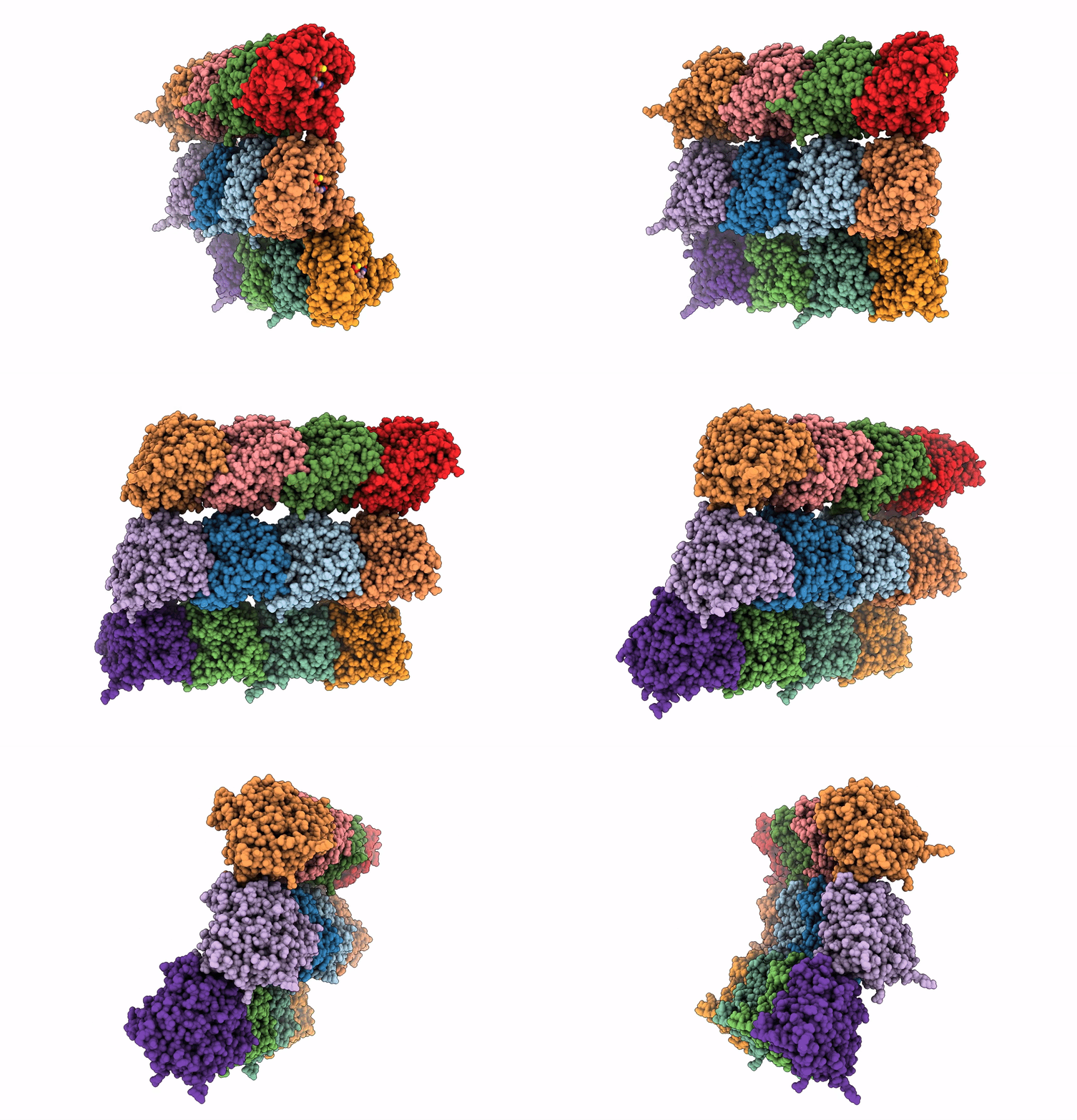
6EVY image
Deposition Date 2017-11-03
Release Date 2018-07-04
Last Version Date 2024-05-15
Entry Detail
PDB ID:
6EVY
Title:
Cryo-EM structure of GTPgammaS-microtubule co-polymerised with doublecortin
Biological Source:
Source Organism:
Sus scrofa (Taxon ID: 9823)
Method Details:
Experimental Method:
Resolution:
4.40 Å
Aggregation State:
FILAMENT
Reconstruction Method:
SINGLE PARTICLE
Macromolecular Entities
Structures with similar UniProt ID
Protein Blast
Polymer Type:polypeptide(L)
Molecule:Tubulin alpha-1B chain
Gene (Uniprot):TUBA1B
Chain IDs:A (auth: E), C (auth: J), D (auth: C), E (auth: L), F (auth: A), G (auth: K)
Chain Length:451
Number of Molecules:6
Biological Source:Sus scrofa
Structures with similar UniProt ID
Protein Blast
Polymer Type:polypeptide(L)
Molecule:Tubulin beta chain
Chain IDs:B (auth: F), H (auth: G), I (auth: D), J (auth: I), K (auth: B), L (auth: H)
Chain Length:445
Number of Molecules:6
Biological Source:Sus scrofa
Primary Citation
The role of tubulin-tubulin lattice contacts in the mechanism of microtubule dynamic instability.
Nat. Struct. Mol. Biol. 25 607 615 (2018)
PMID: 29967541 DOI: 10.1038/s41594-018-0087-8

Abstact

Microtubules form from longitudinally and laterally assembling tubulin α-β dimers. The assembly induces strain in tubulin, resulting in cycles of microtubule catastrophe and regrowth. This 'dynamic instability' is governed by GTP hydrolysis that renders the microtubule lattice unstable, but it is unclear how. We used a human microtubule nucleating and stabilizing neuronal protein, doublecortin, and high-resolution cryo-EM to capture tubulin's elusive hydrolysis intermediate GDP•Pi state, alongside the prehydrolysis analog GMPCPP state and the posthydrolysis GDP state with and without an anticancer drug, Taxol. GTP hydrolysis to GDP•Pi followed by Pi release constitutes two distinct structural transitions, causing unevenly distributed compressions of tubulin dimers, thereby tightening longitudinal and loosening lateral interdimer contacts. We conclude that microtubule catastrophe is triggered because the lateral contacts can no longer counteract the strain energy stored in the lattice, while reinforcement of the longitudinal contacts may support generation of force.

Legend

Protein

Chemical

Disease

Primary Citation of related structures
Feedback Form
Name
Email
Institute
Feedback