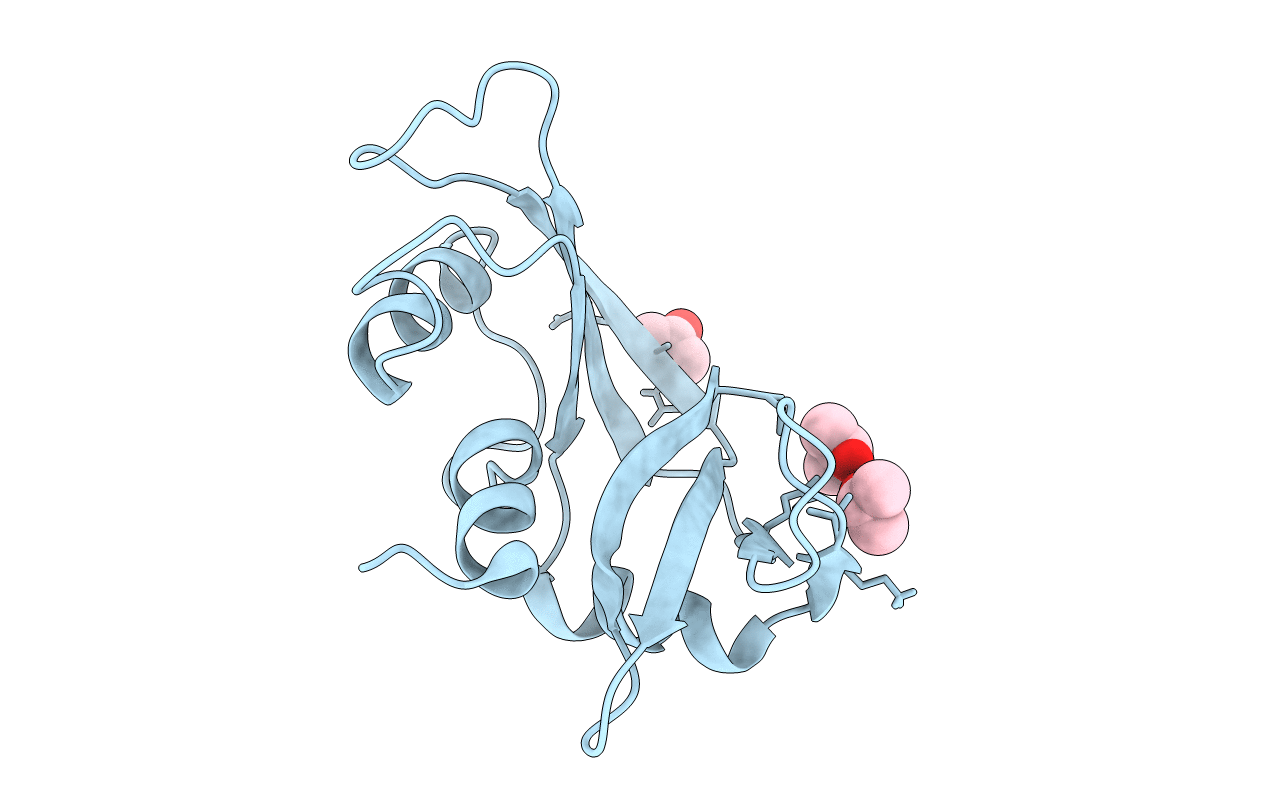
6ETO image
Deposition Date 2017-10-27
Release Date 2018-02-21
Last Version Date 2024-11-13
Entry Detail
PDB ID:
6ETO
Keywords:
Title:
Atomic resolution structure of RNase A (data collection 5)
Biological Source:
Source Organism:
Bos taurus (Taxon ID: 9913)
Method Details:
Experimental Method:
Resolution:
1.02 Å
R-Value Free:
0.16
R-Value Work:
0.13
R-Value Observed:
0.13
Space Group:
P 1 21 1

Macromolecular Entities
Structures with similar UniProt ID
Protein Blast
Polymer Type:polypeptide(L)
Molecule:Ribonuclease pancreatic
Gene (Uniprot):RNASE1
Chain IDs:A
Chain Length:124
Number of Molecules:1
Biological Source:Bos taurus
Ligand Molecules
Primary Citation
The Alkylquinolone Repertoire of Pseudomonas aeruginosa is Linked to Structural Flexibility of the FabH-like 2-Heptyl-3-hydroxy-4(1H)-quinolone (PQS) Biosynthesis Enzyme PqsBC.
Chembiochem ? ? ? (2018)
PMID: 29722462 DOI: 10.1002/cbic.201800153

Abstact

Pseudomonas aeruginosa is a bacterial pathogen that causes life-threatening infections in immunocompromised patients. It produces a large armory of saturated and mono-unsaturated 2-alkyl-4(1H)-quinolones (AQs) and AQ N-oxides (AQNOs) that serve as signaling molecules to control the production of virulence factors and that are involved in membrane vesicle formation and iron chelation; furthermore, they also have, for example, antibiotic properties. It has been shown that the β-ketoacyl-acyl-carrier protein synthase III (FabH)-like heterodimeric enzyme PqsBC catalyzes the last step in the biosynthesis of the most abundant AQ congener, 2-heptyl-4(1H)-quinolone (HHQ), by condensing octanoyl-coenzyme A (CoA) with 2-aminobenzoylacetate (2-ABA), but the basis for the large number of other AQs/AQNOs produced by P. aeruginosa is not known. Here, we demonstrate that PqsBC uses different medium-chain acyl-CoAs to produce various saturated AQs/AQNOs and that it also biosynthesizes mono-unsaturated congeners. Further, we determined the structures of PqsBC in four different crystal forms at 1.5 to 2.7 Å resolution. Together with a previous report, the data reveal that PqsBC adopts open, intermediate, and closed conformations that alter the shape of the acyl-binding cavity and explain the promiscuity of PqsBC. The different conformations also allow us to propose a model for structural transitions that accompany the catalytic cycle of PqsBC that might have broader implications for other FabH-enzymes, for which such structural transitions have been postulated but have never been observed.

Legend

Protein

Chemical

Disease

Primary Citation of related structures
Feedback Form
Name
Email
Institute
Feedback