6EHN image
Deposition Date 2017-09-13
Release Date 2018-03-21
Last Version Date 2024-05-08
Entry Detail
PDB ID:
6EHN
Keywords:
Title:
Structural insight into a promiscuous CE15 esterase from the marine bacterial metagenome
Biological Source:
Source Organism:
Host Organism:
Method Details:
Experimental Method:
Resolution:
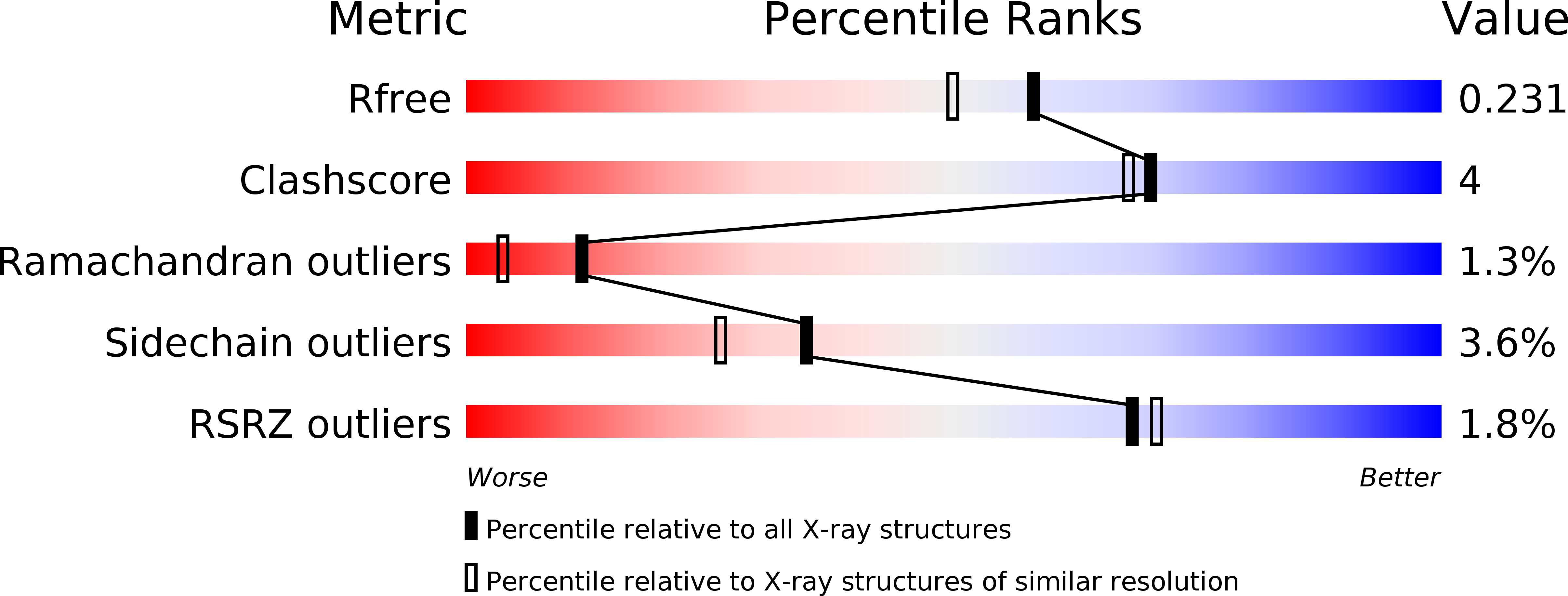
1.90 Å
R-Value Free:
0.22
R-Value Work:
0.18
R-Value Observed:
0.18
Space Group:
P 32 2 1
Macromolecular Entities
Structures with similar UniProt ID
Protein Blast
Polymer Type:polypeptide(L)
Molecule:Carbohydrate esterase MZ0003
Gene (Uniprot):MZ0003
Chain IDs:A
Chain Length:399
Number of Molecules:1
Biological Source:Unknown prokaryotic organism
Ligand Molecules
Primary Citation
Structural insight into a CE15 esterase from the marine bacterial metagenome.
Sci Rep 7 17278 17278 (2017)
PMID: 29222424 DOI: 10.1038/s41598-017-17677-4

Abstact

The family 15 carbohydrate esterase (CE15) MZ0003, which derives from a marine Arctic metagenome, has a broader substrate scope than other members of this family. Here we report the crystal structure of MZ0003, which reveals that residues comprising the catalytic triad differ from previously-characterized fungal homologs, and resolves three large loop regions that are unique to this bacterial sub-clade. The catalytic triad of the bacterial CE15, which includes Asp 332 as its third member, closely resembles that of family 1 carbohydrate esterases (CE1), despite the overall lower structural similarity with members of this family. Two of the three loop regions form a subdomain that deepens the active site pocket and includes several basic residues that contribute to the high positive charge surrounding the active site. Docking simulations predict specific interactions with the sugar moiety of glucuronic-acid substrates, and with aromatically-substituted derivatives that serve as model compounds for the lignin-carbohydrate complex of plant cell walls. Molecular dynamics simulations indicate considerable flexibility of the sub-domain in the substrate-bound form, suggesting plasticity to accommodate different substrates is possible. The findings from this first reported structure of a bacterial member of the CE15 family provide insight into the basis of its broader substrate specificity.

Legend

Protein

Chemical

Disease

Primary Citation of related structures
Feedback Form
Name
Email
Institute
Feedback