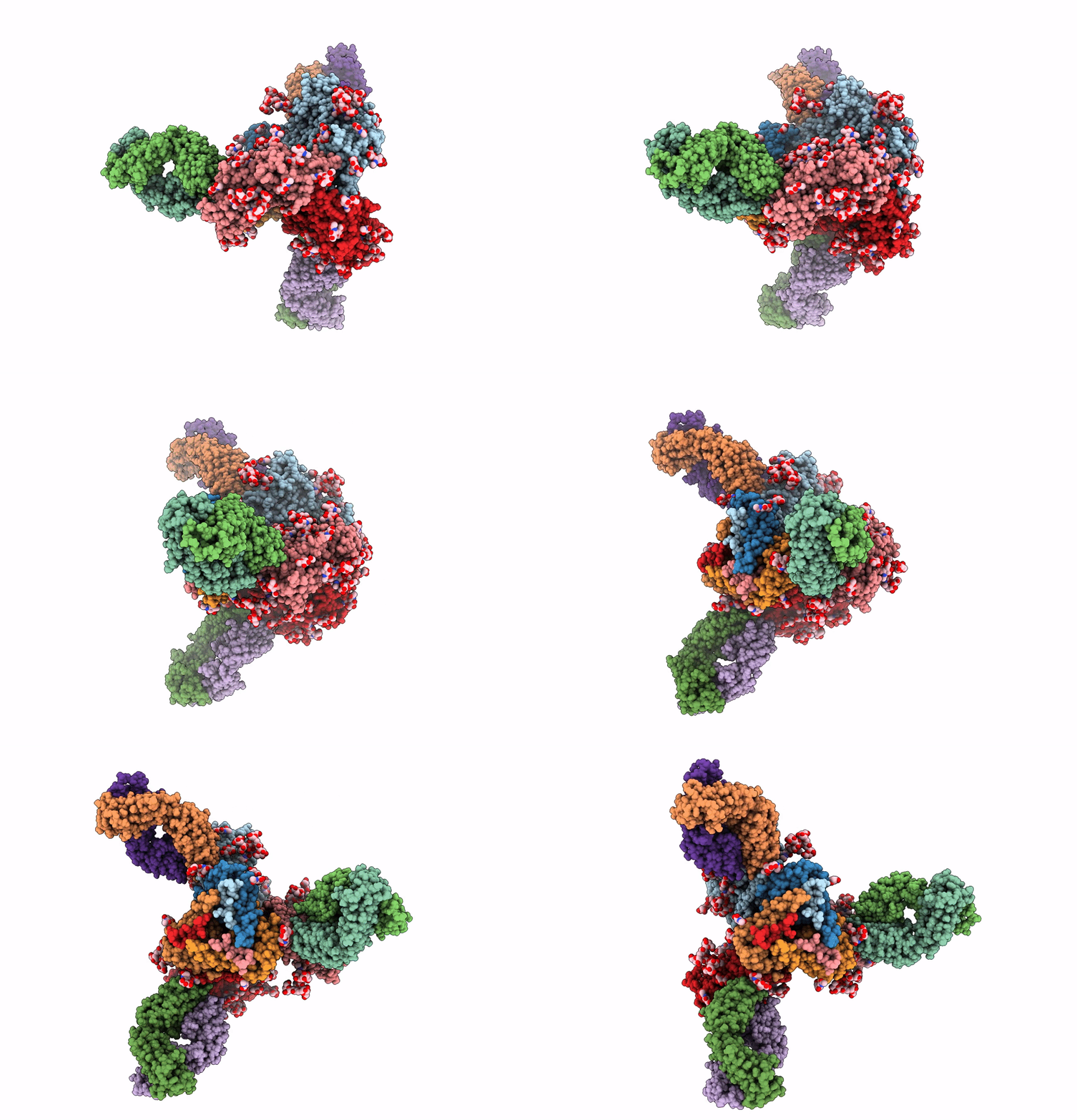
6DID image
Deposition Date 2018-05-23
Release Date 2018-09-05
Last Version Date 2024-11-20
Entry Detail
PDB ID:
6DID
Keywords:
Title:
HIV Env BG505 SOSIP with polyclonal Fabs from immunized rabbit #3417 post-boost#1
Biological Source:
Source Organism:
Host Organism:
Method Details:
Experimental Method:
Resolution:
4.71 Å
Aggregation State:
PARTICLE
Reconstruction Method:
SINGLE PARTICLE

Macromolecular Entities
Structures with similar UniProt ID
Protein Blast
Polymer Type:polypeptide(L)
Molecule:Envelope glycoprotein gp160
Gene (Uniprot):env
Chain IDs:A, C (auth: F), E (auth: G)
Chain Length:481
Number of Molecules:3
Biological Source:Human immunodeficiency virus 1
Structures with similar UniProt ID
Protein Blast
Polymer Type:polypeptide(L)
Molecule:Envelope glycoprotein gp160
Gene (Uniprot):env
Chain IDs:B, D (auth: I), F (auth: J)
Chain Length:153
Number of Molecules:3
Biological Source:Human immunodeficiency virus 1
Structures with similar UniProt ID
Protein Blast
Polymer Type:polypeptide(L)
Molecule:Monoclonal antibody 10A light chain
Chain IDs:G (auth: C), I (auth: E), K (auth: H)
Chain Length:217
Number of Molecules:3
Biological Source:Oryctolagus cuniculus
Structures with similar UniProt ID
Protein Blast
Polymer Type:polypeptide(L)
Molecule:Monoclonal antibody 10A heavy chain
Chain IDs:H (auth: D), J (auth: K), L
Chain Length:214
Number of Molecules:3
Biological Source:Oryctolagus cuniculus
Ligand Molecules
Primary Citation
Electron-Microscopy-Based Epitope Mapping Defines Specificities of Polyclonal Antibodies Elicited during HIV-1 BG505 Envelope Trimer Immunization.
Immunity 49 288 300.e8 (2018)
PMID: 30097292 DOI: 10.1016/j.immuni.2018.07.009

Abstact

Characterizing polyclonal antibody responses via currently available methods is inherently complex and difficult. Mapping epitopes in an immune response is typically incomplete, which creates a barrier to fully understanding the humoral response to antigens and hinders rational vaccine design efforts. Here, we describe a method of characterizing polyclonal responses by using electron microscopy, and we applied this method to the immunization of rabbits with an HIV-1 envelope glycoprotein vaccine candidate, BG505 SOSIP.664. We detected known epitopes within the polyclonal sera and revealed how antibody responses evolved during the prime-boosting strategy to ultimately result in a neutralizing antibody response. We uncovered previously unidentified epitopes, including an epitope proximal to one recognized by human broadly neutralizing antibodies as well as potentially distracting non-neutralizing epitopes. Our method provides an efficient and semiquantitative map of epitopes that are targeted in a polyclonal antibody response and should be of widespread utility in vaccine and infection studies.

Legend

Protein

Chemical

Disease

Primary Citation of related structures
Feedback Form
Name
Email
Institute
Feedback