6DEJ image
Deposition Date 2018-05-12
Release Date 2018-05-23
Last Version Date 2024-10-23
Entry Detail
PDB ID:
6DEJ
Title:
The structure of HcRed7, a brighter and red-shifted HcRed variant
Biological Source:
Source Organism:
Host Organism:
Method Details:
Experimental Method:
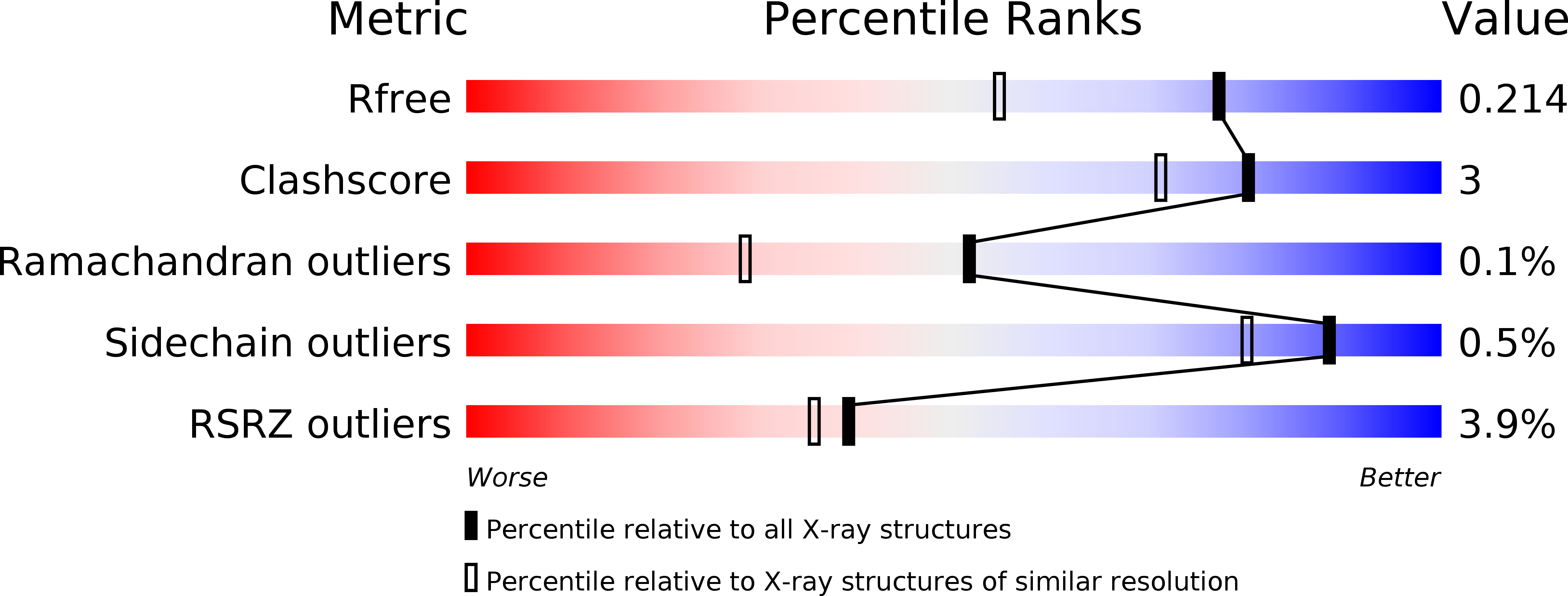
Resolution:
1.63 Å
R-Value Free:
0.21
R-Value Work:
0.17
Space Group:
P 1 21 1
Macromolecular Entities
Structures with similar UniProt ID
Protein Blast
Polymer Type:polypeptide(L)
Molecule:GFP-like non-fluorescent chromoprotein
Chain IDs:A, B, C, D
Chain Length:237
Number of Molecules:4
Biological Source:Heteractis crispa
Modified Residue
Compound ID Chain ID Parent Comp ID Details 2D Image
CRU A GLU chromophore
Primary Citation
Monomerization of far-red fluorescent proteins.
Proc. Natl. Acad. Sci. U.S.A. 115 E11294 E11301 (2018)
PMID: 30425172 DOI: 10.1073/pnas.1807449115

Abstact

Anthozoa-class red fluorescent proteins (RFPs) are frequently used as biological markers, with far-red (λem ∼ 600-700 nm) emitting variants sought for whole-animal imaging because biological tissues are more permeable to light in this range. A barrier to the use of naturally occurring RFP variants as molecular markers is that all are tetrameric, which is not ideal for cell biological applications. Efforts to engineer monomeric RFPs have typically produced dimmer and blue-shifted variants because the chromophore is sensitive to small structural perturbations. In fact, despite much effort, only four native RFPs have been successfully monomerized, leaving the majority of RFP biodiversity untapped in biomarker development. Here we report the generation of monomeric variants of HcRed and mCardinal, both far-red dimers, and describe a comprehensive methodology for the monomerization of red-shifted oligomeric RFPs. Among the resultant variants is mKelly1 (emission maximum, λem = 656 nm), which, along with the recently reported mGarnet2 [Matela G, et al. (2017) Chem Commun (Camb) 53:979-982], forms a class of bright, monomeric, far-red FPs.

Legend

Protein

Chemical

Disease

Primary Citation of related structures
Feedback Form
Name
Email
Institute
Feedback