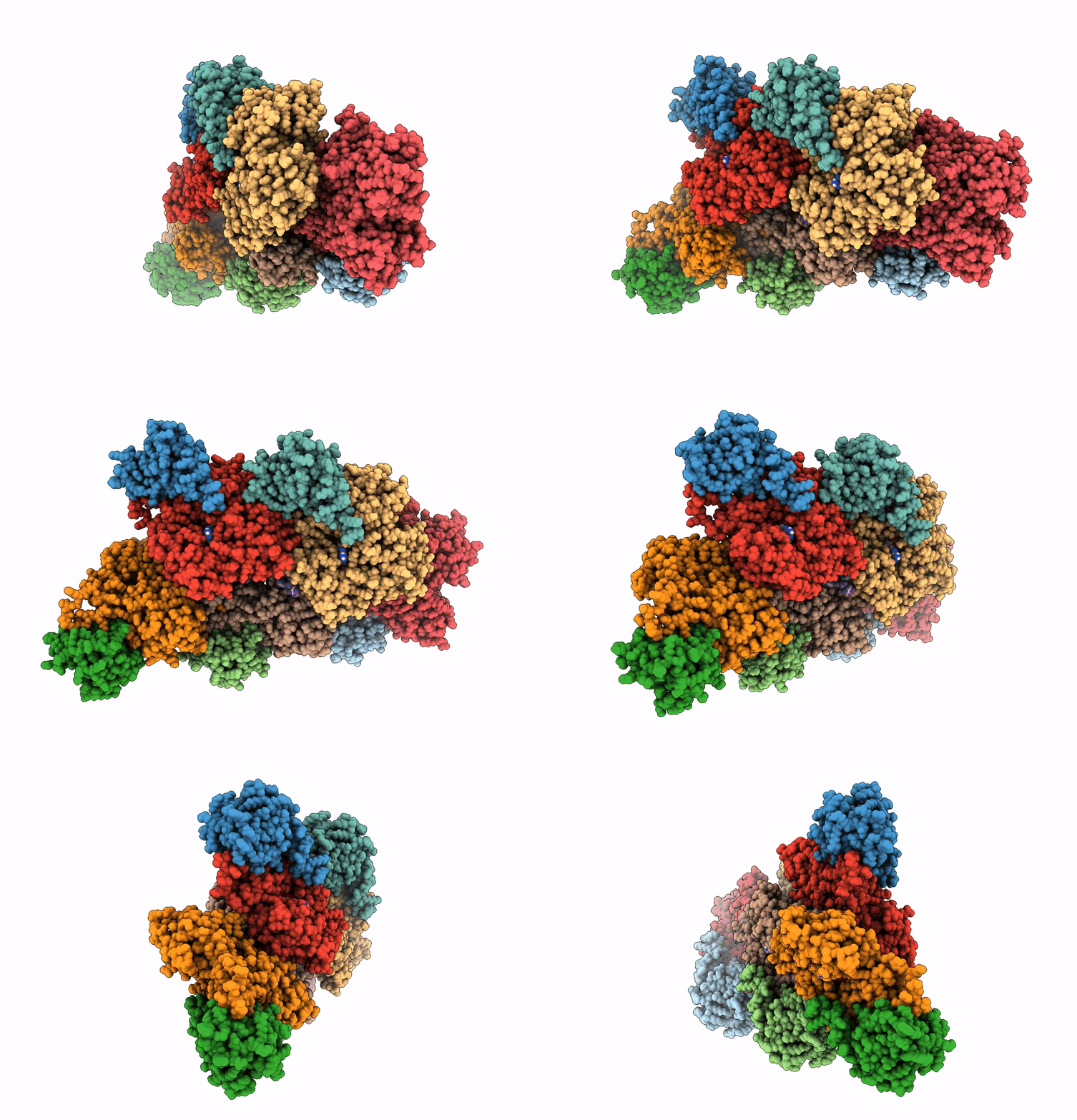
6D8C image
Deposition Date 2018-04-26
Release Date 2018-09-19
Last Version Date 2023-11-15
Entry Detail
PDB ID:
6D8C
Title:
Cryo-EM structure of FLNaABD E254K bound to phalloidin-stabilized F-actin
Biological Source:
Source Organism:
Homo sapiens (Taxon ID: 9606)
Gallus gallus (Taxon ID: 9031)
Amanita phalloides (Taxon ID: 67723)
Host Organism:
Method Details:
Experimental Method:
Resolution:
3.54 Å
Aggregation State:
FILAMENT
Reconstruction Method:
HELICAL
Macromolecular Entities
Structures with similar UniProt ID
Protein Blast
Polymer Type:polypeptide(L)
Molecule:Filamin-A
Gene (Uniprot):FLNA
Mutagens:E254K
Chain IDs:A (auth: D), C (auth: A), E (auth: B), G (auth: C), I (auth: E)
Chain Length:306
Number of Molecules:5
Biological Source:Homo sapiens
Structures with similar UniProt ID
Protein Blast
Polymer Type:polypeptide(L)
Molecule:Actin, alpha skeletal muscle
Gene (Uniprot):ACTA1
Chain IDs:B (auth: H), D (auth: J), F (auth: K), H (auth: L), J (auth: M)
Chain Length:375
Number of Molecules:5
Biological Source:Gallus gallus
Structures with similar UniProt ID
Protein Blast
Polymer Type:polypeptide(L)
Molecule:Phalloidin
Chain IDs:K (auth: N), L (auth: O), M (auth: P)
Chain Length:7
Number of Molecules:3
Biological Source:Amanita phalloides
Modified Residue
Compound ID Chain ID Parent Comp ID Details 2D Image
ALO K THR modified residue
G5G K LEU modified residue
HYP K PRO modified residue
Peptide-like Molecules
PRD_002307
Primary Citation
Structural basis of the filamin A actin-binding domain interaction with F-actin.
Nat. Struct. Mol. Biol. 25 918 927 (2018)
PMID: 30224736 DOI: 10.1038/s41594-018-0128-3

Abstact

Actin-cross-linking proteins assemble actin filaments into higher-order structures essential for orchestrating cell shape, adhesion, and motility. Missense mutations in the tandem calponin homology domains of their actin-binding domains (ABDs) underlie numerous genetic diseases, but a molecular understanding of these pathologies is hampered by the lack of high-resolution structures of any actin-cross-linking protein bound to F-actin. Here, taking advantage of a high-affinity, disease-associated mutant of the human filamin A (FLNa) ABD, we combine cryo-electron microscopy and functional studies to reveal at near-atomic resolution how the first calponin homology domain (CH1) and residues immediately N-terminal to it engage actin. We further show that reorientation of CH2 relative to CH1 is required to avoid clashes with actin and to expose F-actin-binding residues on CH1. Our data explain localization of disease-associated loss-of-function mutations to FLNaCH1 and gain-of-function mutations to the regulatory FLNaCH2. Sequence conservation argues that this provides a general model for ABD-F-actin binding.

Legend

Protein

Chemical

Disease

Primary Citation of related structures
Feedback Form
Name
Email
Institute
Feedback