6D3P image
Deposition Date 2018-04-16
Release Date 2018-06-20
Last Version Date 2024-03-13
Entry Detail
PDB ID:
6D3P
Keywords:
Title:
Crystal structure of an exoribonuclease-resistant RNA from Sweet clover necrotic mosaic virus (SCNMV)
Biological Source:
Source Organism:
Method Details:
Experimental Method:
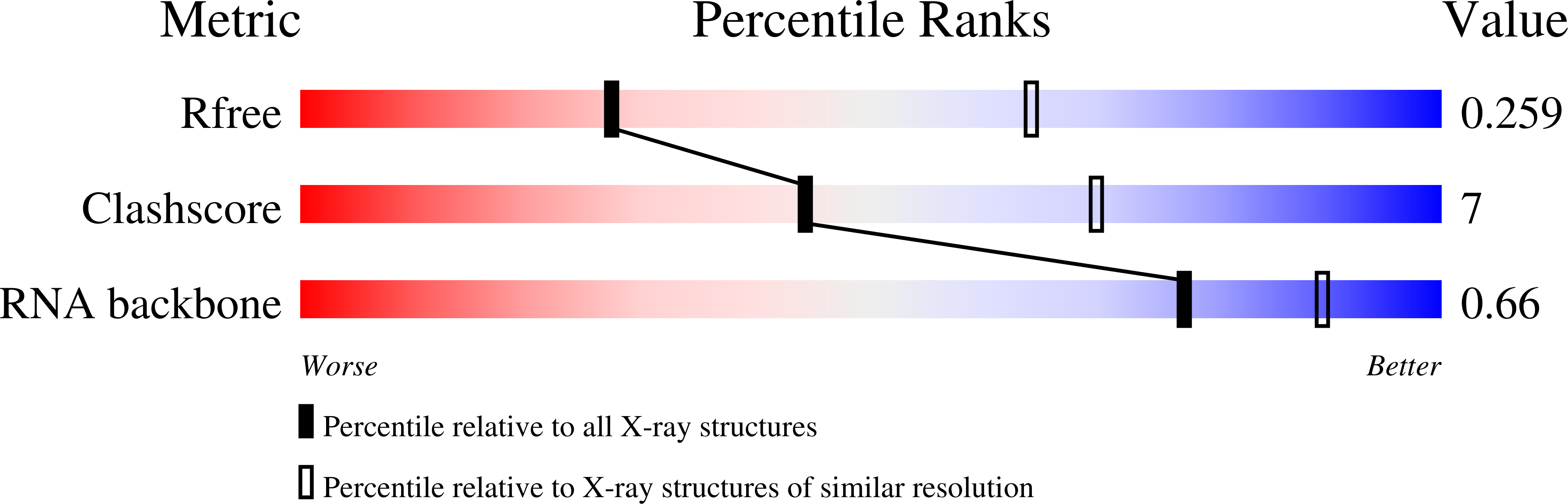
Resolution:
2.90 Å
R-Value Free:
0.25
R-Value Work:
0.24
R-Value Observed:
0.24
Space Group:
P 61 2 2
Macromolecular Entities
Polymer Type:polyribonucleotide
Molecule:RNA (45-MER)
Chain IDs:A
Chain Length:45
Number of Molecules:1
Biological Source:Sweet clover necrotic mosaic virus
Ligand Molecules
Primary Citation
A folded viral noncoding RNA blocks host cell exoribonucleases through a conformationally dynamic RNA structure.
Proc. Natl. Acad. Sci. U.S.A. 115 6404 6409 (2018)
PMID: 29866852 DOI: 10.1073/pnas.1802429115

Abstact

Folded RNA elements that block processive 5' → 3' cellular exoribonucleases (xrRNAs) to produce biologically active viral noncoding RNAs have been discovered in flaviviruses, potentially revealing a new mode of RNA maturation. However, whether this RNA structure-dependent mechanism exists elsewhere and, if so, whether a singular RNA fold is required, have been unclear. Here we demonstrate the existence of authentic RNA structure-dependent xrRNAs in dianthoviruses, plant-infecting viruses unrelated to animal-infecting flaviviruses. These xrRNAs have no sequence similarity to known xrRNAs; thus, we used a combination of biochemistry and virology to characterize their sequence requirements and mechanism of stopping exoribonucleases. By solving the structure of a dianthovirus xrRNA by X-ray crystallography, we reveal a complex fold that is very different from that of the flavivirus xrRNAs. However, both versions of xrRNAs contain a unique topological feature, a pseudoknot that creates a protective ring around the 5' end of the RNA structure; this may be a defining structural feature of xrRNAs. Single-molecule FRET experiments reveal that the dianthovirus xrRNAs undergo conformational changes and can use "codegradational remodeling," exploiting the exoribonucleases' degradation-linked helicase activity to help form their resistant structure; such a mechanism has not previously been reported. Convergent evolution has created RNA structure-dependent exoribonuclease resistance in different contexts, which establishes it as a general RNA maturation mechanism and defines xrRNAs as an authentic functional class of RNAs.

Legend

Protein

Chemical

Disease

Primary Citation of related structures
Feedback Form
Name
Email
Institute
Feedback