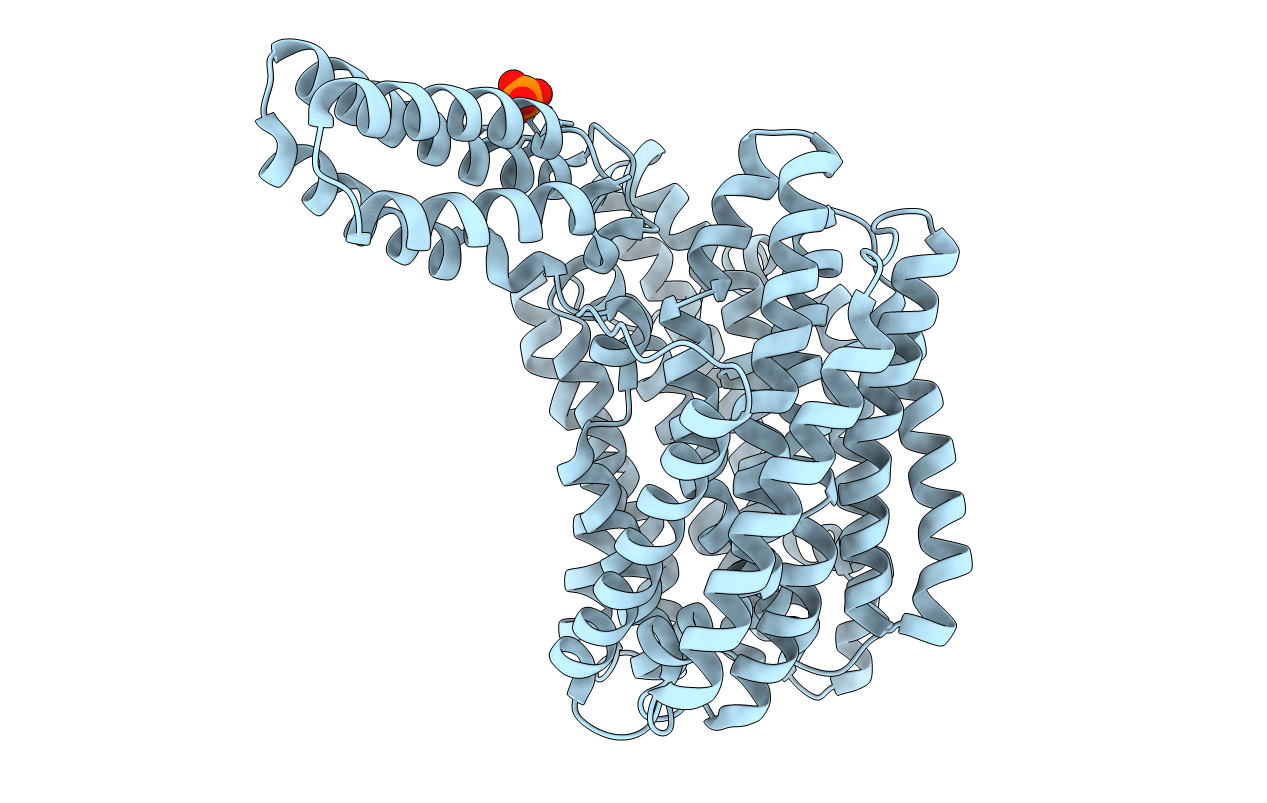
6CC4 image
Deposition Date 2018-02-05
Release Date 2018-06-27
Last Version Date 2023-10-04
Entry Detail
PDB ID:
6CC4
Title:
Structure of MurJ from Escherichia coli
Biological Source:
Source Organism:
Escherichia coli (Taxon ID: 562)
Method Details:
Experimental Method:
Resolution:
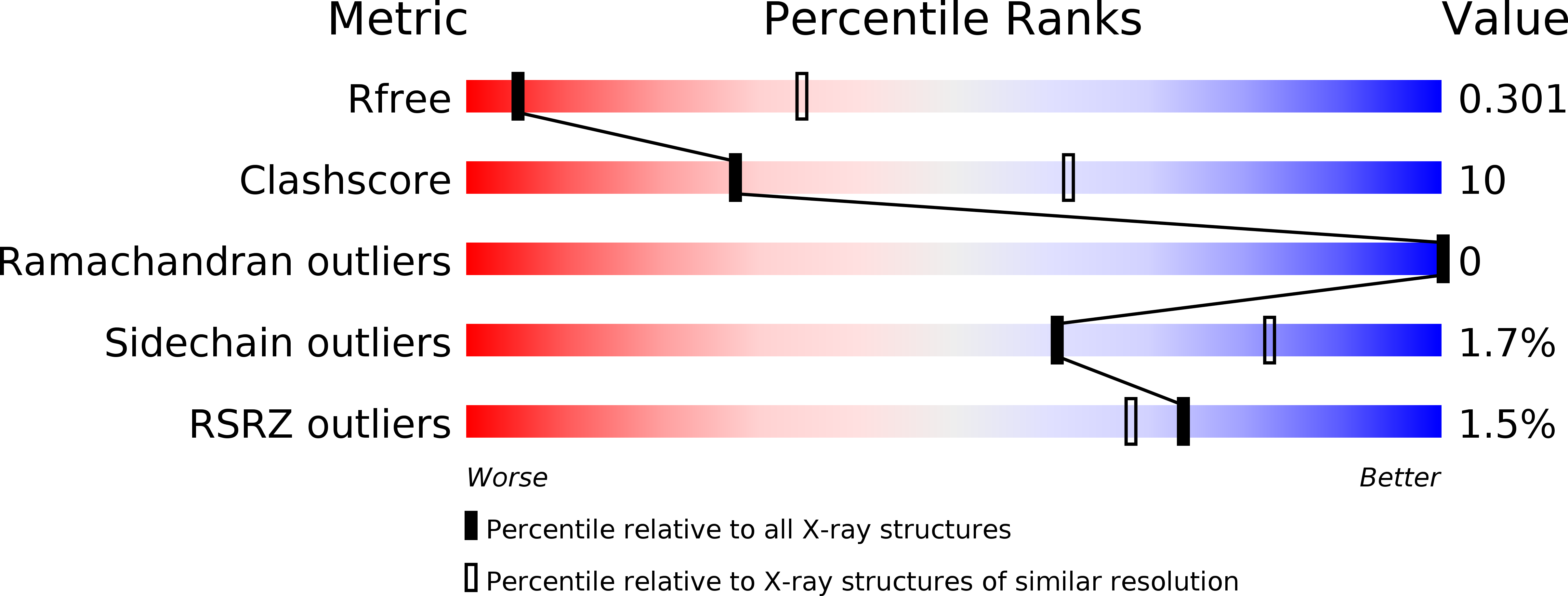
3.50 Å
R-Value Free:
0.30
R-Value Work:
0.27
R-Value Observed:
0.28
Space Group:
C 2 2 21
Macromolecular Entities
Protein Blast
Polymer Type:polypeptide(L)
Molecule:soluble cytochrome b562, lipid II flippase MurJ chimera
Gene (Uniprot):cybC, murJ
Chain IDs:A
Chain Length:614
Number of Molecules:1
Biological Source:Escherichia coli
Ligand Molecules
Primary Citation
Structure and mutagenic analysis of the lipid II flippase MurJ fromEscherichia coli.
Proc. Natl. Acad. Sci. U.S.A. 115 6709 6714 (2018)
PMID: 29891673 DOI: 10.1073/pnas.1802192115

Abstact

The peptidoglycan cell wall provides an essential protective barrier in almost all bacteria, defining cellular morphology and conferring resistance to osmotic stress and other environmental hazards. The precursor to peptidoglycan, lipid II, is assembled on the inner leaflet of the plasma membrane. However, peptidoglycan polymerization occurs on the outer face of the plasma membrane, and lipid II must be flipped across the membrane by the MurJ protein before its use in peptidoglycan synthesis. Due to its central role in cell wall assembly, MurJ is of fundamental importance in microbial cell biology and is a prime target for novel antibiotic development. However, relatively little is known regarding the mechanisms of MurJ function, and structural data for MurJ are available only from the extremophile Thermosipho africanus Here, we report the crystal structure of substrate-free MurJ from the gram-negative model organism Escherichia coli, revealing an inward-open conformation. Taking advantage of the genetic tractability of E. coli, we performed high-throughput mutagenesis and next-generation sequencing to assess mutational tolerance at every amino acid in the protein, providing a detailed functional and structural map for the enzyme and identifying sites for inhibitor development. Lastly, through the use of sequence coevolution analysis, we identify functionally important interactions in the outward-open state of the protein, supporting a rocker-switch model for lipid II transport.

Legend

Protein

Chemical

Disease

Primary Citation of related structures
Feedback Form
Name
Email
Institute
Feedback