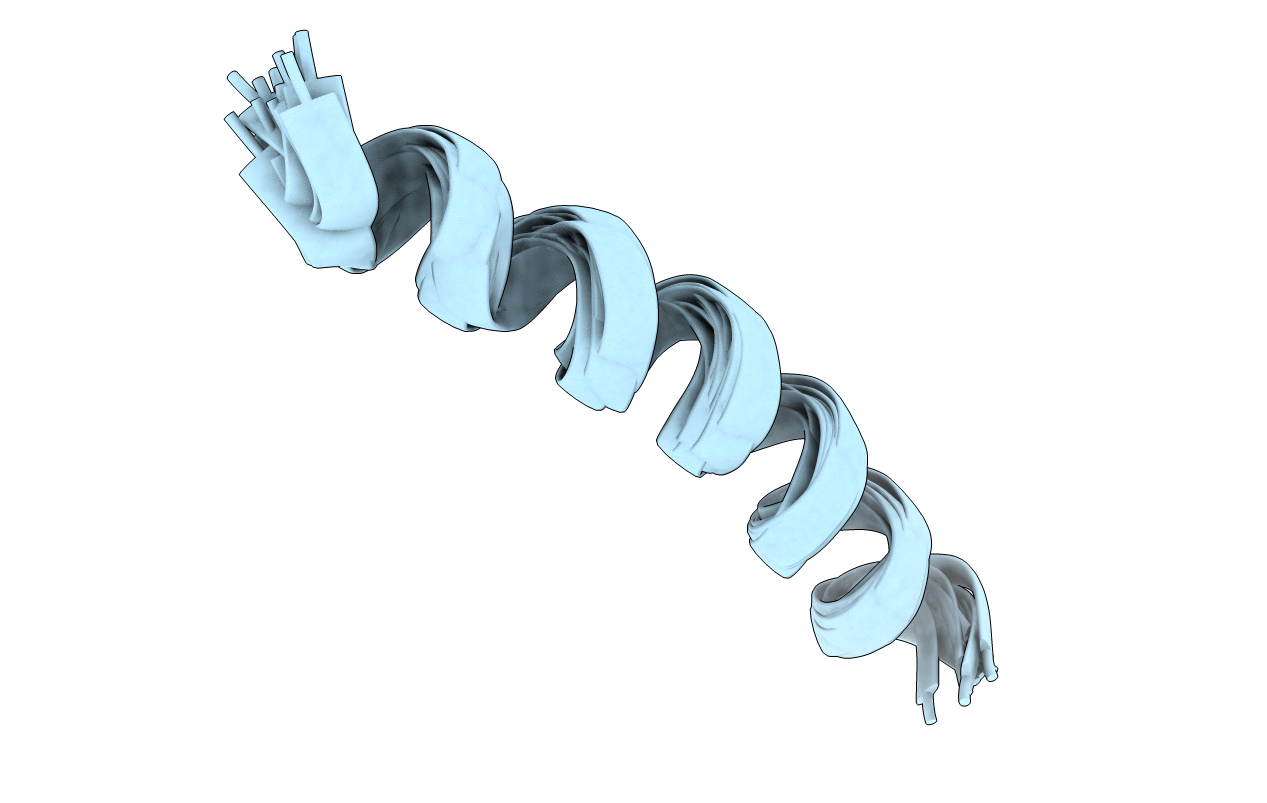
6C41 image
Deposition Date 2018-01-11
Release Date 2018-02-07
Last Version Date 2024-11-13
Entry Detail
PDB ID:
6C41
Title:
The clavanin peptide in the presence of TFE (2,2,2-trifluoroethanol), presented a amphipathic alpha-helices from Phe-2 to Val-22 residues
Biological Source:
Source Organism:
Styela clava (Taxon ID: 7725)
Host Organism:
Method Details:
Experimental Method:
Conformers Calculated:
200
Conformers Submitted:
10
Selection Criteria:
structures with the lowest energy

Macromolecular Entities
Structures with similar UniProt ID
Protein Blast
Polymer Type:polypeptide(L)
Molecule:Clavanin-A
Chain IDs:A
Chain Length:24
Number of Molecules:1
Biological Source:Styela clava
Ligand Molecules
Primary Citation
Structural Studies of a Lipid-Binding Peptide from Tunicate Hemocytes with Anti-Biofilm Activity.
Sci Rep 6 27128 ? (2016)
PMID: 27292548 DOI: 10.1038/srep27128

Abstact

Clavanins is a class of peptides (23aa) histidine-rich, free of post-translational modifications. Clavanins have been studied largely for their ability to disrupt bacterial membranes. In the present study, the interaction of clavanin A with membranes was assessed by dynamic light scattering, zeta potential and permeabilization assays. We observed through those assays that clavanin A lysis bacterial cells at concentrations corresponding to its MIC. Further, the structure and function of clavanin A was investigated. To better understand how clavanin interacted with bacteria, its NMR structure was elucidated. The solution state NMR structure of clavanin A in the presence of TFE-d3 indicated an α-helical conformation. Secondary structures, based on circular dichroism measurements in anionic sodium dodecyl sulfate (SDS) and TFE (2,2,2-trifluorethanol), in silico lipid-peptide docking and molecular simulations with lipids DPPC and DOPC revealed that clavanin A can adopt a variety of folds, possibly influencing its different functions. Microcalorimetry assays revealed that clavanin A was capable of discriminating between different lipids. Finally, clavanin A was found to eradicate bacterial biofilms representing a previously unrecognized function.

Legend

Protein

Chemical

Disease

Primary Citation of related structures
Feedback Form
Name
Email
Institute
Feedback