6C1W image
Deposition Date 2018-01-05
Release Date 2018-03-14
Last Version Date 2024-11-06
Entry Detail
PDB ID:
6C1W
Keywords:
Title:
A tethered niacin-derived pincer complex with a nickel-carbon or sulfite-carbon bond in lactate racemase
Biological Source:
Source Organism:
Host Organism:
Method Details:
Experimental Method:
Resolution:
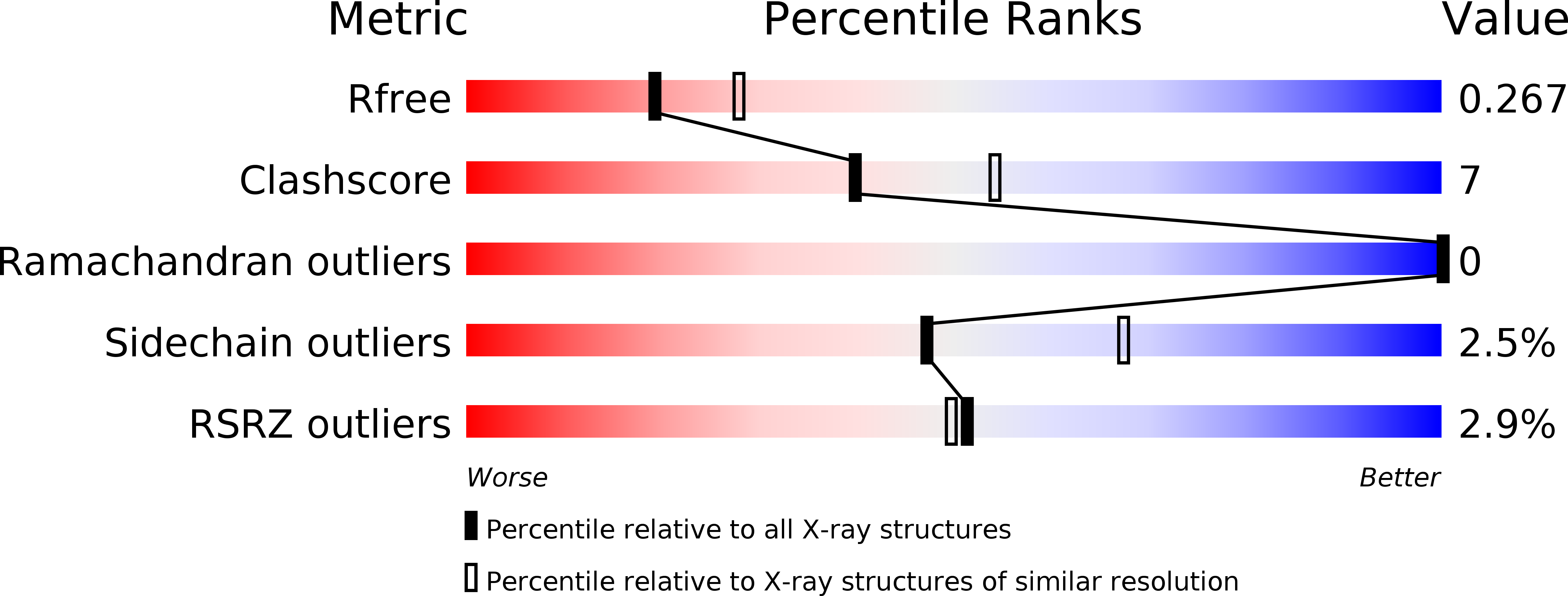
2.40 Å
R-Value Free:
0.26
R-Value Work:
0.20
R-Value Observed:
0.20
Space Group:
P 21 21 21
Macromolecular Entities
Structures with similar UniProt ID
Protein Blast
Polymer Type:polypeptide(L)
Molecule:Lactate racemase
Gene (Uniprot):larA
Mutagens:C-terminal fusion to ASWSHPQFEK
Chain IDs:A, B, C
Chain Length:433
Number of Molecules:3
Biological Source:Lactobacillus plantarum
Primary Citation
Lactate Racemase Nickel-Pincer Cofactor Operates by a Proton-Coupled Hydride Transfer Mechanism.
Biochemistry 57 3244 3251 (2018)
PMID: 29489337 DOI: 10.1021/acs.biochem.8b00100

Abstact

Lactate racemase (LarA) of Lactobacillus plantarum contains a novel organometallic cofactor with nickel coordinated to a covalently tethered pincer ligand, pyridinium-3-thioamide-5-thiocarboxylic acid mononucleotide, but its function in the enzyme mechanism has not been elucidated. This study presents direct evidence that the nickel-pincer cofactor facilitates a proton-coupled hydride transfer (PCHT) mechanism during LarA-catalyzed lactate racemization. No signal was detected by electron paramagnetic resonance spectroscopy for LarA in the absence or presence of substrate, consistent with a +2 metal oxidation state and inconsistent with a previously proposed proton-coupled electron transfer mechanism. Pyruvate, the predicted intermediate for a PCHT mechanism, was observed in quenched solutions of LarA. A normal substrate kinetic isotope effect (kH/ kD of 3.11 ± 0.17) was established using 2-α-2H-lactate, further supporting a PCHT mechanism. UV-visible spectroscopy revealed a lactate-induced perturbation of the cofactor spectrum, notably increasing the absorbance at 340 nm, and demonstrated an interaction of the cofactor with the inhibitor sulfite. A crystal structure of LarA provided greater resolution (2.4 Å) than previously reported and revealed sulfite binding to the pyridinium C4 atom of the reduced pincer cofactor, mimicking hydride reduction during a PCHT catalytic cycle. Finally, computational modeling supports hydride transfer to the cofactor at the C4 position or to the nickel atom, but with formation of a nickel-hydride species requiring dissociation of the His200 metal ligand. In aggregate, these studies provide compelling evidence that the nickel-pincer cofactor acts by a PCHT mechanism.

Legend

Protein

Chemical

Disease

Primary Citation of related structures
Feedback Form
Name
Email
Institute
Feedback