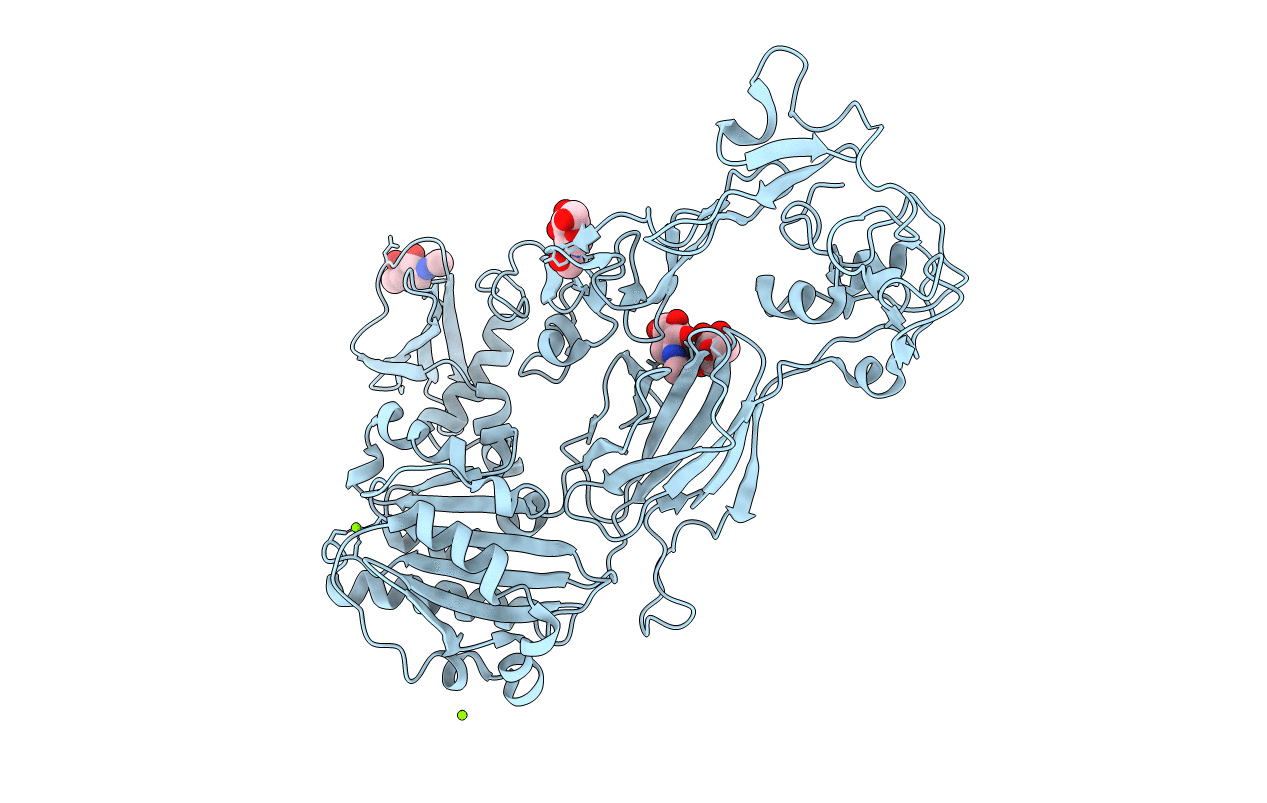
6BXJ image
Deposition Date 2017-12-18
Release Date 2018-10-03
Last Version Date 2024-10-09
Entry Detail
PDB ID:
6BXJ
Keywords:
Title:
Structure of a single-chain beta3 integrin
Biological Source:
Source Organism:
Homo sapiens (Taxon ID: 9606)
Host Organism:
Method Details:
Experimental Method:
Resolution:
2.09 Å
R-Value Free:
0.23
R-Value Work:
0.18
R-Value Observed:
0.18
Space Group:
P 1 21 1
Macromolecular Entities
Protein Blast
Polymer Type:polypeptide(L)
Molecule:Chimera protein of Integrin beta-3 and Integrin alpha-L
Gene (Uniprot):ITGB3, ITGAL
Chain IDs:A
Chain Length:625
Number of Molecules:1
Biological Source:Homo sapiens
Primary Citation
Autonomous conformational regulation of beta3integrin and the conformation-dependent property of HPA-1a alloantibodies.
Proc. Natl. Acad. Sci. U.S.A. 115 E9105 E9114 (2018)
PMID: 30209215 DOI: 10.1073/pnas.1806205115

Abstact

Integrin α/β heterodimer adopts a compact bent conformation in the resting state, and upon activation undergoes a large-scale conformational rearrangement. During the inside-out activation, signals impinging on the cytoplasmic tail of β subunit induce the α/β separation at the transmembrane and cytoplasmic domains, leading to the extended conformation of the ectodomain with the separated leg and the opening headpiece that is required for the high-affinity ligand binding. It remains enigmatic which integrin subunit drives the bent-to-extended conformational rearrangement in the inside-out activation. The β3 integrins, including αIIbβ3 and αVβ3, are the prototypes for understanding integrin structural regulation. The Leu33Pro polymorphism located at the β3 PSI domain defines the human platelet-specific alloantigen (HPA) 1a/b, which provokes the alloimmune response leading to clinically important bleeding disorders. Some, but not all, anti-HPA-1a alloantibodies can distinguish the αIIbβ3 from αVβ3 and affect their functions with unknown mechanisms. Here we designed a single-chain β3 subunit that mimics a separation of α/β heterodimer on inside-out activation. Our crystallographic and functional studies show that the single-chain β3 integrin folds into a bent conformation in solution but spontaneously extends on the cell surface. This demonstrates that the β3 subunit autonomously drives the membrane-dependent conformational rearrangement during integrin activation. Using the single-chain β3 integrin, we identified the conformation-dependent property of anti-HPA-1a alloantibodies, which enables them to differently recognize the β3 in the bent state vs. the extended state and in the complex with αIIb vs. αV This study provides deeper understandings of integrin conformational activation on the cell surface.

Legend

Protein

Chemical

Disease

Primary Citation of related structures
Feedback Form
Name
Email
Institute
Feedback