6BHV image
Deposition Date 2017-10-31
Release Date 2018-02-28
Last Version Date 2023-10-04
Entry Detail
PDB ID:
6BHV
Keywords:
Title:
Human PARP-1 bound to NAD+ analog benzamide adenine dinucleotide (BAD)
Biological Source:
Source Organism:
Homo sapiens (Taxon ID: 9606)
Host Organism:
Method Details:
Experimental Method:
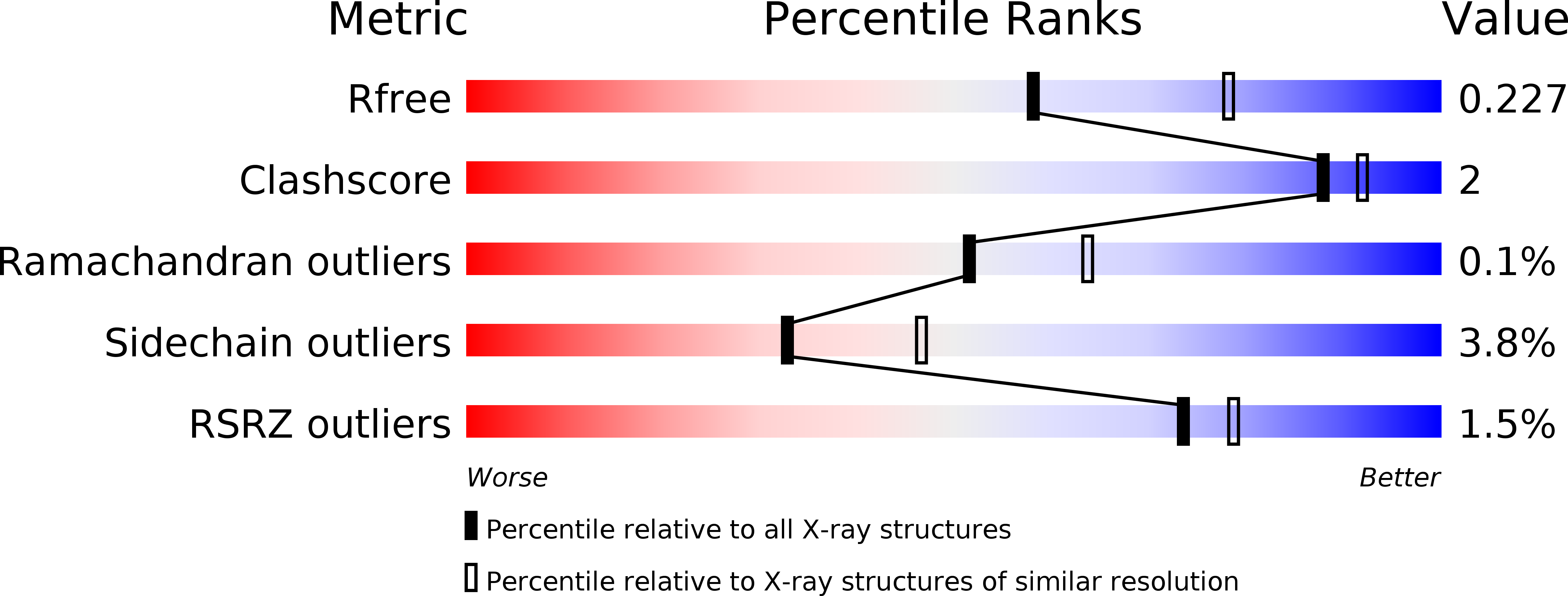
Resolution:
2.30 Å
R-Value Free:
0.22
R-Value Work:
0.19
R-Value Observed:
0.19
Space Group:
P 1
Macromolecular Entities
Structures with similar UniProt ID
Protein Blast
Polymer Type:polypeptide(L)
Molecule:Poly [ADP-ribose] polymerase 1
Gene (Uniprot):PARP1
Chain IDs:A, B, C, D
Chain Length:271
Number of Molecules:4
Biological Source:Homo sapiens
Ligand Molecules
Primary Citation
NAD+analog reveals PARP-1 substrate-blocking mechanism and allosteric communication from catalytic center to DNA-binding domains.
Nat Commun 9 844 844 (2018)
PMID: 29487285 DOI: 10.1038/s41467-018-03234-8

Abstact

PARP-1 cleaves NAD+ and transfers the resulting ADP-ribose moiety onto target proteins and onto subsequent polymers of ADP-ribose. An allosteric network connects PARP-1 multi-domain detection of DNA damage to catalytic domain structural changes that relieve catalytic autoinhibition; however, the mechanism of autoinhibition is undefined. Here, we show using the non-hydrolyzable NAD+ analog benzamide adenine dinucleotide (BAD) that PARP-1 autoinhibition results from a selective block on NAD+ binding. Following DNA damage detection, BAD binding to the catalytic domain leads to changes in PARP-1 dynamics at distant DNA-binding surfaces, resulting in increased affinity for DNA damage, and providing direct evidence of reverse allostery. Our findings reveal a two-step mechanism to activate and to then stabilize PARP-1 on a DNA break, indicate that PARP-1 allostery influences persistence on DNA damage, and have important implications for PARP inhibitors that engage the NAD+ binding site.

Legend

Protein

Chemical

Disease

Primary Citation of related structures
Feedback Form
Name
Email
Institute
Feedback