6B72 image
Deposition Date 2017-10-03
Release Date 2018-02-21
Last Version Date 2024-03-13
Entry Detail
PDB ID:
6B72
Keywords:
Title:
A novel HIV-1 Nef dimer interface induced by a single octyl-glucoside molecule
Biological Source:
Method Details:
Experimental Method:
Resolution:
3.20 Å
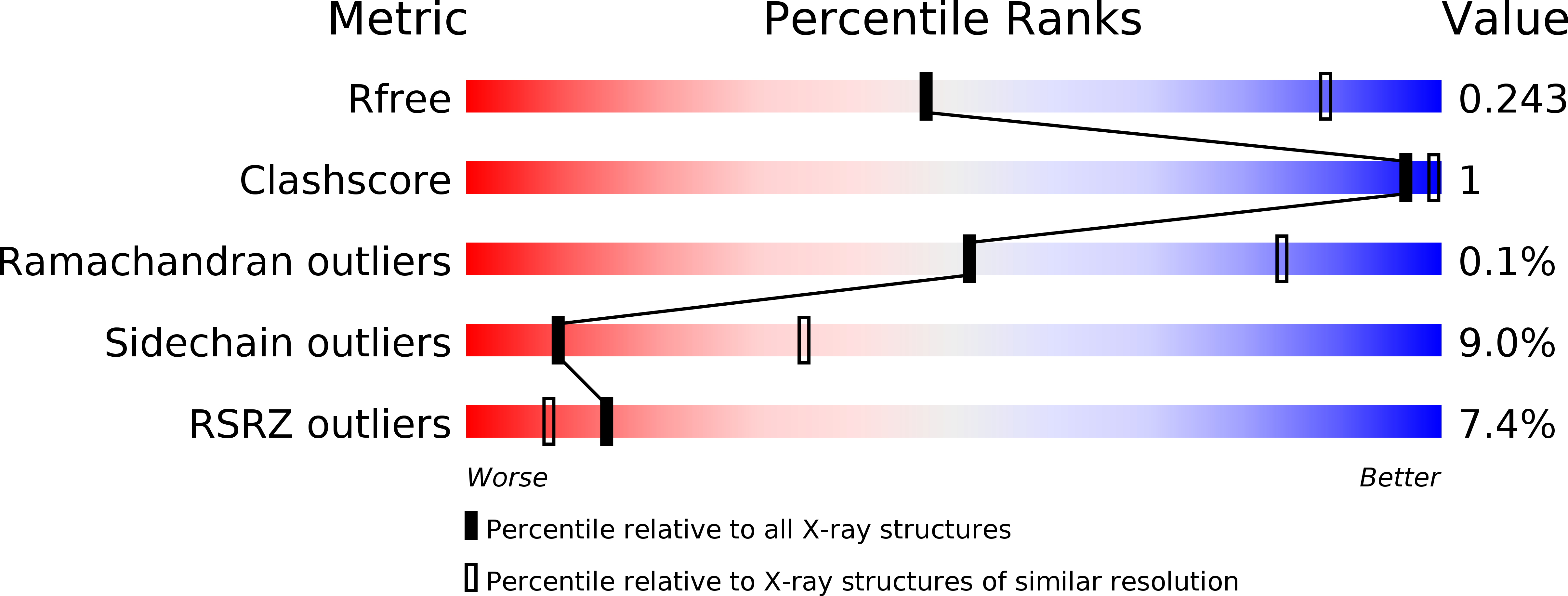
R-Value Free:
0.25
R-Value Work:
0.23
R-Value Observed:
0.23
Space Group:
P 32 2 1
Macromolecular Entities
Structures with similar UniProt ID
Protein Blast
Polymer Type:polypeptide(L)
Molecule:Protein Nef
Gene (Uniprot):nef
Chain IDs:A, B, C, D, E, F
Chain Length:151
Number of Molecules:6
Biological Source:Human immunodeficiency virus type 1 group M subtype B
Ligand Molecules
Primary Citation
A single beta-octyl glucoside molecule induces HIV-1 Nef dimer formation in the absence of partner protein binding.
PLoS ONE 13 e0192512 e0192512 (2018)
PMID: 29415006 DOI: 10.1371/journal.pone.0192512

Abstact

The HIV-1 Nef accessory protein is essential for viral pathogenicity and AIDS progression. Nef forms complexes with multiple host cell factors to facilitate viral replication and promote immune escape of HIV-infected cells. Previous X-ray crystal structures demonstrate that Nef forms homodimers, the orientation of which are influenced by host cell binding partners. In cell-based fluorescence complementation assays, Nef forms homodimers at the plasma membrane. However, recombinant Nef proteins often exist as monomers in solution, suggesting that membrane interaction may also trigger monomer to dimer transitions. In this study, we show that monomeric Nef core proteins can be induced to form dimers in the presence of low concentrations of the non-ionic surfactant, β-octyl glucoside (βOG). X-ray crystallography revealed that a single βOG molecule is present in the Nef dimer, with the 8-carbon acyl chain of the ligand binding to a hydrophobic pocket formed by the dimer interface. This Nef-βOG dimer interface involves helix αB, as observed in previous dimer structures, as well as a helix formed by N-terminal residues 54-66. Nef dimer formation is stabilized in solution by the addition of βOG, providing biochemical validation for the crystal structure. These observations together suggest that the interaction with host cell lipid mediators or other hydrophobic ligands may play a role in Nef dimerization, which has been previously linked to multiple Nef functions including host cell protein kinase activation, CD4 downregulation, and enhancement of HIV-1 replication.

Legend

Protein

Chemical

Disease

Primary Citation of related structures
Feedback Form
Name
Email
Institute
Feedback