6B4R image
Deposition Date 2017-09-27
Release Date 2018-10-03
Last Version Date 2025-04-30
Entry Detail
PDB ID:
6B4R
Keywords:
Title:
The crystal structure of the aldehyde dehydrogenase KauB from Pseudomonas aeruginosa
Biological Source:
Source Organism:
Host Organism:
Method Details:
Experimental Method:
Resolution:
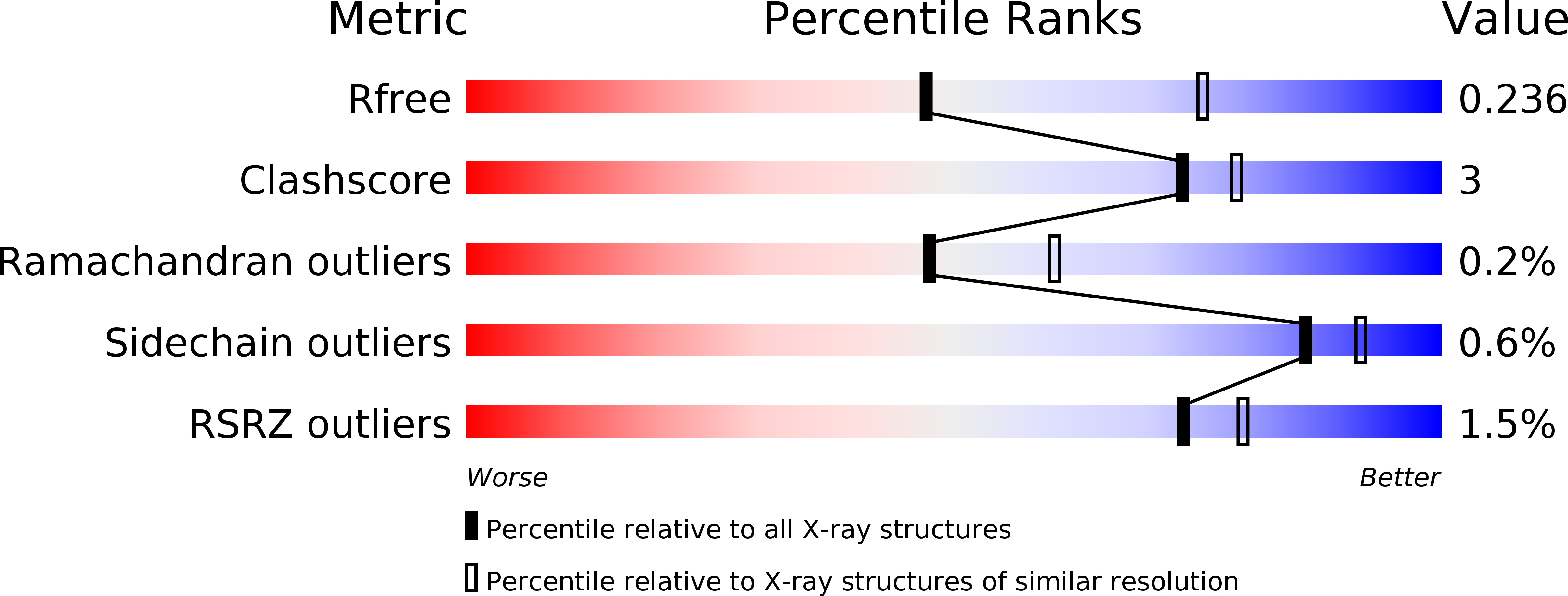
2.55 Å
R-Value Free:
0.23
R-Value Work:
0.17
R-Value Observed:
0.18
Space Group:
C 1 2 1
Macromolecular Entities
Structures with similar UniProt ID
Protein Blast
Polymer Type:polypeptide(L)
Molecule:KauB
Gene (Uniprot):PA5312
Chain IDs:A, C
Chain Length:497
Number of Molecules:2
Biological Source:Pseudomonas aeruginosa PAO1
Structures with similar UniProt ID
Protein Blast
Polymer Type:polypeptide(L)
Molecule:KauB
Gene (Uniprot):PA5312
Chain IDs:B, D
Chain Length:497
Number of Molecules:2
Biological Source:Pseudomonas aeruginosa PAO1
Modified Residue
Compound ID Chain ID Parent Comp ID Details 2D Image
CSD A CYS modified residue
Primary Citation
The structural basis for the broad aldehyde specificity of the aminoaldehyde dehydrogenase PauC from the human pathogen Pseudomonas aeruginosa.
Protein Sci. 34 e70124 e70124 (2025)
PMID: 40248884 DOI: 10.1002/pro.70124

Abstact

Despite significant differences in size and formal charge, the aldehyde dehydrogenase PaPauC (PA5312) from Pseudomonas aeruginosa PAO1 efficiently catalyzes the NAD+-dependent oxidation of the aminoaldehydes formed in polyamines degradation. We report here that PaPauC also oxidizes 4-guanidinebutyraldehyde, formed in one arginine degradation pathway, trimethylaminobutyraldehyde, of unknown metabolic origin, and indole-3-acetaldehyde, a precursor of the plant growth-promoting hormone indoleacetic acid. PaPauC has been proposed as a potential target for combating P. aeruginosa. However, understanding its structure-function relationships, crucial for developing specific inhibitors, is lacking. Using X-ray crystallography, we identified the structural characteristics that determine PaPauC broad aldehyde specificity: a spacious aldehyde-entrance tunnel and six active-site residues. Docking simulations, site-directed mutagenesis, and kinetic analyses support the interactions of Lys479 with glutamylated aminoaldehydes; Phe169, Trp176, and Phe467 with amino and guanidinium groups through cation-π interactions and with the indole group via NH-π and CH-π interactions; Asp459 with amino and indole groups; and Thr303 with amide and guanidinium groups. Exploiting the distinctive structural features of the PaPauC active site could aid in developing specific inhibitors to combat P. aeruginosa infections in humans and animals, as well as in preventing its colonization of plants, which are abundant P. aeruginosa reservoirs and, therefore, a significant source of human infections.

Legend

Protein

Chemical

Disease

Primary Citation of related structures
Feedback Form
Name
Email
Institute
Feedback