6B4E image
Deposition Date 2017-09-26
Release Date 2018-06-20
Last Version Date 2023-10-04
Entry Detail
PDB ID:
6B4E
Title:
Crystal structure of Saccharomyces cerevisiae Gle1 CTD-Nup42 GBM complex
Biological Source:
Method Details:
Experimental Method:
Resolution:
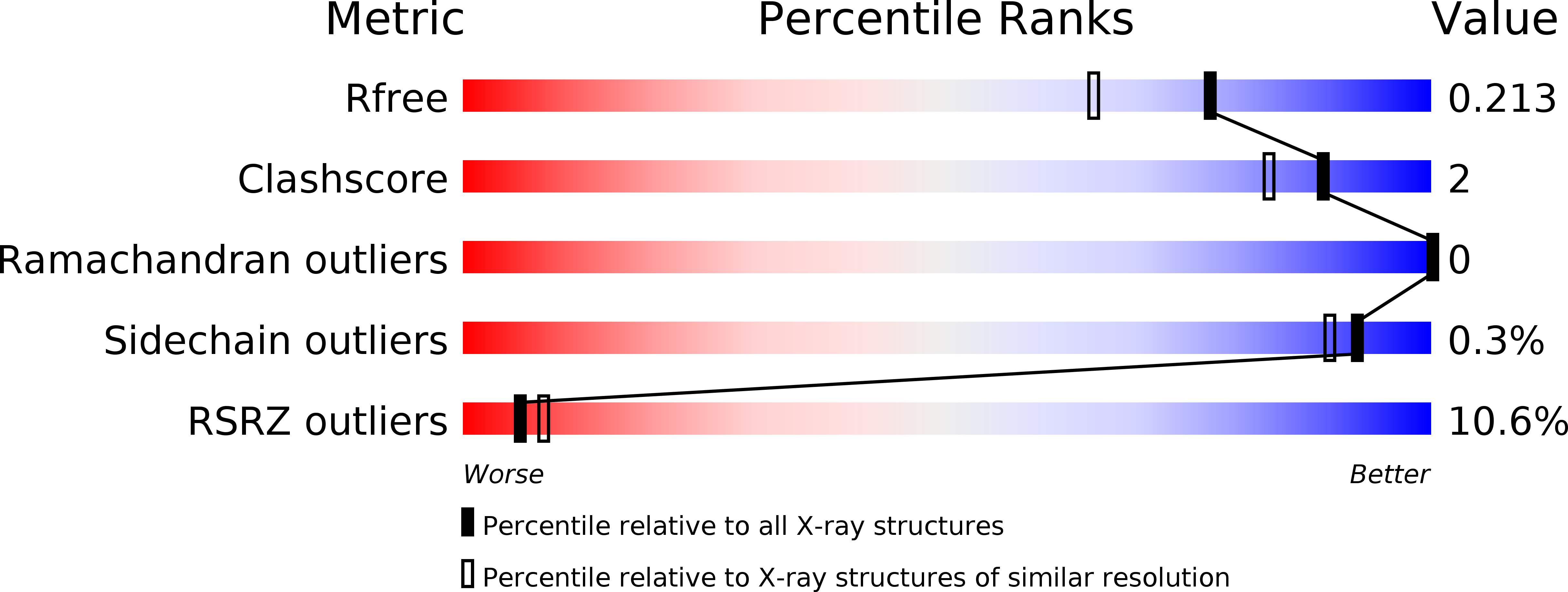
1.75 Å
R-Value Free:
0.21
R-Value Work:
0.18
R-Value Observed:
0.18
Space Group:
P 43 21 2
Macromolecular Entities
Structures with similar UniProt ID
Protein Blast
Polymer Type:polypeptide(L)
Molecule:Nucleoporin GLE1
Gene (Uniprot):GLE1
Chain IDs:A (auth: B), B (auth: A)
Chain Length:296
Number of Molecules:2
Biological Source:Saccharomyces cerevisiae (strain ATCC 204508 / S288c)
Structures with similar UniProt ID
Protein Blast
Polymer Type:polypeptide(L)
Molecule:Nucleoporin NUP42
Gene (Uniprot):NUP42
Chain IDs:C, D
Chain Length:39
Number of Molecules:2
Biological Source:Saccharomyces cerevisiae (strain ATCC 204508 / S288c)
Primary Citation
Structural and functional analysis of mRNA export regulation by the nuclear pore complex.
Nat Commun 9 2319 2319 (2018)
PMID: 29899397 DOI: 10.1038/s41467-018-04459-3

Abstact

The nuclear pore complex (NPC) controls the passage of macromolecules between the nucleus and cytoplasm, but how the NPC directly participates in macromolecular transport remains poorly understood. In the final step of mRNA export, the DEAD-box helicase DDX19 is activated by the nucleoporins Gle1, Nup214, and Nup42 to remove Nxf1•Nxt1 from mRNAs. Here, we report crystal structures of Gle1•Nup42 from three organisms that reveal an evolutionarily conserved binding mode. Biochemical reconstitution of the DDX19 ATPase cycle establishes that human DDX19 activation does not require IP6, unlike its fungal homologs, and that Gle1 stability affects DDX19 activation. Mutations linked to motor neuron diseases cause decreased Gle1 thermostability, implicating nucleoporin misfolding as a disease determinant. Crystal structures of human Gle1•Nup42•DDX19 reveal the structural rearrangements in DDX19 from an auto-inhibited to an RNA-binding competent state. Together, our results provide the foundation for further mechanistic analyses of mRNA export in humans.

Legend

Protein

Chemical

Disease

Primary Citation of related structures
Feedback Form
Name
Email
Institute
Feedback