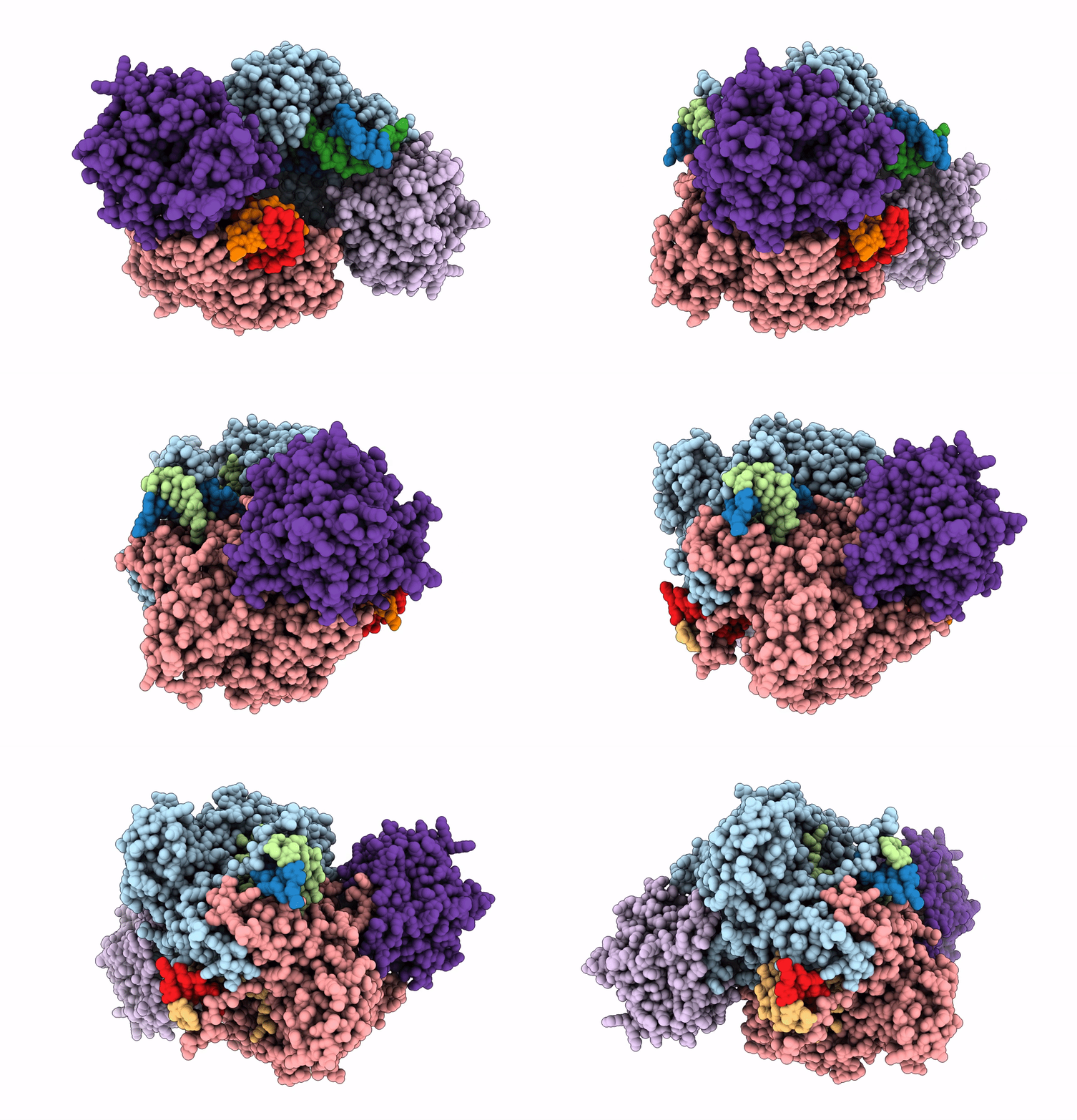
6B40 image
Deposition Date 2017-09-25
Release Date 2019-03-20
Last Version Date 2024-03-13
Entry Detail
PDB ID:
6B40
Keywords:
Title:
BbRAGL-3'TIR synaptic complex with nicked DNA refined with C2 symmetry
Biological Source:
Source Organism:
Host Organism:
Method Details:
Experimental Method:
Resolution:
4.30 Å
Aggregation State:
PARTICLE
Reconstruction Method:
SINGLE PARTICLE
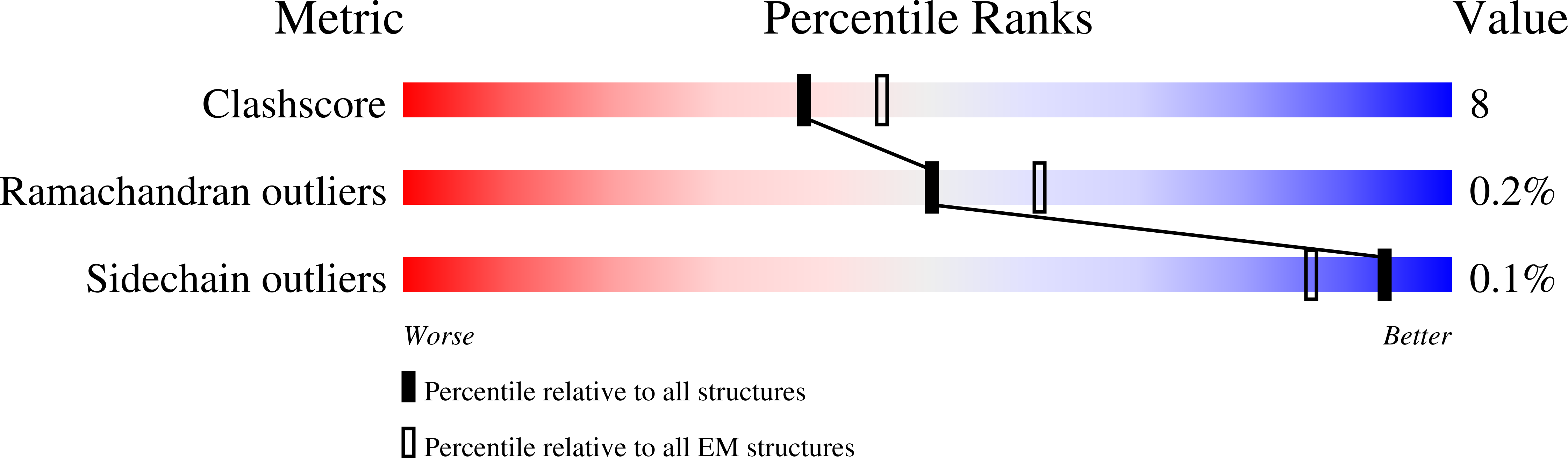
Macromolecular Entities
Structures with similar UniProt ID
Protein Blast
Polymer Type:polypeptide(L)
Molecule:RAG1L,RAG1L
Gene (Uniprot):RAG1L
Chain IDs:A, F (auth: E)
Chain Length:658
Number of Molecules:2
Biological Source:Branchiostoma belcheri
Polymer Type:polydeoxyribonucleotide
Molecule:31TIR intact strand
Chain IDs:B, G (auth: F)
Chain Length:62
Number of Molecules:2
Biological Source:Branchiostoma belcheri
Polymer Type:polydeoxyribonucleotide
Molecule:31TIR pre-nicked strand of signal DNA
Chain IDs:C, H (auth: G)
Chain Length:47
Number of Molecules:2
Biological Source:Branchiostoma belcheri
Polymer Type:polydeoxyribonucleotide
Molecule:31TIR pre-nicked strand of flanking DNA
Chain IDs:D, I (auth: H)
Chain Length:15
Number of Molecules:2
Biological Source:Branchiostoma belcheri
Structures with similar UniProt ID
Protein Blast
Polymer Type:polypeptide(L)
Molecule:RAG2L
Gene (Uniprot):RAG2L
Chain IDs:E (auth: M), J (auth: N)
Chain Length:366
Number of Molecules:2
Biological Source:Branchiostoma belcheri
Primary Citation
Transposon molecular domestication and the evolution of the RAG recombinase.
Nature 569 79 84 (2019)
PMID: 30971819 DOI: 10.1038/s41586-019-1093-7

Abstact

Domestication of a transposon (a DNA sequence that can change its position in a genome) to give rise to the RAG1-RAG2 recombinase (RAG) and V(D)J recombination, which produces the diverse repertoire of antibodies and T cell receptors, was a pivotal event in the evolution of the adaptive immune system of jawed vertebrates. The evolutionary adaptations that transformed the ancestral RAG transposase into a RAG recombinase with appropriately regulated DNA cleavage and transposition activities are not understood. Here, beginning with cryo-electron microscopy structures of the amphioxus ProtoRAG transposase (an evolutionary relative of RAG), we identify amino acid residues and domains the acquisition or loss of which underpins the propensity of RAG for coupled cleavage, its preference for asymmetric DNA substrates and its inability to perform transposition in cells. In particular, we identify two adaptations specific to jawed-vertebrates-arginine 848 in RAG1 and an acidic region in RAG2-that together suppress RAG-mediated transposition more than 1,000-fold. Our findings reveal a two-tiered mechanism for the suppression of RAG-mediated transposition, illuminate the evolution of V(D)J recombination and provide insight into the principles that govern the molecular domestication of transposons.

Legend

Protein

Chemical

Disease

Primary Citation of related structures
Feedback Form
Name
Email
Institute
Feedback