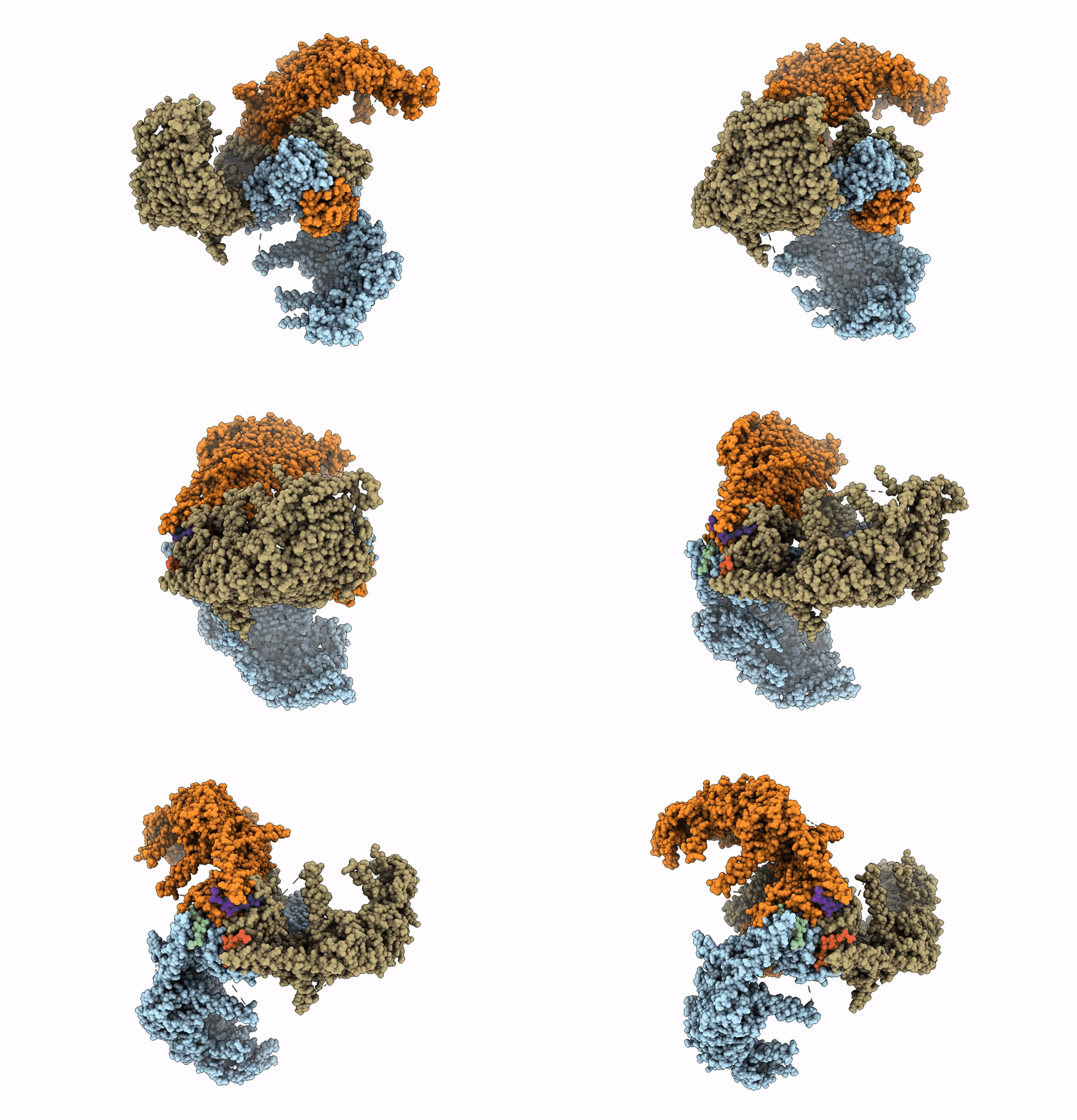
6B3R image
Deposition Date 2017-09-22
Release Date 2017-12-20
Last Version Date 2024-10-23
Entry Detail
PDB ID:
6B3R
Title:
Structure of the mechanosensitive channel Piezo1
Biological Source:
Source Organism:
Mus musculus (Taxon ID: 10090)
Host Organism:
Method Details:
Experimental Method:
Resolution:
3.80 Å
Aggregation State:
PARTICLE
Reconstruction Method:
SINGLE PARTICLE
Macromolecular Entities
Structures with similar UniProt ID
Protein Blast
Polymer Type:polypeptide(L)
Molecule:Piezo-type mechanosensitive ion channel component 1
Gene (Uniprot):Piezo1
Chain IDs:A, C, D (auth: E)
Chain Length:2547
Number of Molecules:3
Biological Source:Mus musculus
Polymer Type:polypeptide(L)
Molecule:Piezo-type mechanosensitive ion channel component 1, unknown fragment
Chain IDs:B, E (auth: D), F
Chain Length:16
Number of Molecules:3
Biological Source:Mus musculus
Ligand Molecules
Primary Citation
Structure-based membrane dome mechanism for Piezo mechanosensitivity.
Elife 6 ? ? (2017)
PMID: 29231809 DOI: 10.7554/eLife.33660

Abstact

Mechanosensitive ion channels convert external mechanical stimuli into electrochemical signals for critical processes including touch sensation, balance, and cardiovascular regulation. The best understood mechanosensitive channel, MscL, opens a wide pore, which accounts for mechanosensitive gating due to in-plane area expansion. Eukaryotic Piezo channels have a narrow pore and therefore must capture mechanical forces to control gating in another way. We present a cryo-EM structure of mouse Piezo1 in a closed conformation at 3.7Å-resolution. The channel is a triskelion with arms consisting of repeated arrays of 4-TM structural units surrounding a pore. Its shape deforms the membrane locally into a dome. We present a hypothesis in which the membrane deformation changes upon channel opening. Quantitatively, membrane tension will alter gating energetics in proportion to the change in projected area under the dome. This mechanism can account for highly sensitive mechanical gating in the setting of a narrow, cation-selective pore.

Legend

Protein

Chemical

Disease

Primary Citation of related structures
Feedback Form
Name
Email
Institute
Feedback