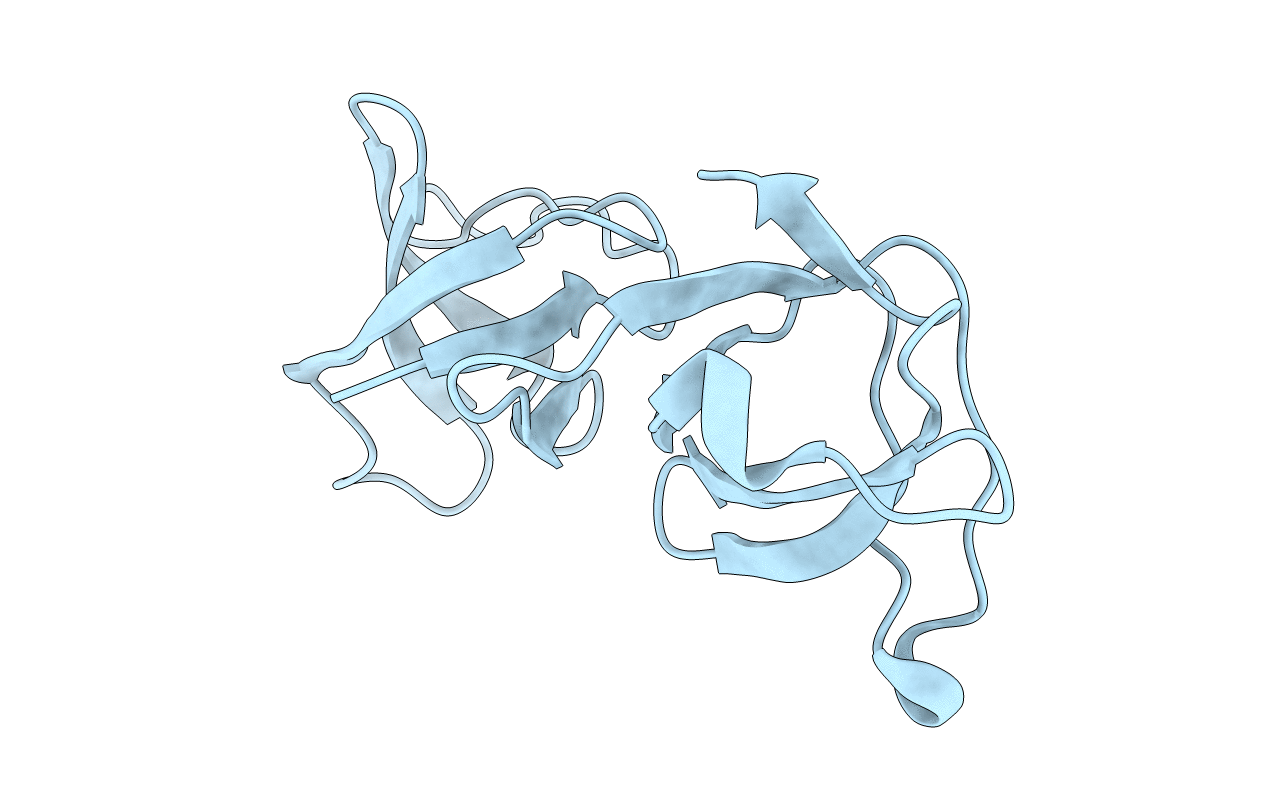
6B26 image
Deposition Date 2017-09-19
Release Date 2017-10-25
Last Version Date 2023-10-04
Entry Detail
PDB ID:
6B26
Keywords:
Title:
Crystal structure of human STAC2 Tandem SH3 Domains (296-411)
Biological Source:
Source Organism(s):
Homo sapiens (Taxon ID: 9606)
Expression System(s):
Method Details:
Experimental Method:
Resolution:
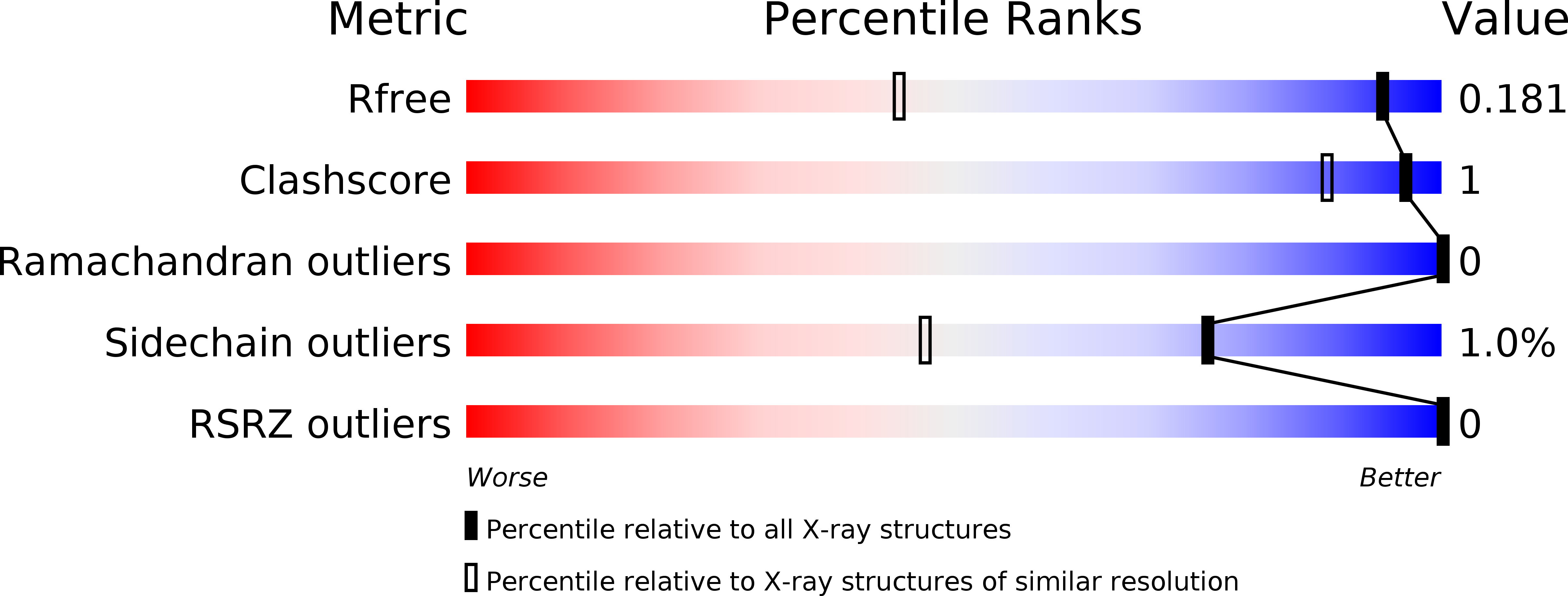
1.20 Å
R-Value Free:
0.16
R-Value Work:
0.15
R-Value Observed:
0.15
Space Group:
P 21 21 21
Macromolecular Entities
Structures with similar UniProt ID
Protein Blast
Polymer Type:polypeptide(L)
Molecule:SH3 and cysteine-rich domain-containing protein 2
Gene (Uniprot):STAC2
Chain IDs:A
Chain Length:120
Number of Molecules:1
Biological Source:Homo sapiens
Primary Citation
Structural insights into binding of STAC proteins to voltage-gated calcium channels.
Proc. Natl. Acad. Sci. U.S.A. 114 E9520 E9528 (2017)
PMID: 29078335 DOI: 10.1073/pnas.1708852114

Abstact

Excitation-contraction (EC) coupling in skeletal muscle requires functional and mechanical coupling between L-type voltage-gated calcium channels (CaV1.1) and the ryanodine receptor (RyR1). Recently, STAC3 was identified as an essential protein for EC coupling and is part of a group of three proteins that can bind and modulate L-type voltage-gated calcium channels. Here, we report crystal structures of tandem-SH3 domains of different STAC isoforms up to 1.2-Å resolution. These form a rigid interaction through a conserved interdomain interface. We identify the linker connecting transmembrane repeats II and III in two different CaV isoforms as a binding site for the SH3 domains and report a crystal structure of the complex with the STAC2 isoform. The interaction site includes the location for a disease variant in STAC3 that has been linked to Native American myopathy (NAM). Introducing the mutation does not cause misfolding of the SH3 domains, but abolishes the interaction. Disruption of the interaction via mutations in the II-III loop perturbs skeletal muscle EC coupling, but preserves the ability of STAC3 to slow down inactivation of CaV1.2.

Legend

Protein

Chemical

Disease

Primary Citation of related structures
Feedback Form
Name
Email
Institute
Feedback