6B12 image
Deposition Date 2017-09-15
Release Date 2017-12-20
Last Version Date 2024-10-30
Entry Detail
PDB ID:
6B12
Title:
Structure of Tne2 in complex with Tni2
Biological Source:
Method Details:
Experimental Method:
Resolution:
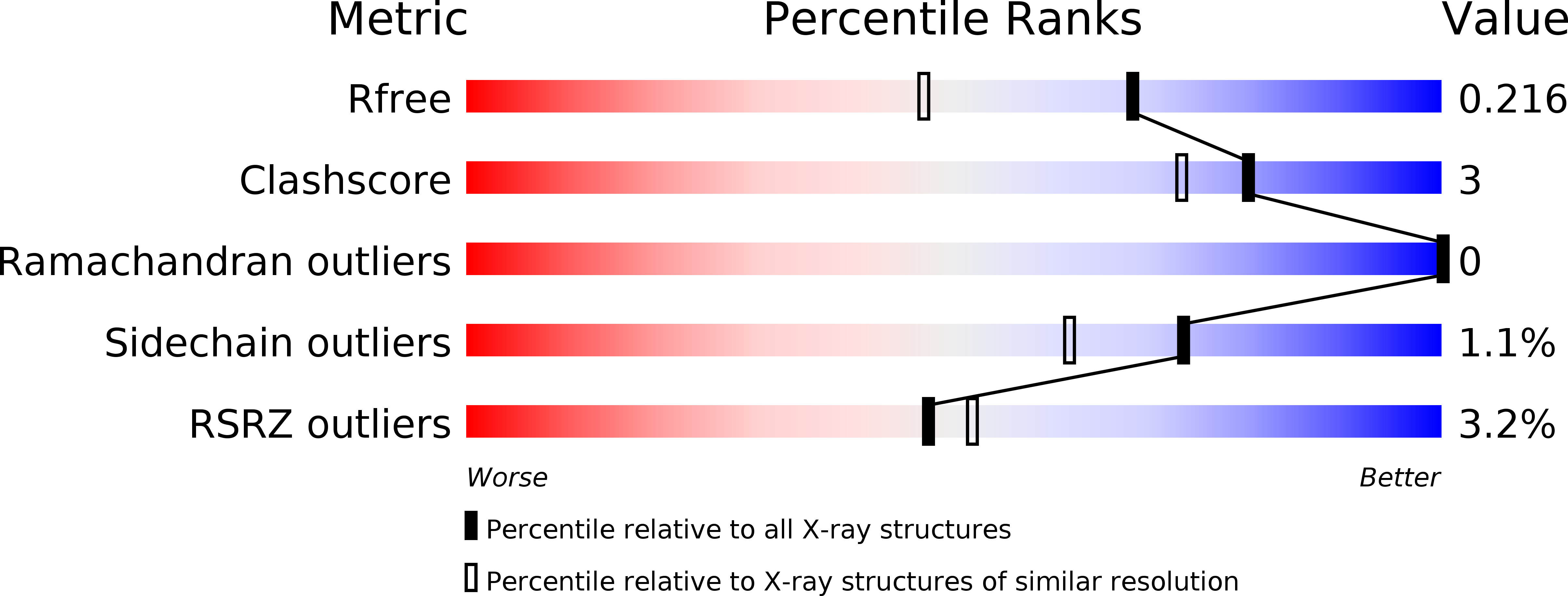
1.71 Å
R-Value Free:
0.21
R-Value Work:
0.18
R-Value Observed:
0.18
Space Group:
C 1 2 1
Macromolecular Entities
Structures with similar UniProt ID
Protein Blast
Polymer Type:polypeptide(L)
Molecule:Tne2
Gene (Uniprot):PFL_6209
Chain IDs:A, D
Chain Length:135
Number of Molecules:2
Biological Source:Pseudomonas fluorescens (strain ATCC BAA-477 / NRRL B-23932 / Pf-5)
Structures with similar UniProt ID
Protein Blast
Polymer Type:polypeptide(L)
Molecule:Tni2
Gene (Uniprot):PFL_6210
Chain IDs:B, C
Chain Length:153
Number of Molecules:2
Biological Source:Pseudomonas fluorescens (strain ATCC BAA-477 / NRRL B-23932 / Pf-5)
Modified Residue
Compound ID Chain ID Parent Comp ID Details 2D Image
MSE A MET modified residue
Primary Citation
Diverse NADase effector families mediate interbacterial antagonism via the type VI secretion system.
J. Biol. Chem. 293 1504 1514 (2018)
PMID: 29237732 DOI: 10.1074/jbc.RA117.000178

Abstact

The bacterial type VI secretion system (T6SS) mediates antagonistic cell-cell interactions between competing Gram-negative bacteria. In plant-beneficial bacteria, this pathway has been shown to suppress the growth of bacterial pathogens; however, the identification and mode of action of T6SS effector proteins that mediate this protective effect remain poorly defined. Here, we identify two previously uncharacterized effectors required for interbacterial antagonism by the plant commensal bacterium Pseudomonas protegens Consistent with the established effector-immunity paradigm for antibacterial T6SS substrates, the toxic activities of these effectors are neutralized by adjacently encoded cognate immunity determinants. Although one of these effectors, RhsA, belongs to the family of DNase enzymes, the activity of the other was not apparent from its sequence. To determine the mechanism of toxicity of this latter effector, we determined its 1.3 Å crystal structure in complex with its immunity protein and found that it resembles NAD(P)+-degrading enzymes. In line with this structural similarity, biochemical characterization of this effector, termed Tne2 (Type VI secretion NADase effector family 2), demonstrates that it possesses potent NAD(P)+ hydrolase activity. Tne2 is the founding member of a widespread family of interbacterial NADases predicted to transit not only the Gram-negative T6SS but also the Gram-positive type VII secretion system, a pathway recently implicated in interbacterial competition among Firmicutes. Together, this work identifies new T6SS effectors employed by a plant commensal bacterium to antagonize its competitors and broadly implicates NAD(P)+-hydrolyzing enzymes as substrates of interbacterial conflict pathways found in diverse bacterial phyla.

Legend

Protein

Chemical

Disease

Primary Citation of related structures
Feedback Form
Name
Email
Institute
Feedback