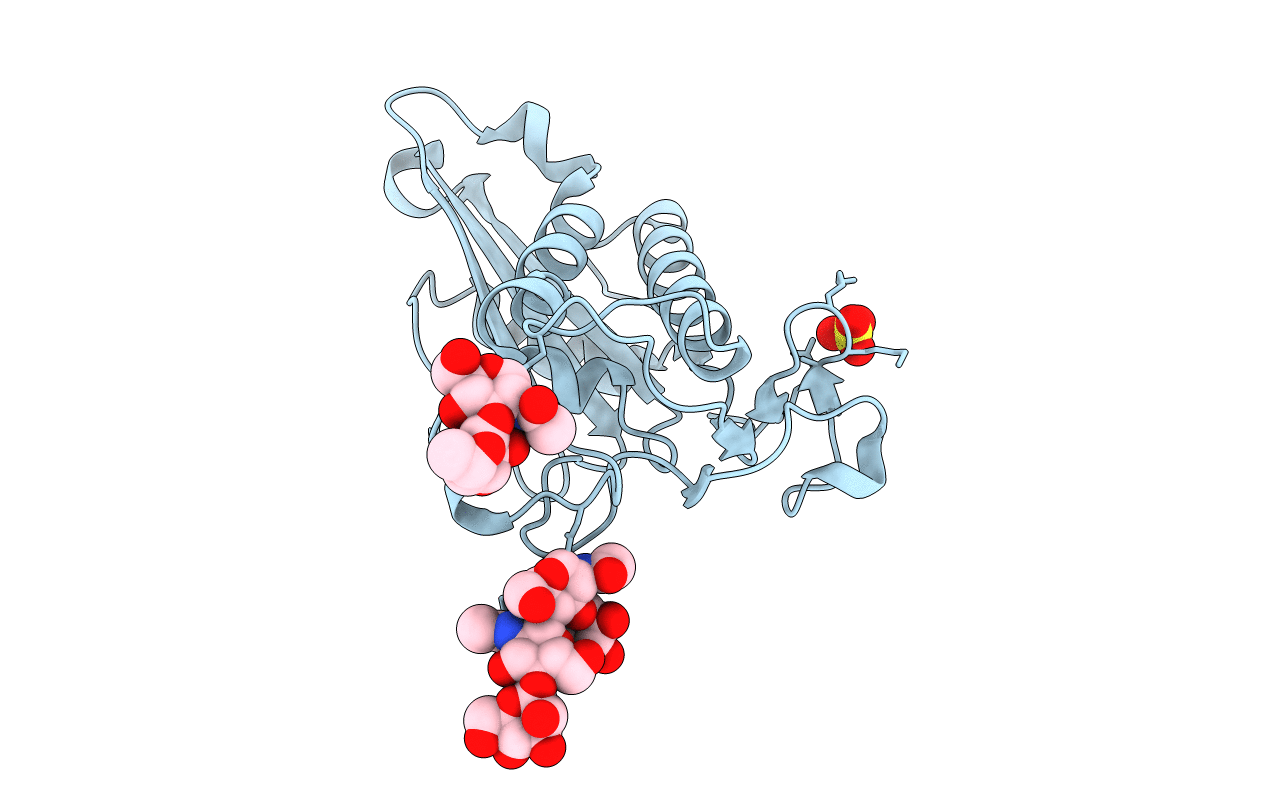
6ANY image
Deposition Date 2017-08-14
Release Date 2018-03-28
Last Version Date 2024-10-16
Entry Detail
PDB ID:
6ANY
Keywords:
Title:
Structure of BmVAL-1
Biological Source:
Source Organism(s):
Brugia malayi (Taxon ID: 6279)
Expression System(s):
Method Details:
Experimental Method:
Resolution:
2.25 Å
R-Value Free:
0.21
R-Value Work:
0.18
R-Value Observed:
0.18
Space Group:
P 43 21 2
Macromolecular Entities
Structures with similar UniProt ID
Protein Blast
Polymer Type:polypeptide(L)
Molecule:Bm4233, isoform b
Chain IDs:A
Chain Length:206
Number of Molecules:1
Biological Source:Brugia malayi
Ligand Molecules
Primary Citation
Crystal structure of Brugia malayi venom allergen-like protein-1 (BmVAL-1), a vaccine candidate for lymphatic filariasis.
Int. J. Parasitol. 48 371 378 (2018)
PMID: 29501266 DOI: 10.1016/j.ijpara.2017.12.003

Abstact

Brugia malayi is a causative agent of lymphatic filariasis, a major tropical disease. The infective L3 parasite stage releases immunomodulatory proteins including the venom allergen-like proteins (VALs), which are members of the SCP/TAPS (Sperm-coating protein/Tpx/antigen 5/pathogenesis related-1/Sc7) superfamily. BmVAL-1 is a major target of host immunity with >90% of infected B. malayi microfilaraemic cases being seropositive for antibodies to BmVAL-1. This study is part of ongoing efforts to characterize the structures and functions of important B. malayi proteins. Recombinant BmVAL-1 was produced using a plant expression system, crystallized and the structure was solved by molecular replacement and refined to 2.1 Å, revealing the characteristic alpha/beta/alpha sandwich topology of eukaryotic SCP/TAPS proteins. The protein has more than 45% loop regions and these flexible loops connect the helices and strands, which are longer than predicted based on other parasite SCP/TAPS protein structures. The large central cavity of BmVAL-1 is a prototypical CRISP cavity with two histidines required to bind divalent cations. The caveolin-binding motif (CBM) that mediates sterol binding in SCP/TAPS proteins is large and open in BmVAL-1 and is N-glycosylated. N-glycosylation of the CBM does not affect the ability of BmVAL-1 to bind sterol in vitro. BmVAL-1 complements the in vivo sterol export phenotype of yeast mutants lacking their endogenous SCP/TAPS proteins. The in vitro sterol-binding affinity of BmVAL-1 is comparable with Pry1, a yeast sterol transporting SCP/TAPS protein. Sterol binding of BmVAL-1 is dependent on divalent cations. BmVAL-1 also has a large open palmitate-binding cavity, which binds palmitate comparably to tablysin-15, a lipid-binding SCP/TAPS protein. The central cavity, CBM and palmitate-binding cavity of BmVAL-1 are interconnected within the monomer with channels that can serve as pathways for water molecules, cations and small molecules.

Legend

Protein

Chemical

Disease

Primary Citation of related structures
Feedback Form
Name
Email
Institute
Feedback