5x6b image
Deposition Date 2017-02-21
Release Date 2017-12-06
Last Version Date 2023-11-22
Entry Detail
PDB ID:
5X6B
Title:
Crystal structure of SepCysE-SepCysS in complex with tRNACys from Methanocaldococcus jannaschii
Biological Source:
Source Organism:
Host Organism:
Method Details:
Experimental Method:
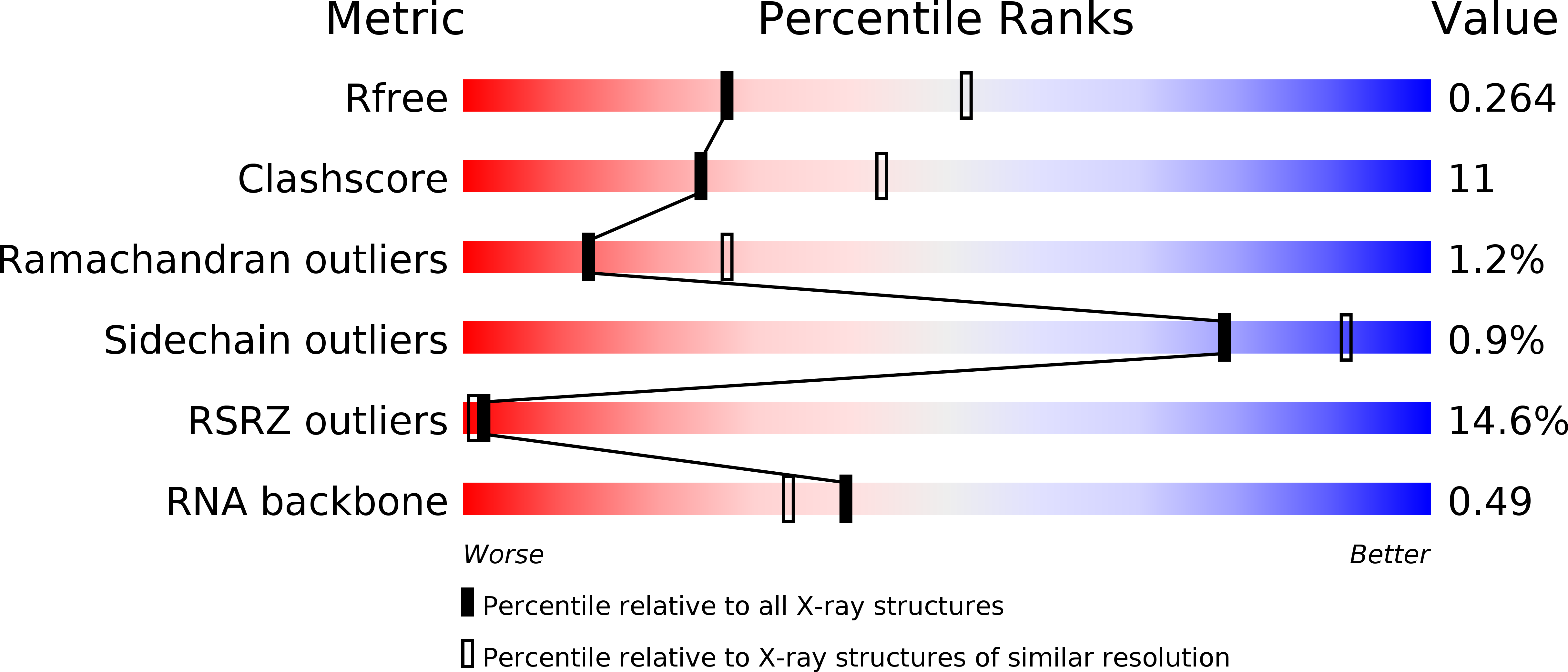
Resolution:
2.60 Å
R-Value Free:
0.26
R-Value Work:
0.22
R-Value Observed:
0.22
Space Group:
P 65 2 2
Macromolecular Entities
Structures with similar UniProt ID
Protein Blast
Polymer Type:polypeptide(L)
Molecule:Uncharacterized protein MJ1481
Gene (Uniprot):MJ1481
Chain IDs:C (auth: E), D (auth: F)
Chain Length:216
Number of Molecules:2
Biological Source:Methanocaldococcus jannaschii
Structures with similar UniProt ID
Protein Blast
Polymer Type:polypeptide(L)
Molecule:O-phospho-L-seryl-tRNA:Cys-tRNA synthase
Chain IDs:A (auth: I), B (auth: J)
Chain Length:417
Number of Molecules:2
Biological Source:Methanocaldococcus jannaschii DSM 2661
Polymer Type:polyribonucleotide
Molecule:tRNACys
Chain IDs:E (auth: P)
Chain Length:75
Number of Molecules:1
Biological Source:Methanocaldococcus jannaschii DSM 2661
Modified Residue
Compound ID Chain ID Parent Comp ID Details 2D Image
LLP A LYS modified residue
Primary Citation
Structural basis for tRNA-dependent cysteine biosynthesis
Nat Commun 8 1521 1521 (2017)
PMID: 29142195 DOI: 10.1038/s41467-017-01543-y

Abstact

Cysteine can be synthesized by tRNA-dependent mechanism using a two-step indirect pathway, where O-phosphoseryl-tRNA synthetase (SepRS) catalyzes the ligation of a mismatching O-phosphoserine (Sep) to tRNACys followed by the conversion of tRNA-bounded Sep into cysteine by Sep-tRNA:Cys-tRNA synthase (SepCysS). In ancestral methanogens, a third protein SepCysE forms a bridge between the two enzymes to create a ternary complex named the transsulfursome. By combination of X-ray crystallography, SAXS and EM, together with biochemical evidences, here we show that the three domains of SepCysE each bind SepRS, SepCysS, and tRNACys, respectively, which mediates the dynamic architecture of the transsulfursome and thus enables a global long-range channeling of tRNACys between SepRS and SepCysS distant active sites. This channeling mechanism could facilitate the consecutive reactions of the two-step indirect pathway of Cys-tRNACys synthesis (tRNA-dependent cysteine biosynthesis) to prevent challenge of translational fidelity, and may reflect the mechanism that cysteine was originally added into genetic code.

Legend

Protein

Chemical

Disease

Primary Citation of related structures
Feedback Form
Name
Email
Institute
Feedback