5ZUL image
Deposition Date 2018-05-08
Release Date 2019-01-30
Last Version Date 2023-11-22
Entry Detail
PDB ID:
5ZUL
Keywords:
Title:
Small heat shock protein from Mycobacterium marinum M : Form-3
Biological Source:
Source Organism:
Host Organism:
Method Details:
Experimental Method:
Resolution:
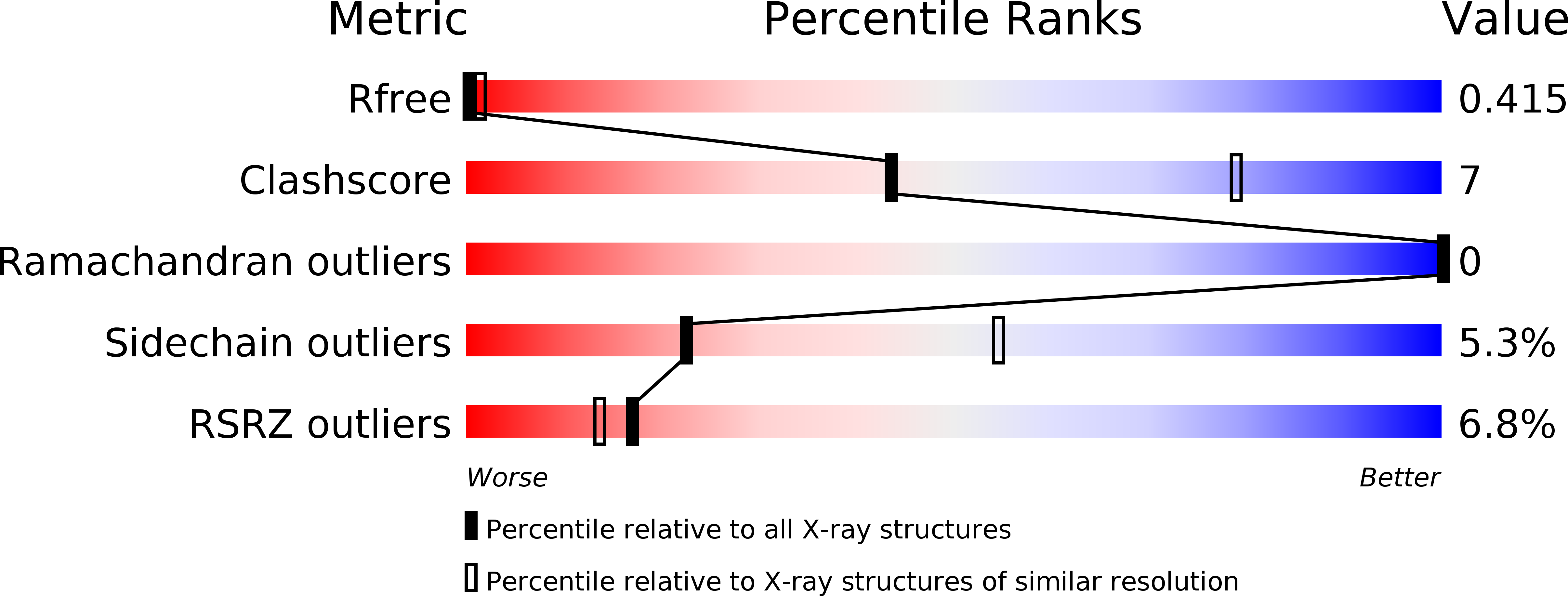
3.75 Å
R-Value Free:
0.40
R-Value Work:
0.36
R-Value Observed:
0.36
Space Group:
C 2 2 21
Macromolecular Entities
Structures with similar UniProt ID
Protein Blast
Polymer Type:polypeptide(L)
Molecule:Small heat shock protein
Gene (Uniprot):MMAR_2991
Chain IDs:A, B, C, D, E, F
Chain Length:149
Number of Molecules:6
Biological Source:Mycobacterium marinum M
Ligand Molecules
Primary Citation
Dodecameric structure of a small heat shock protein from Mycobacterium marinum M.
Proteins 87 365 379 (2019)
PMID: 30632633 DOI: 10.1002/prot.25657

Abstact

Small heat shock proteins (sHSPs) are ATP-independent molecular chaperones present ubiquitously in all kingdoms of life. Their low molecular weight subunits associate to form higher order structures. Under conditions of stress, sHSPs prevent aggregation of substrate proteins by undergoing rapid changes in their conformation or stoichiometry. Polydispersity and dynamic nature of these proteins have made structural investigations through crystallography a daunting task. In pathogens like Mycobacteria, sHSPs are immuno-dominant antigens, enabling survival of the pathogen within the host and contributing to disease persistence. We characterized sHSPs from Mycobacterium marinum M and determined the crystal structure of one of these. The protein crystallized in three different conditions as dodecamers, with dimers arranged in a tetrahedral fashion to form a closed cage-like architecture. Interestingly, we found a pentapeptide bound to the dodecamers revealing one of the modes of sHSP-substrate interaction. Further, we have observed that ATP inhibits the chaperoning activity of the protein.

Legend

Protein

Chemical

Disease

Primary Citation of related structures
Feedback Form
Name
Email
Institute
Feedback