5ZCU image
Deposition Date 2018-02-20
Release Date 2019-03-06
Last Version Date 2023-11-22
Entry Detail
PDB ID:
5ZCU
Keywords:
Title:
Crystal structure of RCAR3:PP2C wild-type with pyrabactin
Biological Source:
Source Organism:
Host Organism:
Method Details:
Experimental Method:
Resolution:
2.41 Å
R-Value Free:
0.25
R-Value Work:
0.20
R-Value Observed:
0.20
Space Group:
C 2 2 21
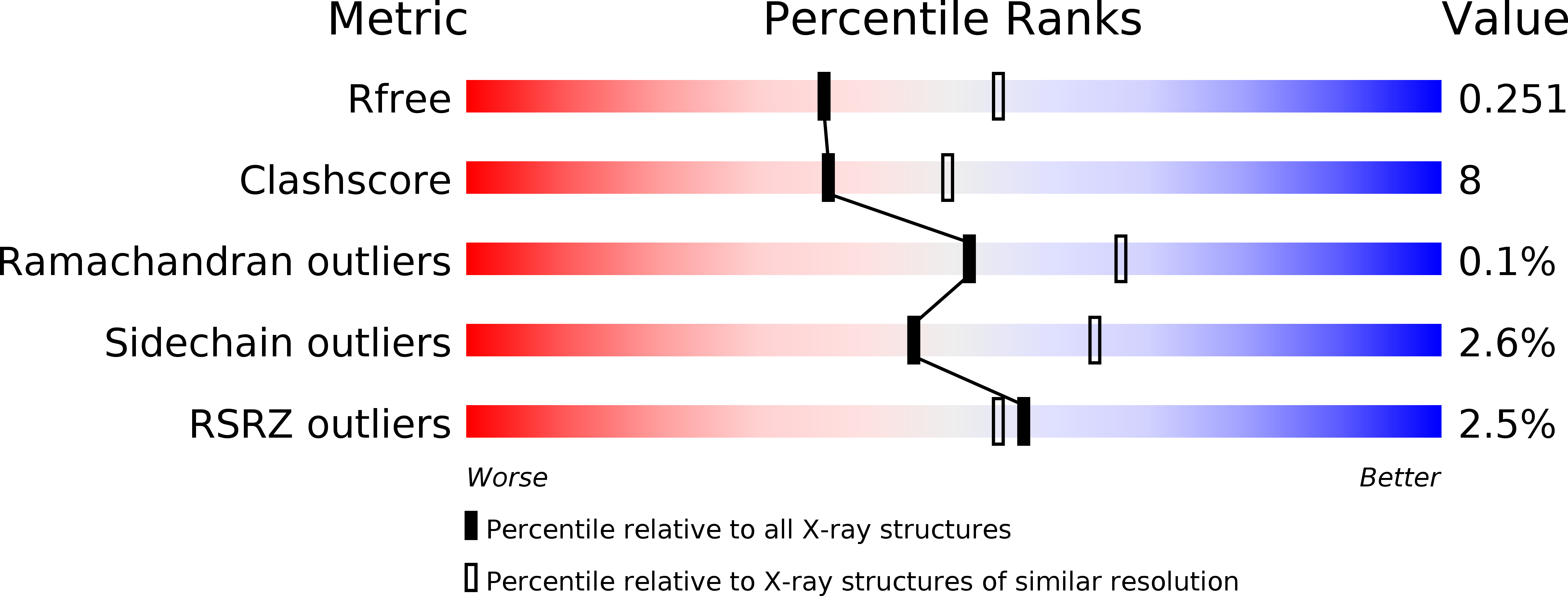
Macromolecular Entities
Structures with similar UniProt ID
Protein Blast
Polymer Type:polypeptide(L)
Molecule:Probable protein phosphatase 2C 50
Gene (Uniprot):PP2C50
Mutagens:E139A/E140A/K142A
Chain IDs:A, B
Chain Length:328
Number of Molecules:2
Biological Source:Oryza sativa subsp. japonica
Structures with similar UniProt ID
Protein Blast
Polymer Type:polypeptide(L)
Molecule:ABA receptor RCAR3
Chain IDs:C, D
Chain Length:175
Number of Molecules:2
Biological Source:Oryza sativa
Primary Citation
Structural determinants for pyrabactin recognition in ABA receptors in Oryza sativa.
Plant Mol.Biol. 100 319 333 (2019)
PMID: 30941543 DOI: 10.1007/s11103-019-00862-6

Abstact

We determined the structure of OsPYL/RCAR3:OsPP2C50 complex with pyrabactin. Our results suggest that a less-conserved phenylalanine of OsPYL/RCAR subfamily I is one of considerations of ABA agonist development for Oryza sativa. Pyrabactin is a synthetic chemical mimicking abscisic acid (ABA), a naturally occurring phytohormone orchestrating abiotic stress responses. ABA and pyrabactin share the same pocket in the ABA receptors but pyrabactin modulates ABA signaling differently, exhibiting both agonistic and antagonistic effects. To explore structural determinants of differential functionality of pyrabactin, we determined the crystal structure of OsPYL/RCAR3:pyrabactin:OsPP2C50, the first rice ABA receptor:co-receptor complex structure with a synthetic ABA mimicry. The water-mediated interaction between the wedging Trp-259 of OsPP2C50 and pyrabactin is lost, undermining the structural integrity of the ABA receptor:co-receptor. The loss of the interaction of the wedging tryptophan of OsPP2C with pyrabactin appears to contribute to the weaker functionality of pyrabactin. Pyrabactin in the OsPYL/RCAR3:OsPP2C50 complex adopts a conformation different from that in ABA receptors from Arabidopsis. Phe125, specific to the subfamily I of OsPYL/RCARs in the ABA binding pocket, appears to be the culprit for the differential conformation of pyrabactin. Although the gate closure essential for the integrity of ABA receptor:co-receptor is preserved in the presence of pyrabactin, Phe125 apparently restricts accessibility of pyrabactin, leading to decreased affinity for OsPYL/RCAR3 evidenced by phosphatase assay. However, Phe125 does not affect conformation and accessibility of ABA. Yeast two-hybrid, germination and gene transcription analyses in rice also support that pyrabactin imposes a weak effect on the control of ABA signaling. Taken together, our results suggest that phenylalanine substitution of OsPYL/RCARs subfamily I may be one of considerations for ABA synthetic agonist development.

Legend

Protein

Chemical

Disease

Primary Citation of related structures
Feedback Form
Name
Email
Institute
Feedback