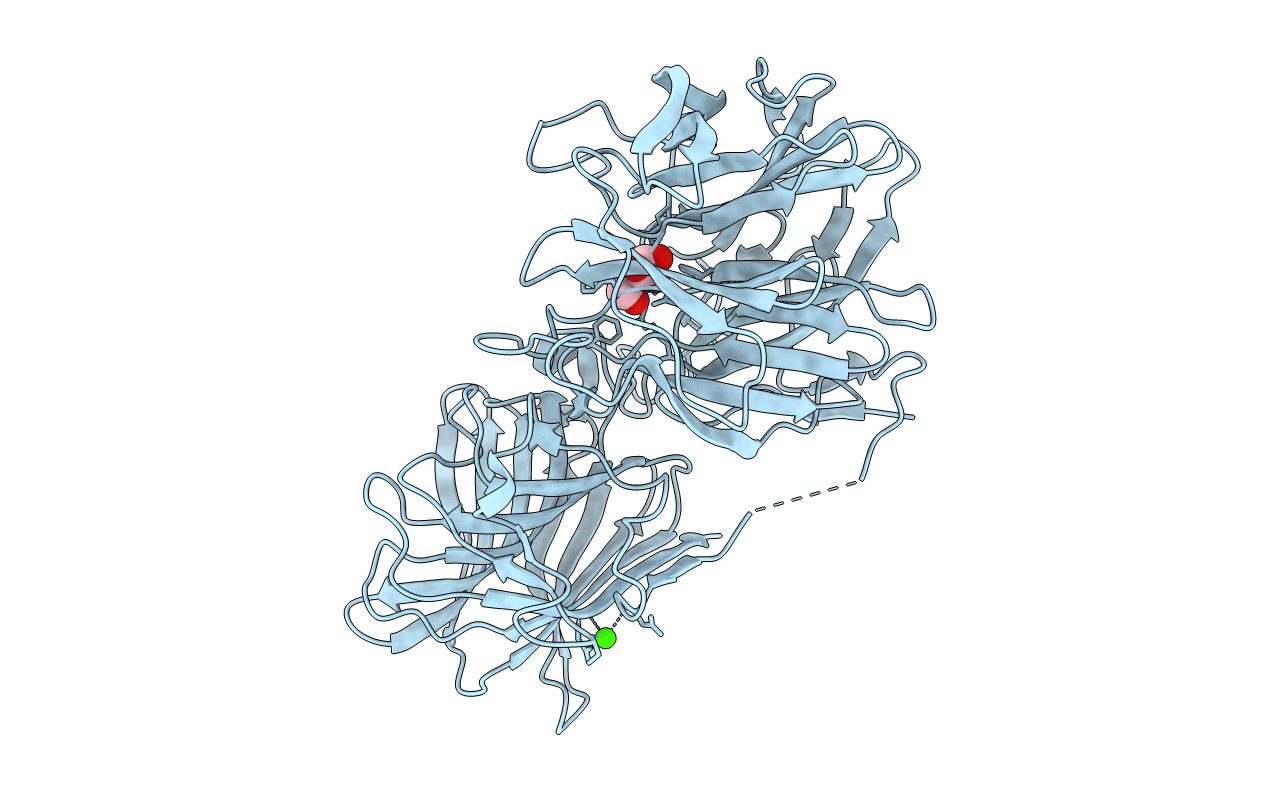
5Z5F image
Deposition Date 2018-01-18
Release Date 2018-04-25
Last Version Date 2023-11-22
Entry Detail
PDB ID:
5Z5F
Keywords:
Title:
Crystal structure of a thermostable glycoside hydrolase family 43 {beta}-1,4-xylosidase from Geobacillus thermoleovorans IT-08 in complex with L-arabinose
Biological Source:
Source Organism:
Method Details:
Experimental Method:
Resolution:
2.10 Å
R-Value Free:
0.19
R-Value Work:
0.14
R-Value Observed:
0.15
Space Group:
P 43 21 2
Macromolecular Entities
Structures with similar UniProt ID
Protein Blast
Polymer Type:polypeptide(L)
Molecule:Beta-xylosidase
Gene (Uniprot):xyl
Chain IDs:A
Chain Length:543
Number of Molecules:1
Biological Source:Geobacillus thermoleovorans
Primary Citation
Structural basis of product inhibition by arabinose and xylose of the thermostable GH43 beta-1,4-xylosidase from Geobacillus thermoleovorans IT-08.
PLoS ONE 13 e0196358 e0196358 (2018)
PMID: 29698436 DOI: 10.1371/journal.pone.0196358

Abstact

Complete degradation of the xylan backbone of hemicellulosic plant cell walls requires the synergistic action of endo-xylanases and β-1,4-xylosidases. While endo-xylanases produce xylooligosaccharides from xylan, β-1,4-xylosidases degrade the xylooligosaccharides into xylose monomers. The glycoside hydrolase family 43 β-1,4-xylosidase from Geobacillus thermoleovorans IT-08 is a promising, heat stable catalyst for the saccharification of hemicellulosic material into simple fermentable sugars, but it is competitively inhibited by its products arabinose and xylose. As a first step to help overcome this problem, we elucidated crystal structures of the enzyme in the unliganded form and with bound products, at 1.7-2.0 Å resolution. The structures are very similar to those of other enzymes belonging to glycoside hydrolase family 43. Unexpectedly, the monosaccharides are bound in very different ways. Arabinose preferentially binds in subsite -1, while xylose exclusively interacts with subsite +1. These structures and sugar binding preferences suggest ways for improving the catalytic performance of the enzyme by rational mutational design.

Legend

Protein

Chemical

Disease

Primary Citation of related structures
Feedback Form
Name
Email
Institute
Feedback