5YRP image
Deposition Date 2017-11-09
Release Date 2018-05-09
Last Version Date 2024-11-06
Entry Detail
PDB ID:
5YRP
Title:
Crystal structure of the EAL domain of Mycobacterium smegmatis DcpA
Biological Source:
Method Details:
Experimental Method:
Resolution:
2.99 Å
R-Value Free:
0.30
R-Value Work:
0.25
R-Value Observed:
0.25
Space Group:
I 4 2 2
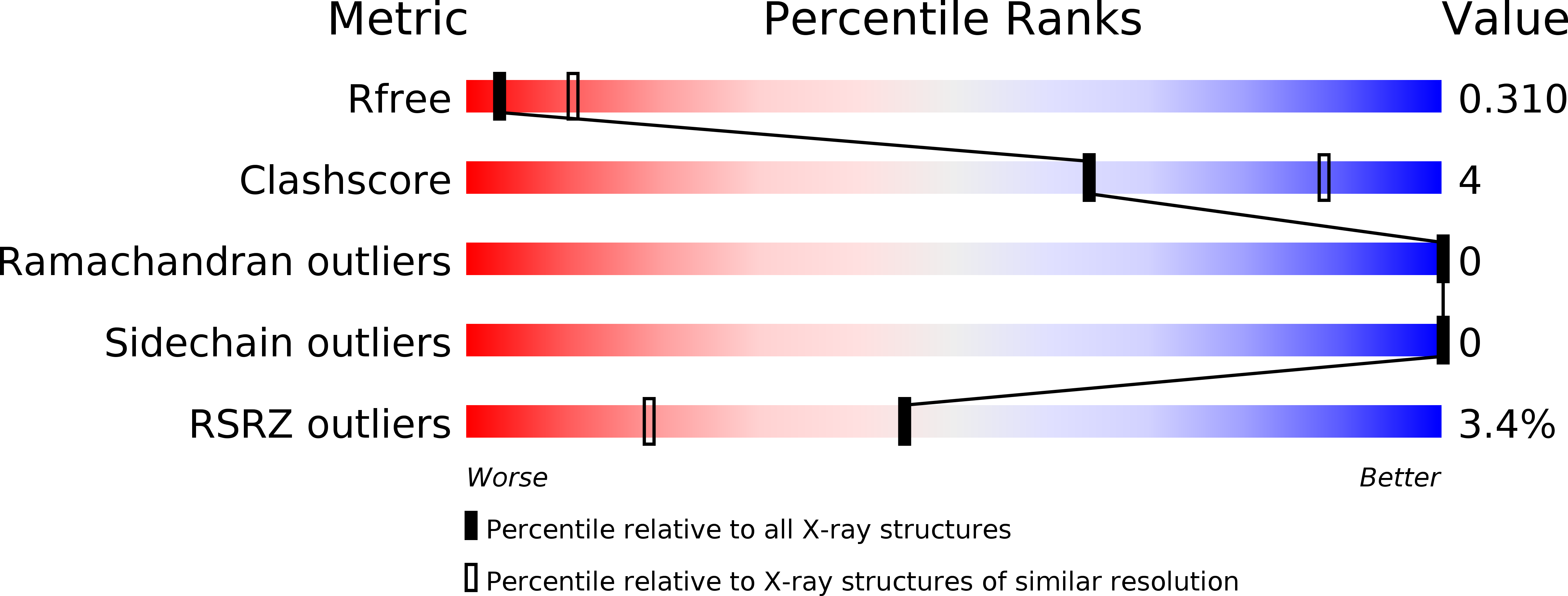
Macromolecular Entities
Structures with similar UniProt ID
Protein Blast
Polymer Type:polypeptide(L)
Molecule:Sensory box/response regulator
Gene (Uniprot):MSMEG_2196
Chain IDs:A, B
Chain Length:247
Number of Molecules:2
Biological Source:Mycobacterium smegmatis (strain ATCC 700084 / mc(2)155)
Modified Residue
Compound ID Chain ID Parent Comp ID Details 2D Image
MSE A MET modified residue
Ligand Molecules
Primary Citation
The GDP-switched GAF domain of DcpA modulates the concerted synthesis/hydrolysis of c-di-GMP inMycobacterium smegmatis.
Biochem. J. 475 1295 1308 (2018)
PMID: 29555845 DOI: 10.1042/BCJ20180079

Abstact

The second messenger c-di-GMP [bis-(3'-5')-cyclic dimeric guanosine monophosphate] plays a key role in bacterial growth, survival and pathogenesis, and thus its intracellular homeostasis should be finely maintained. Mycobacterium smegmatis encodes a GAF (mammalian cGMP-regulated phosphodiesterases, Anabaenaadenylyl cyclases and Escherichia coli transcription activator FhlA) domain containing bifunctional enzyme DcpA (diguanylate cyclase and phosphodiesterase A) that catalyzes the synthesis and hydrolysis of c-di-GMP. Here, we found that M. smegmatis DcpA catalyzes the hydrolysis of c-di-GMP at a higher velocity, compared with synthetic activity, resulting in a sum reaction from the ultimate substrate GTP to the final product pGpG [5'-phosphoguanylyl-(3'-5')-guanosine]. Fusion with the N-terminal GAF domain enables the GGDEF (Gly-Gly-Asp-Glu-Phe) domain of DcpA to dimerize and accordingly gain synthetic activity. Screening of putative metabolites revealed that GDP is the ligand of the GAF domain. Binding of GDP to the GAF domain down-regulates synthetic activity, but up-regulates hydrolytic activity, which, in consequence, might enable a timely response to the transient accumulation of c-di-GMP at the stationary phase or under stresses. Combined with the crystal structure of the EAL (Glu-Ala-Leu) domain and the small-angle X-ray scattering data, we propose a putative regulatory model of the GAF domain finely tuned by the intracellular GTP/GDP ratio. These findings help us to better understand the concerted control of the synthesis and hydrolysis of c-di-GMP in M. smegmatis in various microenvironments.

Legend

Protein

Chemical

Disease

Primary Citation of related structures
Feedback Form
Name
Email
Institute
Feedback