5YQG image
Deposition Date 2017-11-06
Release Date 2018-02-07
Last Version Date 2024-10-23
Entry Detail
PDB ID:
5YQG
Title:
The structure of 14-3-3 and pNumb peptide
Biological Source:
Source Organism:
Mus musculus (Taxon ID: 10090)
Host Organism:
Method Details:
Experimental Method:
Resolution:
2.10 Å
R-Value Free:
0.22
R-Value Work:
0.18
R-Value Observed:
0.18
Space Group:
P 1 21 1
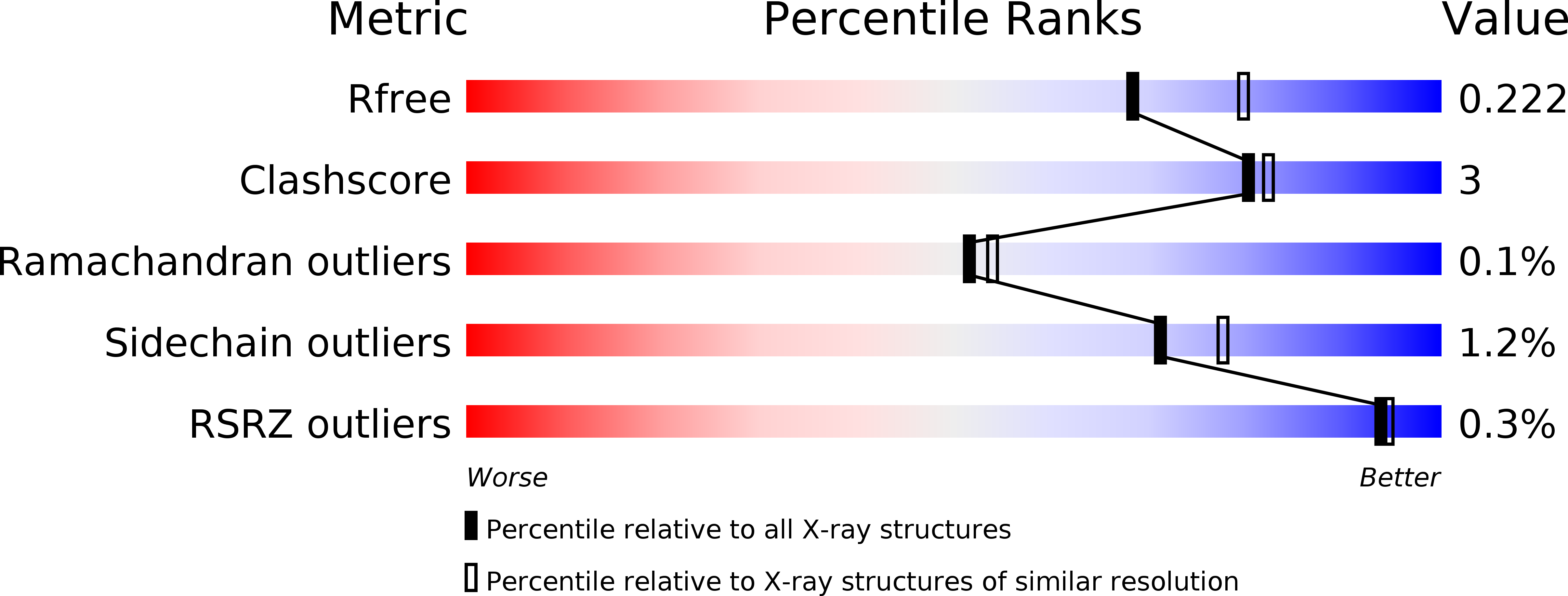
Macromolecular Entities
Structures with similar UniProt ID
Protein Blast
Polymer Type:polypeptide(L)
Molecule:14-3-3 protein eta
Gene (Uniprot):Ywhah
Chain IDs:A, B, C, D
Chain Length:252
Number of Molecules:4
Biological Source:Mus musculus
Structures with similar UniProt ID
Protein Blast
Polymer Type:polypeptide(L)
Molecule:Peptide from Protein numb homolog
Gene (Uniprot):Numb
Chain IDs:E, F
Chain Length:31
Number of Molecules:2
Biological Source:Mus musculus
Modified Residue
Compound ID Chain ID Parent Comp ID Details 2D Image
SEP E SER modified residue
Primary Citation
Structural determinants controlling 14-3-3 recruitment to the endocytic adaptor Numb and dissociation of the Numb/alpha-adaptin complex.
J. Biol. Chem. 293 4149 4158 (2018)
PMID: 29382713 DOI: 10.1074/jbc.RA117.000897

Abstact

Traffic of cargo across membranes helps establish, maintain, and reorganize distinct cellular compartments and is fundamental to many metabolic processes. The cargo-selective endocytic adaptor Numb participates in clathrin-dependent endocytosis by attaching cargoes to the clathrin adaptor α-adaptin. The phosphorylation of Numb at Ser265 and Ser284 recruits the regulatory protein 14-3-3, accompanied by the dissociation of Numb from α-adaptin and Numb's translocation from the cortical membrane to the cytosol. However, the molecular mechanisms underlying the Numb-α-adaptin interaction and its regulation by Numb phosphorylation and 14-3-3 recruitment remain poorly understood. Here, biochemical and structural analyses of the Numb·14-3-3 complex revealed that Numb phosphorylation at both Ser265 and Ser284 is required for Numb's efficient interaction with 14-3-3. We also discovered that an RQFRF motif surrounding Ser265 in Numb functions together with the canonical C-terminal DPF motif, required for Numb's interaction with α-adaptin, to form a stable complex with α-adaptin. Of note, we provide evidence that the phosphorylation-induced binding of 14-3-3 to Numb directly competes with the binding of α-adaptin to Numb. Our findings suggest a potential mechanism governing the dynamic assembly of Numb with α-adaptin or 14-3-3. This dual-site recognition of Numb by α-adaptin may have implications for other α-adaptin targets. We propose that the newly identified α-adaptin-binding site surrounding Ser265 in Numb functions as a triggering mechanism for the dynamic dissociation of the Numb·α-adaptin complex.

Legend

Protein

Chemical

Disease

Primary Citation of related structures
Feedback Form
Name
Email
Institute
Feedback