5YPU image
Deposition Date 2017-11-03
Release Date 2018-09-26
Last Version Date 2024-10-23
Entry Detail
PDB ID:
5YPU
Title:
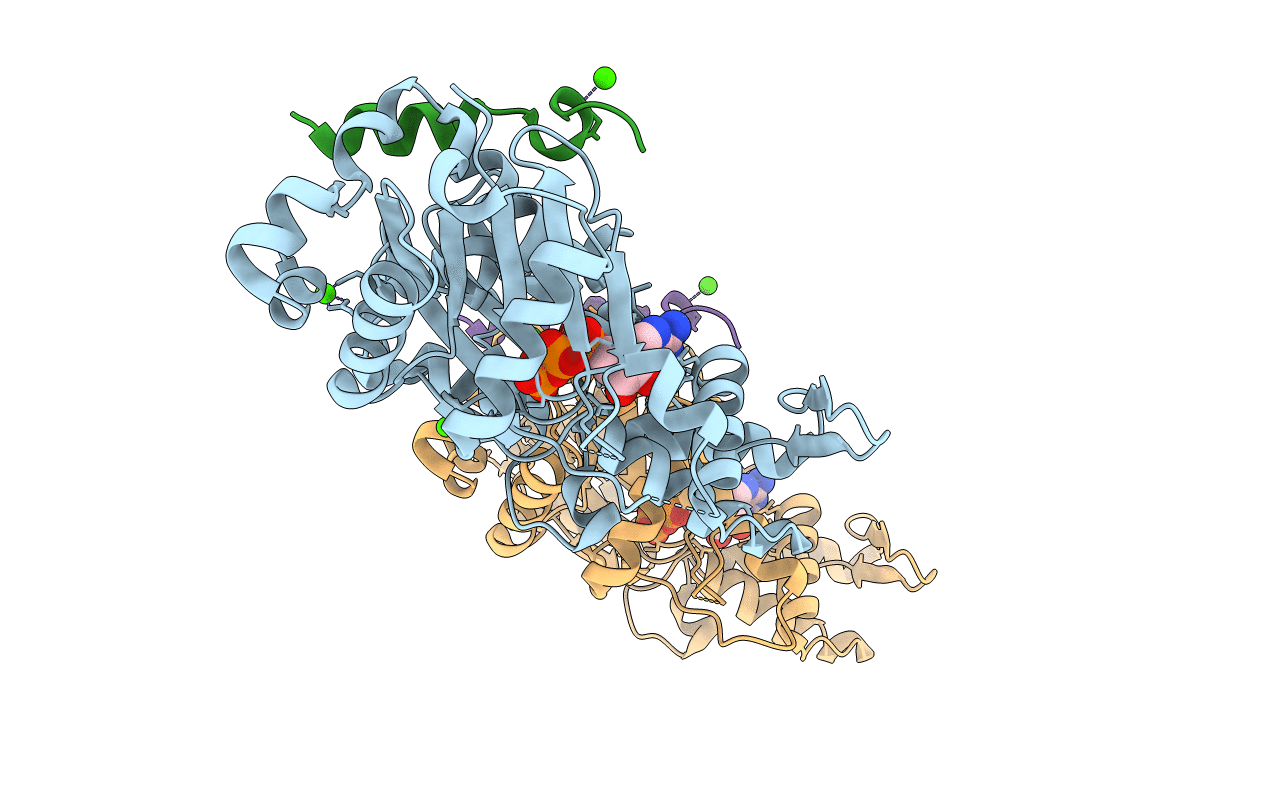
Crystal structure of an actin monomer in complex with the nucleator Cordon-Bleu MET72NLE WH2-motif peptide
Biological Source:
Source Organism:
Method Details:
Experimental Method:
Resolution:
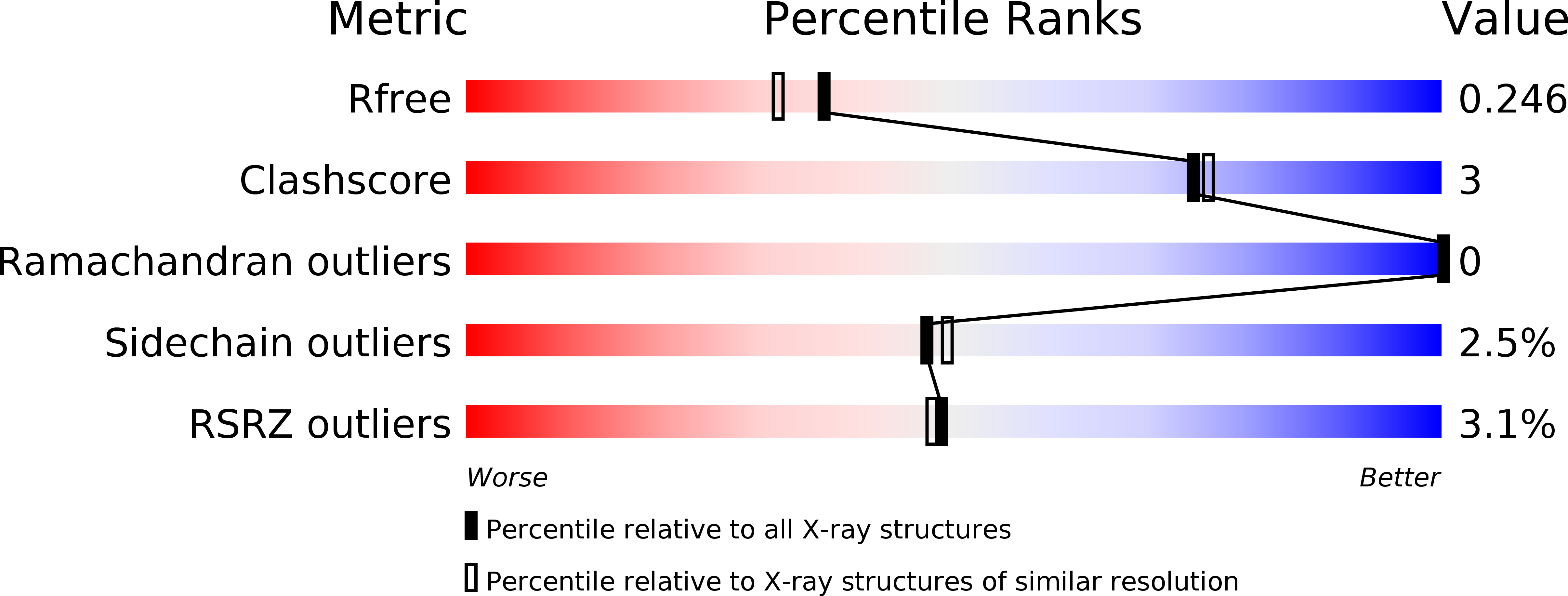
2.00 Å
R-Value Free:
0.24
R-Value Work:
0.19
R-Value Observed:
0.19
Space Group:
C 1 2 1
Macromolecular Entities
Structures with similar UniProt ID
Protein Blast
Polymer Type:polypeptide(L)
Molecule:Actin, alpha skeletal muscle
Gene (Uniprot):ACTA1
Chain IDs:A, C
Chain Length:368
Number of Molecules:2
Biological Source:Oryctolagus cuniculus
Structures with similar UniProt ID
Protein Blast
Polymer Type:polypeptide(L)
Molecule:Cordon-Bleu WH2 motif
Mutagens:MET72NLE
Chain IDs:B, D
Chain Length:22
Number of Molecules:2
Biological Source:Mus musculus
Primary Citation
Structural evidence for the roles of divalent cations in actin polymerization and activation of ATP hydrolysis
Proc. Natl. Acad. Sci. U.S.A. 115 10345 10350 (2018)
PMID: 30254171 DOI: 10.1073/pnas.1806394115

Abstact

The structure of the actin filament is known at a resolution that has allowed the architecture of protein components to be unambiguously assigned. However, fully understanding the chemistry of the system requires higher resolution to identify the ions and water molecules involved in polymerization and ATP hydrolysis. Here, we find experimental evidence for the association of cations with the surfaces of G-actin in a 2.0-Å resolution X-ray structure of actin bound to a Cordon-Bleu WH2 motif and in previously determined high-resolution X-ray structures. Three of four reoccurring divalent cation sites were stable during molecular dynamics (MD) simulations of the filament, suggesting that these sites may play a functional role in stabilizing the filament. We modeled the water coordination at the ATP-bound Mg2+, which also proved to be stable during the MD simulations. Using this model of the filament with a hydrated ATP-bound Mg2+, we compared the cumulative probability of an activated hydrolytic water molecule approaching the γ-phosphorous of ATP, in comparison with G-actin, in the MD simulations. The cumulative probability increased in F-actin in line with the activation of actin's ATPase activity on polymerization. However, inclusion of the cations in the filament lowered cumulative probability, suggesting the rate of hydrolysis may be linked to filament flexibility. Together, these data extend the possible roles of Mg2+ in polymerization and the mechanism of polymerization-induced activation of actin's ATPase activity.

Legend

Protein

Chemical

Disease

Primary Citation of related structures
Feedback Form
Name
Email
Institute
Feedback